

Team leader and members roles and responsibilities ppt example





Try Before you Buy Download Free Sample Product
 Impress Your
 Audience
 100%
100% Editable
 Save Hours
 of Time


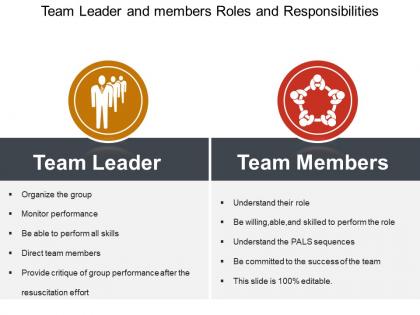
Ensure the success of your business with this team leader and members roles and responsibilities PPT example. Use this team leader responsibilities presentation layout to define the duties performed a team leader such as communicating company goals, safety practices, and deadlines with designated teams. With the help of this role of project manager PPT template you can document the duties of a person who handles all the aspects of the project from project initiation to project delivery. Use this role and responsibilities of team members PowerPoint slideshow to understand each member's contribution to the team. Our template of project management team members can be used to measure the scope of the project and for reporting regularly on the progress of the project so to be on the approved schedule. With the help of our team roles at work PowerPoint slide you can define roles based on different categories such as action oriented roles, people oriented roles and thought-oriented roles. Your thoughts will play their part. Enact it with our Team Leader And Members Roles And Responsibilities Ppt Example.
People who downloaded this PowerPoint presentation also viewed the following :
Team leader and members roles and responsibilities ppt example with all 5 slides:
Evolve consistently with our Team Leader And Members Roles And Responsibilities Ppt Example. Don't let things get hackneyed.



FAQs for Team leader and members roles and
So you need about five key people on your team. Project manager obviously - someone's gotta wrangle the timeline and deadlines. Technical lead is huge, they're making the big calls on how stuff actually gets built. Subject matter experts bring the specialized knowledge you can't fake. Stakeholders give you requirements and tell you when you're heading in the wrong direction. Oh and a sponsor with real authority and budget - trust me, you'll hit roadblocks that only they can clear. The job titles might be different at your company but those roles are pretty standard across the board. Just make sure everyone knows what they own from the start.
Dude, it's a game changer when everyone knows their lane. No more of that "wait, I thought Sarah was doing this" chaos that derails everything. People can actually focus on what they're good at instead of constantly figuring out the basics. Plus accountability becomes so much simpler - you know exactly who to bug for updates or when shit hits the fan. Honestly, half the drama in most teams comes from this stuff being unclear. Just write it all down, make sure everyone sees it, and don't let people wiggle out of their assignments later.
Cross-train people ahead of time - seriously, this saves your ass when everything hits the fan. Figure out who's adaptable and won't freak out juggling extra stuff. Once chaos starts, throw job titles out the window honestly. Move tasks around based on who's actually drowning vs who can handle more. Daily check-ins are clutch for this. I've watched teams completely implode because managers wouldn't reassign work when someone was buried. Keep talking to everyone about their workload and be ready to shuffle things constantly. Some people are just better at wearing multiple hats.
So basically as a leader you're looking at the big picture stuff - setting direction, making final calls, hitting those team goals. Regular team members? They're more focused on their specific tasks and bringing their expertise. Leaders deal with all the messy parts too... conflict resolution, managing stakeholders, keeping everyone on the same page (seriously, it's like herding cats half the time). Both roles need good communication though. If you're thinking about moving into leadership, maybe start by mentoring someone new or jump on a small project to lead. Gets you a feel for whether you actually like it.
Oh man, the worst part is when everyone's stepping on each other's toes because nobody knows who's supposed to do what. Classic case of "I thought YOU were handling that." Then you get the opposite problem - roles so rigid that work can't flow naturally between people. Honestly, job descriptions are kinda useless half the time since what you actually do day-to-day is totally different from what's written down. Regular team check-ins help though. Just sit down together and hash out who's doing what, then adjust as you go.
Okay so first thing - get everyone to write down what they're actually responsible for in a shared doc or Slack. Be super specific about what's yours vs what's collaborative. Those "wait I thought you were doing that" moments are the worst and totally avoidable! Regular check-ins help tons, especially when new stuff starts. Say things like "I'm point person for X" or "need your thoughts on Y by Friday." When responsibilities overlap (they definitely will), just call it out and figure out who's leading. Oh and make these talks normal, not just crisis mode conversations.
RACI charts are your best bet here - shows who's responsible, accountable, consulted, and informed for each thing. Super helpful. Org charts work if you're dealing with basic hierarchy stuff. Swimlane diagrams are clutch when processes bounce between different people or departments (honestly underrated tool). You can build these in Lucidchart or Miro, though I've seen people do perfectly fine ones in Google Sheets too. Just pick whatever format clicks with how your team actually works and start there.
Honestly, mixing up team roles is where the real magic happens. Your analytical people are great at spotting patterns and breaking stuff down. Creative types? They'll come up with ideas nobody else thought of. Then you've got detail people who catch all the stuff that would bite you later - super valuable but sometimes overlooked. Big-picture folks keep everyone from getting lost in the weeds. Oh, and communication people are clutch for translating between all these different thinking styles. Instead of having everyone tackle problems the same way, try switching up who leads based on what kind of challenge you're facing. Works way better than you'd expect.
Honestly, clear team roles are a game changer. People know what they're doing instead of stepping on each other's toes or waiting around for someone else to handle stuff. Think of it like - I dunno, a basketball team where everyone has their position. Don't make roles too strict though. That kills creativity and makes people feel trapped in a box. You want accountability but also flexibility when someone needs to jump in and help out. The best setup? Roles that actually work together and create natural spots for collaboration. Oh, and review them every few months to see if they still make sense.
Honestly, just figure out what everyone's actually good at first. Sarah's a detail person? Give her the project planning. Tom's smooth with clients? He should handle stakeholder stuff. Pretty obvious when you think about it. People feel way more confident when they're not fighting against their natural abilities - plus your team actually gets better results since everyone's doing what they rock at. Oh and definitely have real conversations with them about what they love doing vs what drains them. That's where the magic happens.
Look, accountability is what stops teams from falling apart. When you actually own your stuff, everyone else notices and starts doing the same. Otherwise you get that thing where responsibilities turn into "suggestions" people ignore when it's inconvenious (been there too many times). It's the little things that matter - don't miss deadlines, say something when you're stuck, own up to mistakes before they blow up. That's how trust gets built. Oh and definitely be super clear about what you're supposed to do and keep people updated. The communication part is honestly half the battle.
Look, job descriptions are basically suggestions once a project gets messy. When things go sideways, pull everyone together and figure out who's drowning vs. who can take on more. Cross-training is your friend here - saves you when someone gets slammed or bounces. Don't be weird about shuffling responsibilities around. What you planned six months ago probably doesn't match what's actually happening now. Talk openly about workloads instead of letting people suffer in silence (we've all been there). Start with whatever's creating your biggest headache right now and work backwards from there.
Honestly, role rotation is pretty smart. Your people pick up new skills and actually get how everything fits together. Collaboration gets way better too - hard to complain about another team when you've walked in their shoes, you know? Plus it kills those knowledge silos where only one person can handle something critical. Super risky when they go on vacation or quit. People stay more interested when they're not doing the exact same thing forever. Oh, and start small - just try it for one project first. See how messy it gets before going all in.
So with remote work, roles get weirdly blurry but you also need stricter boundaries - makes no sense but it's true. People end up doing more random stuff outside their job description since you can't just walk over and bug someone. Everyone becomes responsible for communication now, not just managers. Your boss isn't watching over your shoulder anymore so you're way more accountable for your own work. Collaboration happens but it's planned out instead of spontaneous. Honestly the biggest thing? Write down who does what - like everything. Also be super clear about when you're actually available to respond.
Do a proper welcome meeting first - go over their actual role, what they're responsible for, how they connect to team goals. Write it down too because honestly, everyone blanks on half that info after day one. Get them a buddy for the first couple weeks. Someone they can bug with dumb questions without feeling weird about it. I'd also do weekly check-ins that first month to catch any confusion about who does what. Don't assume they'll just figure out the boundaries on their own - spell it out clearly from the start.
-
Very well designed and informative templates.
-
Top Quality presentations that are easily editable.
-
Best Representation of topics, really appreciable.
-
Innovative and Colorful designs.