

Team Leader Management Powerpoint Presentation Slides





Try Before you Buy Download Free Sample Product
 Impress Your
 Audience
 100%
100% Editable
 Save Hours
 of Time


Introducing Team Leader Management Powerpoint Presentation Slides which will help to develop and implement a timeline for the team. Discuss the core responsibilities of a team leader. Take the assistance of leadership management PPT graphics to mention skills management such as leading employees, strategic planning, change management, employee development, etc. Showcase the roles of an effective team leader by utilizing leadership skills PowerPoint visuals. Address the leadership in a holistic manner at the individual and organizational level by taking the aid of leadership management framework PowerPoint slideshow. Mention the steps that can help to establish and maintain the productive and collaborative team. Facilitate the execution of a company’s strategy by utilizing leadership development PPT slideshow. Thus, motivate your team and ensure that they reach their goals by downloading our ready to use team management skills PowerPoint presentation.
People who downloaded this PowerPoint presentation also viewed the following :
Content of this Powerpoint Presentation
A manager or executive officer of any department is loaded with multiple tasks and jobs. However, managing his subordinates is an important task that employees at such positions carry out. What can help is hiring a team leader who acts as a bridge between the manager and the team. However, you may be wondering what kind of responsibilities should be delegated to a future team leader and what can be expected by the company from him.
To understand this well, you need a thorough document that can help you convey the roles and responsibilities. SlideTeam’s 100% editable, customizable and worthy team leader management templates can help you with this task.
The PowerPoint Presentation Template covers every single aspect of the team leader management profile and allows you to convey a detailed idea about what you expect from your team leaders in the immediate few hours, and in the coming future.
We recommend that you check out some of the slides shown in sections of this blog and learn deeply about the team leader management template.
Template 1: Need for Leadership Management
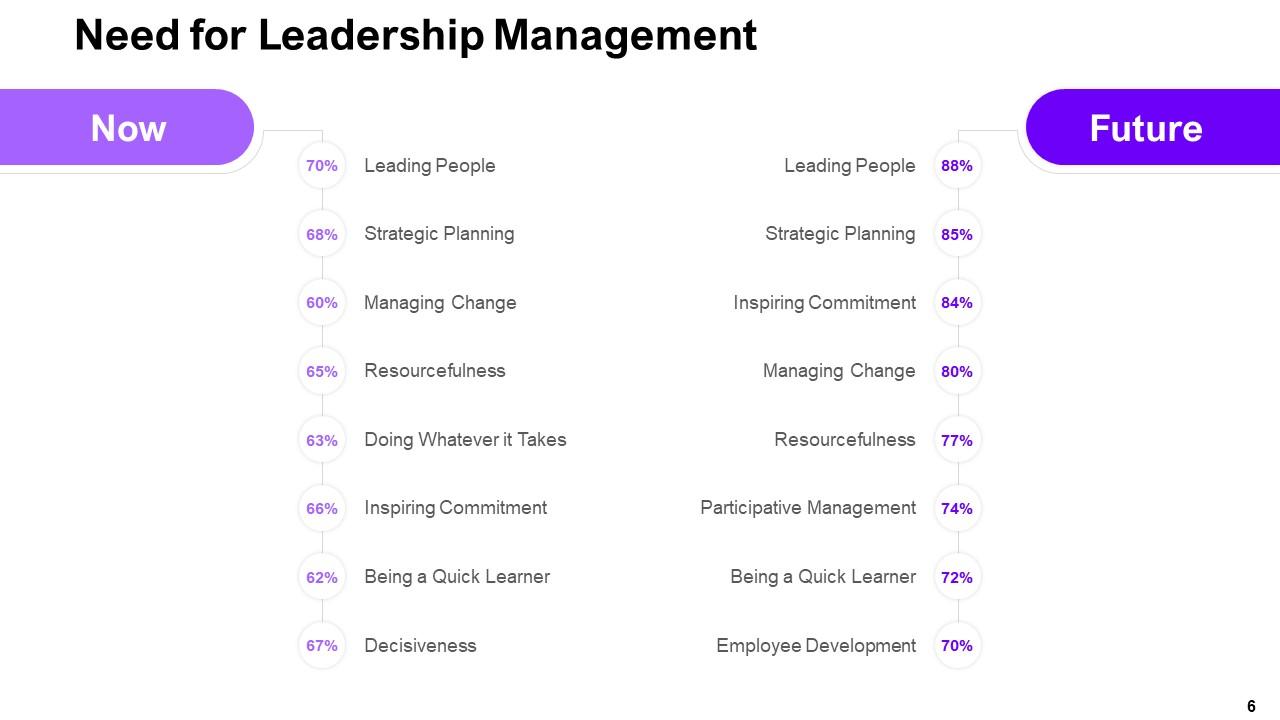
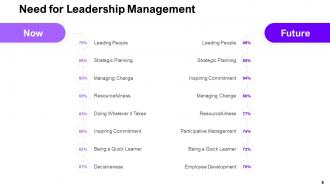
You can inform your company’s team leaders on the kind of help expected from them in the present, and in the immediate future. The slide allows you to demonstrate the degree of individual needs in the form of percentages. The need for leading people may presently be around 70%, but the management may expect a growth in this parameter to 88%. Similarly, the need for Strategic Planning could be 68% presently but considering its importance, it may increase to 85% in the future.
Template 2: Leadership Goals
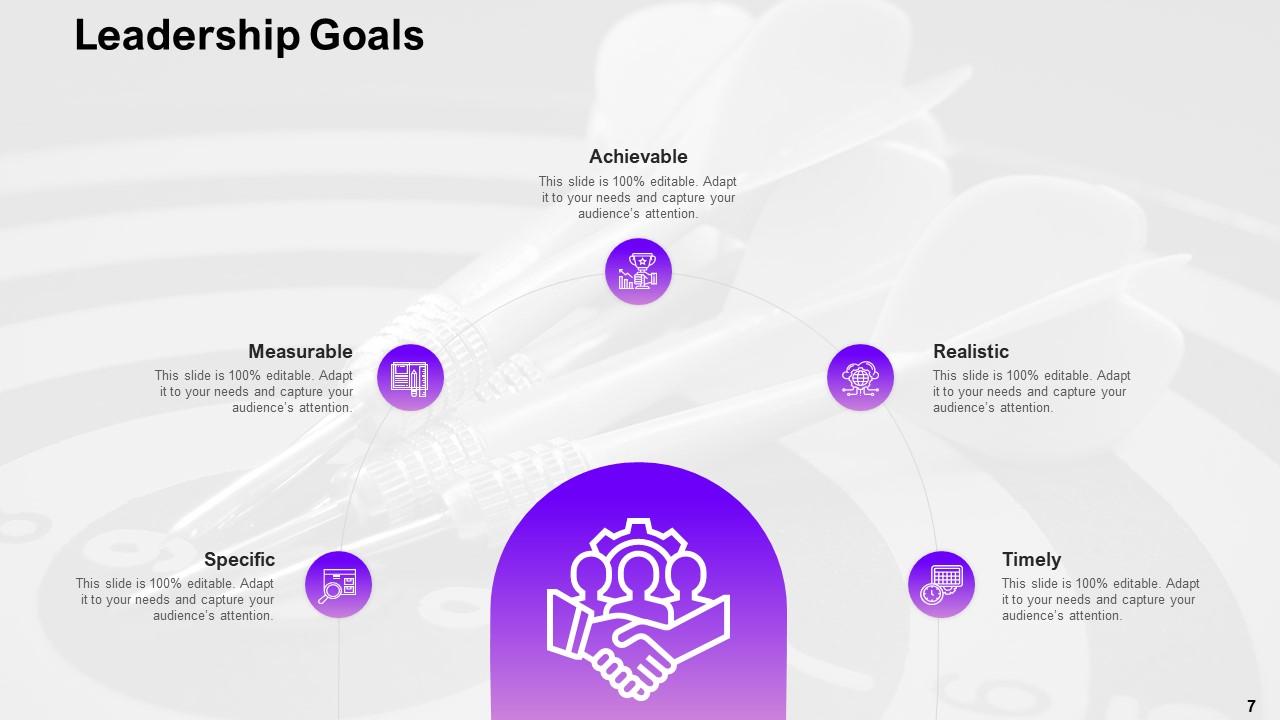
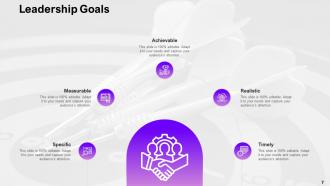
Your team leaders may be confused about the actual goals of the leadership domain. Using this slide, you can enlighten them about the same to enhance their level. Generally, top leadership goals state that all tasks undertaken should be completed on time. Similarly, the targets set for the employees should be realistic and achievable. You can also state that some methods must be implemented to measure whether the employees or teams of employees are optimal in their time and resources in which they complete allocated tasks.
Template 3: Leadership Management Framework
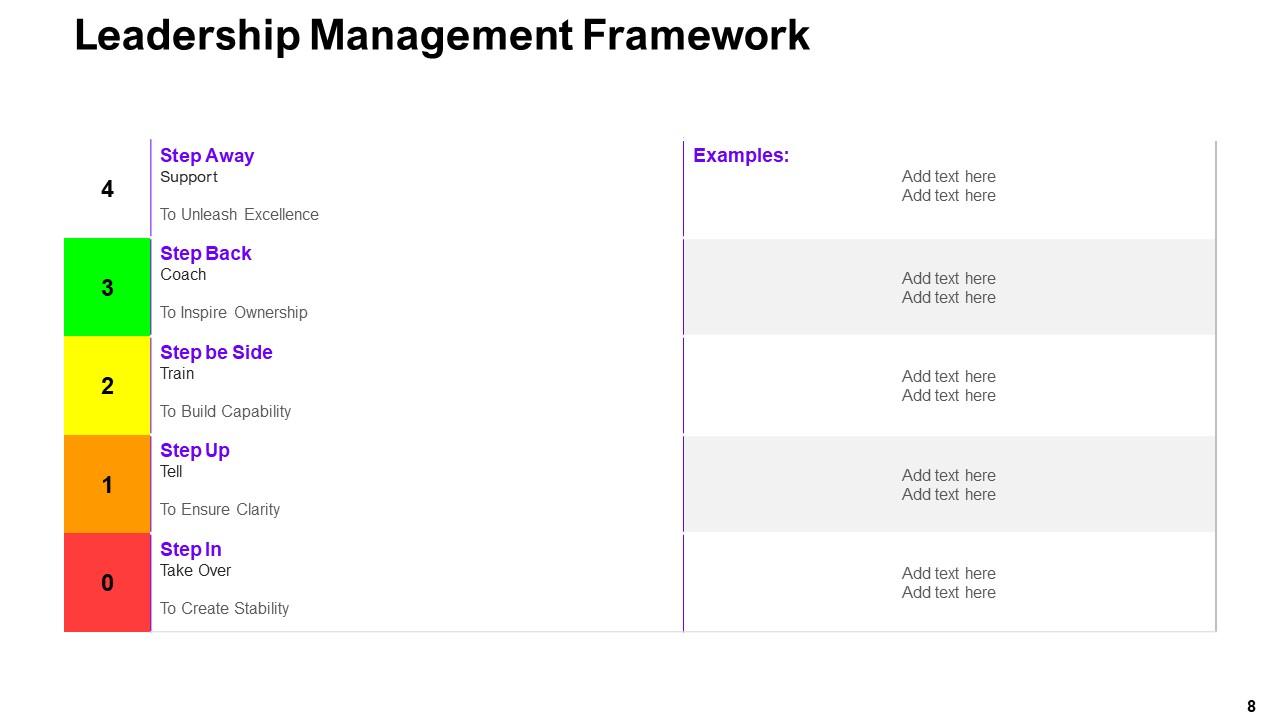
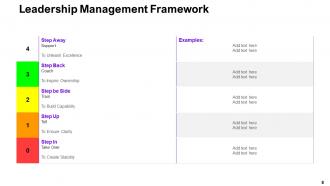
The leadership management framework slide of this template is a descriptive document that shows what to do in types of stages that inevitably mark the completion of a task. The slide showcases a color-coded structure in which red means that the team leader needs to intervene and white shows that he can safely step away. Within each stage, you can also add a small text explaining what the team leader should do in such a case.
Template 4: Designing Organization Template

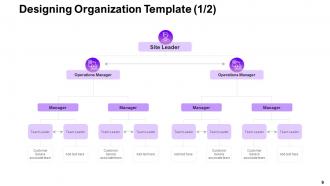
This slide on the Team Leader management template showcases the formation of the organization and its employees in the form of a tree chart. The chart starts at the top with the Site Leader, under which two main Operations Managers are present. Under these two managers, the team further divides into Junior or Associate Managers. Under the supervision of these managers, you can add the Team Leaders. These team leaders work as a bridge between the associate managers and the Customer Service Team or other teams.
Template 5: Designing Organization Template

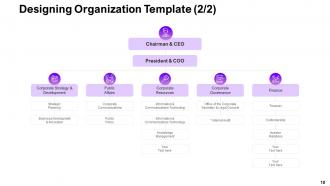
At times, the previously presented organization template may be ineffective in presenting an accurate image of the organizational structure. Here, you can use this chart instead. Within this template, you can place the Chairman and CEO at the top followed by the President and COO and further add the departments under his supervision. These departments can be associated with Corporate Strategy and Development, Public Affairs, and further. Under these departments, you can enlist the main personnel.
Template 6: Leading Managing Following Template
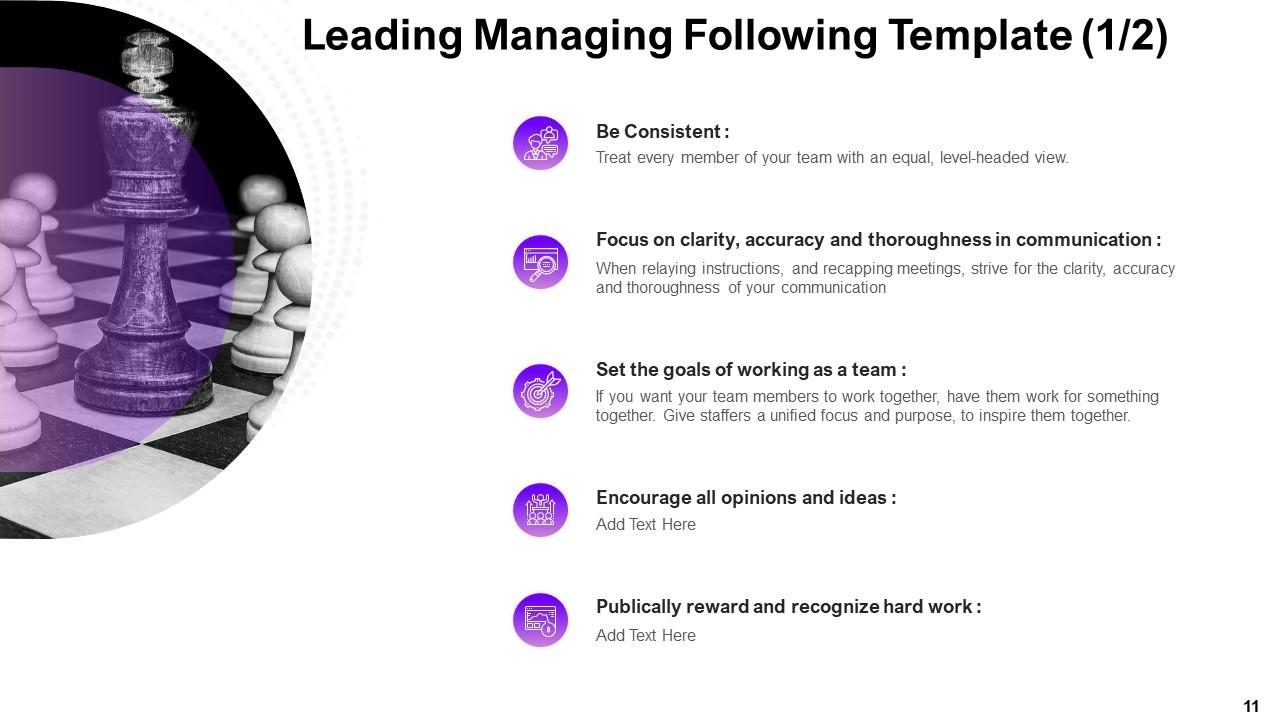
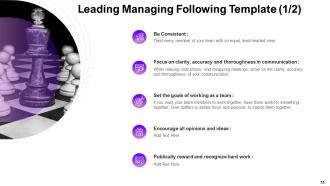
The Team Leader may have forgotten how to lead and manage the team as well as make them follow the required acts and paths. This slide helps showcase aspects that help a team leader in handling people under his/her wing. In this slide, you can list and explain the virtues expected from a team leader like maintaining consistency, focusing on the accuracy of projects, encouraging the opinions of your subordinates, setting individual and collective goals, etc.
Template 7: Leading Managing Following Template

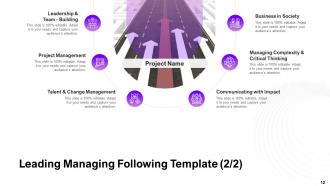
This Leading Managing Following Template is an option that you can use, depending on the resources with you. If you want to proceed with a different approach to showcasing the responsibilities of a team leader, you can edit and finalize this slide. The slide includes responsibilities like managing the complexities of data and projects, managing business with respect to society, communicating in a way that’s influential, managing existing and future talent, and designing and managing the flow of projects, and more.
Template 8: Change Management Model
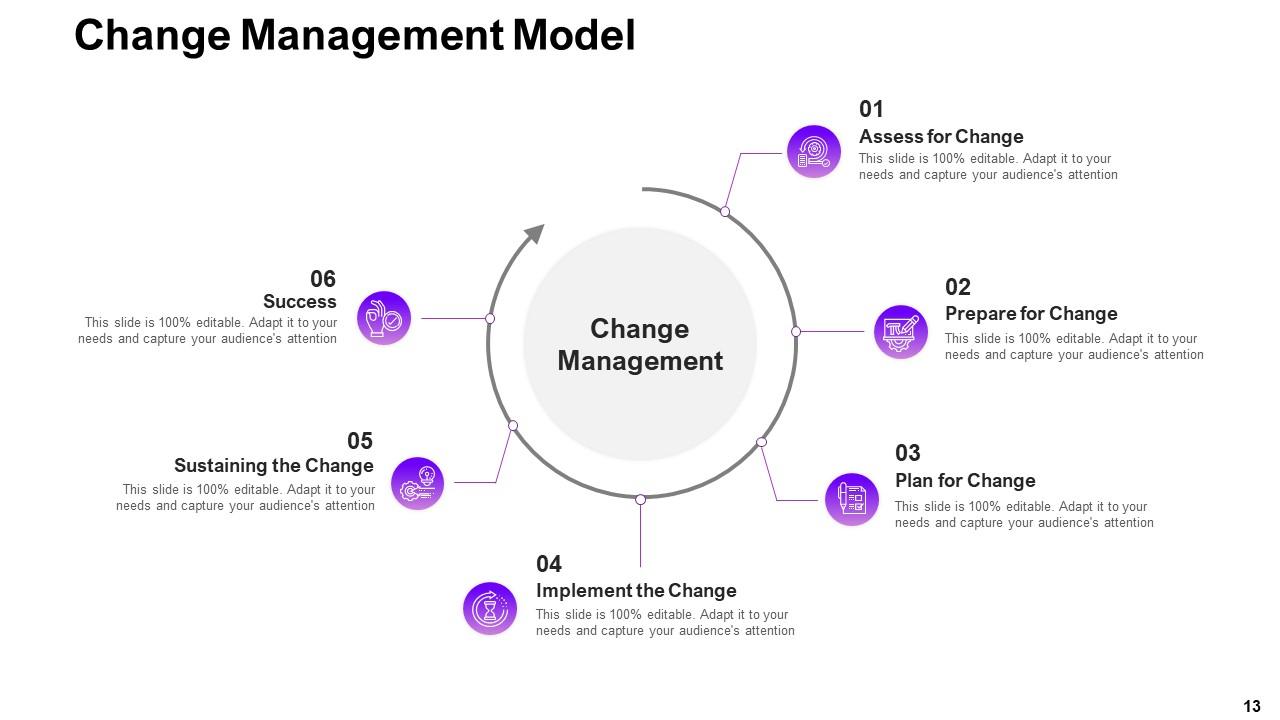
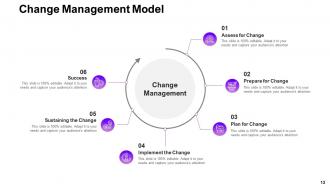
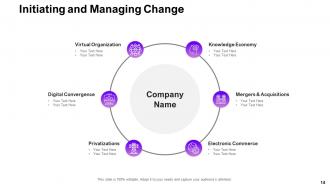
Change is the only constant. A project may be designed after extensive planning but due to unforeseen reasons, may need to be modified. It is the responsibility of the team leader to ensure and facilitate this change. This slide showcases steps needed to stimulate and introduce changes smoothly. The process starts with an extensive assessment of change, proceeding to the preparations for such a change, planning for the change, implementing the change, sustaining the change, and achieving success at the end.
Template 9: Thinking Critically Making Decisions Solving Problems Template
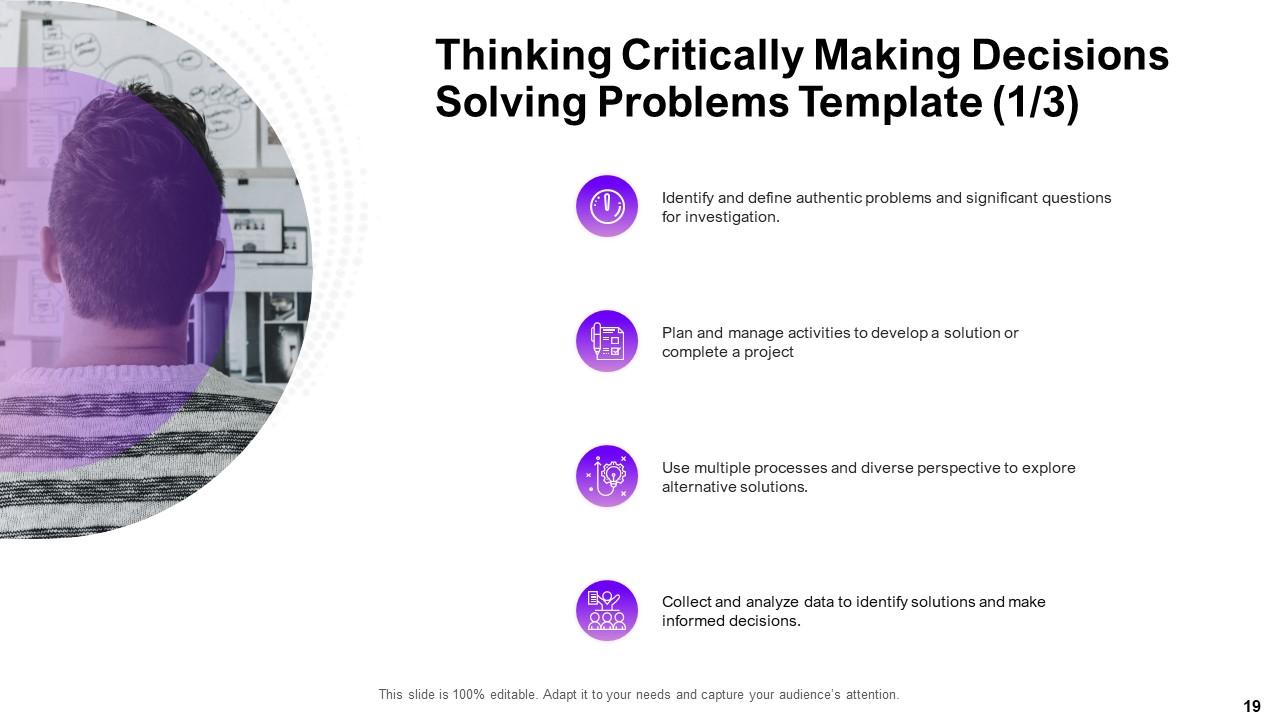
A Team Leader has to act on more than just instincts. This slide helps showcase what a team leader needs to access and analyze to complete a project. To execute, the team leader needs to think critically about every aspect of the project and its surrounding environment. Once the analysis is done, the team leader needs to decide how to act. For this, the leader can devise a well-versed solution to fix the problems faced.
Template 10: Managing Time Template
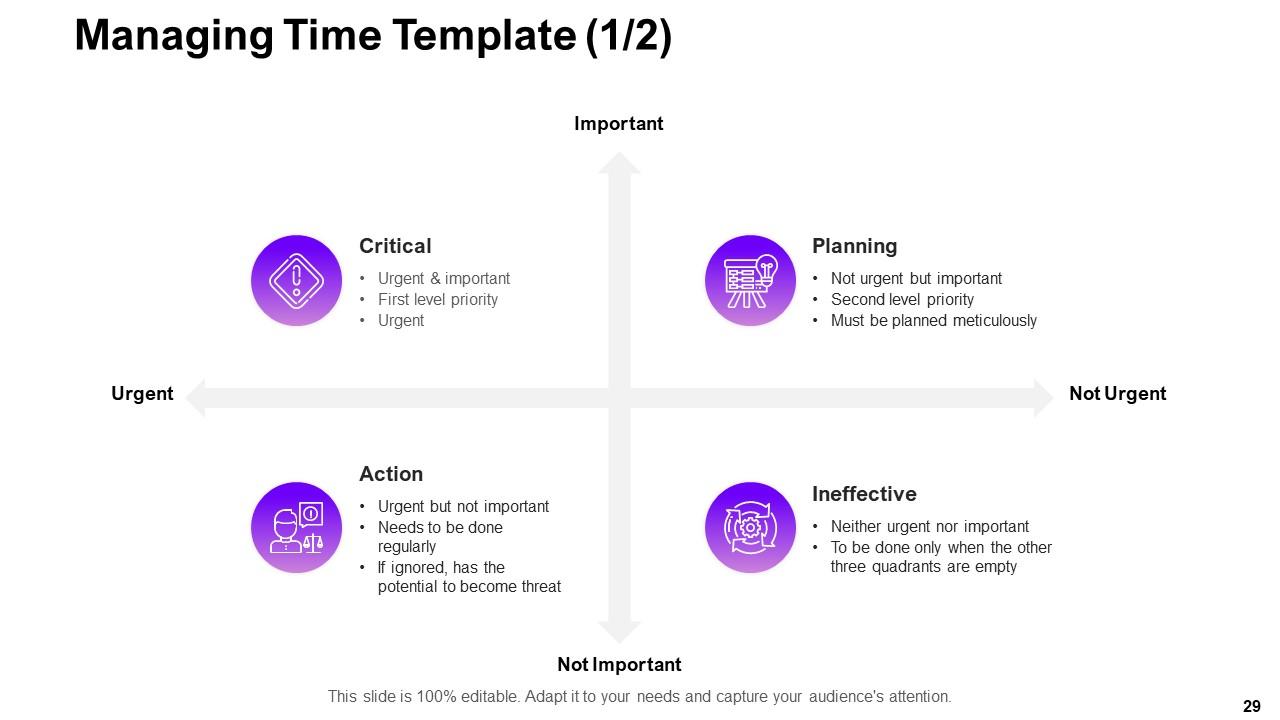
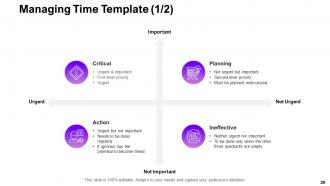
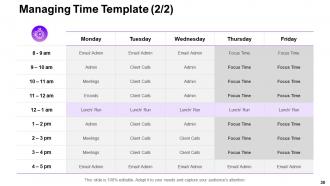
The time of a team leader must not be wasted. This slide helps in showcasing what’s important for a manager and what’s not. Similarly, what’s urgent and what’s not urgent. To showcase the importance and urgency, the slide takes the help of a chart to divide the tasks into four types viz. Critical, Planning, Action, and Ineffective. The team leader should analyze the importance and urgency of each task using this chart and act, accordingly.
Lead Your Team to Success with Team Leader Management Template
Team Leader is a crucial position in any organization. A team leader is the main element that keeps the team and the projects together. Additionally, the team manager also works as a link for the upper management to the lower-level executives.
Hence, it's necessary that the team leader has extensive information about how to act and proceed with his team, projects, and more. Using the above template, you can easily enlighten your team leaders on how to behave smartly and take the business to new heights.
Team Leader Management Powerpoint Presentation Slides with all 78 slides:
Use our Team Leader Management Powerpoint Presentation Slides to effectively help you save your valuable time. They are readymade to fit into any presentation structure.










FAQs for Team Leader Management
Look, start with weekly one-on-ones where you actually listen to what's screwing them over. Set clear goals upfront - sounds obvious but half the managers I know skip this part. You'll spend tons of time being their shield from upper management drama, which honestly gets exhausting but it's crucial. Give feedback regularly instead of waiting for reviews. When you delegate, pick meaningful stuff, not just your leftover tasks. Show people how their work fits the big picture. Remove whatever's blocking them. Develop your people instead of just... managing tasks? That's the difference between good and meh leadership.
You gotta model it first - own your screwups and actually listen when people talk. Do regular one-on-ones with real questions, not just "how's work going?" When someone admits they're struggling or points out problems, don't jump straight into fix-it mode (hardest thing ever, but trust me). React positively instead. Set up team retros where people can share ideas without getting judged. Oh, and be consistent about it - people won't open up if you handle their honesty well one day but poorly the next. They're basically testing whether you're safe to be real with.
Don't let it fester - that's when things get really ugly. Talk to each person separately first so you get the real story (people are way more honest one-on-one). Then bring them together for a group chat. Here's the thing though - focus on what they're actually doing, not their personalities. Nobody wants to hear they're being "difficult." Help them find something they can both agree on and build from there. Sometimes you'll have to be the tiebreaker if they're being stubborn. Stay neutral and keep bringing it back to work stuff, not who's right.
Honestly, just sit down with each person and ask what gets them excited about work - plus what they think they're actually good at. I know it sounds obvious, but most managers never do this! Watch how they act during different tasks too. Some people literally light up when doing certain stuff. Once you figure out their strengths, give them projects that match those skills. Oh and definitely call out their wins publicly - people love being recognized for what they excel at. The whole thing is basically putting the right person on the right work when you can.
Honestly, people want way more feedback than most managers think - it's weird but true. Give specific comments on what's going well AND what needs work, but don't wait for those formal review meetings. Ask your team what they need from you too, and get them giving feedback to each other during meetings. When someone does great work, definitely call it out publicly. The key is making it timely and actually useful. Oh, and pick one person this week to give detailed feedback on their recent project - just start there.
Look, emotional intelligence is huge for leading teams. You've gotta read the room and actually connect with people - not just bark orders. When someone's having a rough day, you'll notice even if they don't spell it out. Conflicts happen, but good leaders don't make them ten times worse by being tone-deaf. I swear, I've watched super smart managers completely bomb because they treated people like robots. But here's the thing - you can totally get better at this stuff. Just pause when you're stressed instead of immediately reacting, and actually listen when your team brings you problems.
Get super specific about what you actually want and when. Like instead of "improve customer service," say "reply to emails in 4 hours max and hit 90% satisfaction by month-end." I totally bombed this once - my team kept missing stuff because honestly, they had no clue what I was aiming for. Write it down where everyone can see it. Weekly check-ins are clutch too. The whole point is being clear enough that there's zero wiggle room for "oh I thought you meant..." Trust me, vague goals are just setting everyone up to fail.
Honestly, three things work best: recognition, autonomy, and growth stuff. People love getting called out for good work publicly - even the introverts who pretend they hate attention. Trust your team to own projects and figure out the how, while you stick to what needs doing and why. Development matters too - training, mentoring, whatever fits. Oh and regular one-on-ones are a game changer, seriously. I'd pick one thing to try this week first though. Don't overwhelm yourself trying to fix everything at once.
Honestly, you just gotta figure out what works for each person. Like, some people need constant check-ins and super clear direction. Others? Just tell them the goal and leave them alone. I totally bombed this once with a developer - got way too hands-on and he basically stopped talking to me lol. Also pay attention to how they like communicating. Face-to-face meetings work for some folks, but others would rather just send updates via email or Slack. Best thing is to straight up ask them what management style actually helps them get stuff done.
Definitely send them a welcome message before they start and get their desk set up. First day, walk them around for proper introductions - way better than just waving at people from across the room. Coffee chats with key teammates that first week are clutch. Give them something real to work on early, not just random busy work (honestly, nothing kills morale faster than feeling useless). Oh, and check in regularly those first couple weeks. People won't always speak up if they're struggling, so just ask how it's going.
Mix hard numbers with actual conversations - that's what works. Track deadlines, quality scores, goal completion. Numbers matter, but they're kinda useless without context. Do regular one-on-ones to figure out why performance dips or spikes happen. Team dynamics and communication patterns tell you tons too. I'd set up a monthly dashboard for the key stuff, but honestly? Just talking to your people regularly about what's broken and what's going great is half the battle. Individual growth tracking helps spot who needs support before things go sideways.
Honestly, it all comes down to being fair and consistent with everyone. Don't play favorites - even if Sarah's coffee game is incredible! Be upfront about your expectations and give real feedback. Stay out of the drama when conflicts pop up, just stick to facts. Your team needs to trust you, and that only happens through what you do, not what you say. Oh and respect their boundaries too - nobody wants a boss who texts at 9pm. I'd also check your own biases regularly because we all have them. Trust builds slowly but it's worth it.
Honestly, people clam up when they think you'll judge their weird ideas. Block actual calendar time for brainstorming - not just lip service about "being creative." I'm weirdly passionate about this because I've watched so many good ideas die in meetings. Celebrate the failures that actually teach you something. Ask open questions instead of steering people toward what you want to hear. Bring in outside voices sometimes too. Show them you care about exploring ideas, not just landing on the "right" answer immediately. Try one real brainstorming session this week.
Ugh, honestly the communication thing will drive you crazy - people miss stuff constantly and feel totally out of the loop. Time zones are brutal too. Plus you can't just peek over someone's shoulder to see how they're doing without being super weird about it. Building any kind of team vibe is tough when nobody's grabbing lunch together. Oh and trust issues become real when you've never actually met half your team. Over-communicate like crazy though, do lots of one-on-ones, and maybe set up some random virtual hangout spaces where people can just chat about whatever.
Honestly, just stay consistent with your boundaries while actually caring about your team as people. Ask about their weekend, grab coffee - but don't flip-flop between being their buddy one minute and pulling rank the next. That confuses everyone and makes you look weak, tbh. Be clear when you're making the final call vs. when you want their input. And here's the thing - admit when you screw up or don't know something. I've watched too many managers try to act like they're perfect. Your team will respect the honesty way more than fake authority.
-
Thanks for all your great templates they have saved me lots of time and accelerate my presentations. Great product, keep them up!
-
Colors used are bright and distinctive.
-
Designs have enough space to add content.