


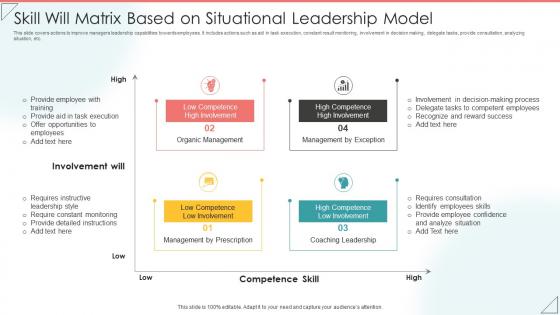
Skill Will Matrix Based On Situational Leadership Model




Try Before you Buy Download Free Sample Product
 Impress Your
 Audience
 100%
100% Editable
 Save Hours
 of Time


This slide covers actions to improve managers leadership capabilities towards employees. It includes actions such as aid in task execution, constant result monitoring, involvement in decision making, delegate tasks, provide consultation, analyzing situation, etc.
People who downloaded this PowerPoint presentation also viewed the following :
Skill Will Matrix Based On Situational Leadership Model with all 6 slides:
Use our Skill Will Matrix Based On Situational Leadership Model to effectively help you save your valuable time. They are readymade to fit into any presentation structure.





FAQs for Skill Will Matrix Based On
The Skill Will Matrix is a leadership assessment tool that evaluates team members across two dimensions: their skill level (capability to perform tasks) and will level (motivation and attitude toward work). Leaders apply this matrix by categorizing employees into four quadrants—high skill/high will, low skill/high will, high skill/low will, and low skill/low will—enabling targeted development strategies, personalized coaching approaches, and strategic resource allocation that ultimately enhances team performance and organizational effectiveness.
Managers can effectively assess employee skills through performance reviews, competency evaluations, peer feedback, and direct observation, while measuring willingness via engagement surveys, one-on-one discussions, and behavioral indicators. This strategic combination enables targeted development plans, optimized team assignments, and personalized coaching approaches, with many organizations finding that regular matrix assessments enhance talent management and drive improved performance outcomes.
**INPUT**: What strategies can be implemented for team members in the "High Skill, Low Will" category? **OUTPUT**: High skill, low will team members require targeted motivation strategies including understanding root causes of disengagement, providing new challenges, offering career advancement opportunities, and aligning tasks with personal interests. These approaches enhance job satisfaction by addressing burnout, leveraging expertise in mentoring roles, and creating ownership through project leadership, ultimately transforming valuable talent into engaged contributors.
The Skill Will Matrix facilitates better task delegation by systematically evaluating team members across skill competency and willingness dimensions, enabling managers to match tasks with optimal performers. Through this strategic assessment, organizations can assign high-skill, high-will employees to critical projects, provide development opportunities for willing learners, and ultimately enhance productivity while building stronger, more engaged teams.
Organizational culture significantly influences employee will through recognition systems, growth opportunities, psychological safety, and alignment with personal values. Companies with supportive cultures, clear advancement paths, and meaningful work often find higher engagement levels, while toxic environments can diminish motivation regardless of skill level, ultimately impacting performance and retention across teams.
The Skill Will Matrix identifies training needs by plotting employees across four quadrants based on competency and motivation levels, revealing whether individuals need skill development, motivational support, or performance management interventions. Organizations use this framework to design targeted development programs, with high-will, low-skill employees receiving technical training while high-skill, low-will employees get engagement initiatives, ultimately optimizing resource allocation and accelerating workforce development.
The Skill Will Matrix improves performance management by systematically categorizing employees based on competency and motivation levels, enabling targeted development strategies, clearer goal setting, and more effective resource allocation. This strategic approach streamlines manager-employee conversations, enhances succession planning accuracy, and delivers more personalized coaching interventions, with many organizations finding that structured talent assessments ultimately accelerate individual growth and organizational performance outcomes.
Feedback should target specific skill gaps through structured development plans, mentoring programs, and targeted training initiatives, while addressing motivational challenges through clear goal-setting, recognition systems, and career pathway discussions. Managers can deliver constructive conversations that combine performance data with personalized development opportunities, ultimately creating actionable roadmaps that enhance both competency levels and employee engagement across teams.
Individuals in the "Low Skill, Low Will" quadrant require comprehensive intervention through structured training programs, clear goal-setting, mentoring relationships, and motivational initiatives to address both competency and engagement gaps. Organizations often implement performance improvement plans, skills assessments, and regular feedback sessions, while many find that pairing these employees with enthusiastic mentors and providing quick wins helps rebuild confidence and motivation simultaneously.
The Skill Will Matrix assists succession planning by identifying high-potential employees with strong capabilities and motivation, enabling strategic talent pipeline development, targeted skill enhancement programs, and role-specific readiness assessments. Through systematic evaluation of current competencies and engagement levels, organizations streamline leadership transitions, accelerate career progression pathways, and ensure critical positions maintain continuity, ultimately delivering stronger organizational resilience and employee retention.
**INPUT**: What tools and resources can support the implementation of the Skill Will Matrix? **OUTPUT**: Tools supporting Skill Will Matrix implementation include performance management software, employee assessment platforms, 360-degree feedback systems, competency mapping tools, and learning management systems. These resources streamline evaluation processes by automating skill assessments, tracking development progress, and facilitating targeted coaching interventions, with many organizations finding that integrated platforms deliver enhanced talent visibility and accelerated employee growth outcomes. **Word count: 58 words**
The Skill Will Matrix aligns with Agile and Lean methodologies by enabling continuous team assessment, adaptive resource allocation, and iterative capability building throughout project cycles. This strategic combination streamlines sprint planning, enhances cross-functional collaboration, and minimizes skill bottlenecks, with many Agile organizations finding that regular matrix evaluations ultimately deliver faster development cycles and improved team performance.
Yes, numerous organizations across industries have successfully implemented the Skill Will Matrix, including technology companies for team restructuring, healthcare systems for nurse development programs, and financial services firms for sales team optimization. These applications consistently demonstrate improved employee engagement, reduced turnover, and enhanced performance management, with many organizations finding that the matrix streamlines talent development decisions and delivers measurable productivity gains.
Cross-training significantly enhances the Skill Will Matrix by elevating employees' skill levels across multiple competencies, enabling strategic movement from high-will/low-skill to high-will/high-skill quadrants. Through structured cross-functional programs, organizations develop versatile talent pools, reduce dependency risks, and create internal mobility pathways, with many companies finding that cross-trained employees demonstrate increased engagement and adaptability in dynamic business environments.
Common pitfalls include overlooking individual motivations, making assessments based on limited observations, failing to update evaluations regularly, and not involving team members in self-assessment discussions. These assessment errors can lead to misplaced development resources, reduced employee engagement, and ineffective talent management strategies, with many organizations finding that collaborative evaluation approaches and regular reassessment cycles ultimately deliver more accurate insights and stronger team performance outcomes.
-
This PowerPoint layout is very helpful from a business point of view, and it's visually stunning too! I'm so happy with this product because it has helped me understand and deliver great presentations.
-
Well-designed and informative templates. Absolutely brilliant!