


Team member roles and responsibilities powerpoint themes





Try Before you Buy Download Free Sample Product
 Impress Your
 Audience
 100%
100% Editable
 Save Hours
 of Time


For the proper and uniform growth of your business organization, we recommend that you download and use our team management roles and responsibilities PowerPoint themes. Using our job description PPT template you will be able to discuss various business related processes like the details of your team members, their role & duties, responsibilities, about the core team members, functional team leader, the other team members, project resource, etc. This team management PowerPoint presentation will be very useful when you wish to give an update about the ongoing projects of your team to your superiors or your fellow members. By the use of our tables and matrix PPT presentation, you will be able to make a presentation which is very impressive and understandable due to its eye catchy features. So get ready to take all the credit without putting in a lot of efforts. Also, this deck of slides has been designed using high resolution and premium quality slides. Be the foremost choice of the audience. Our Team Member Roles And Responsibilities Powerpoint Themes will come first to mind.
People who downloaded this PowerPoint presentation also viewed the following :
Content of this Powerpoint Presentation
In the inherently dynamic field of teamwork, clarity over roles and responsibilities forms the underpinning success. Just as well-oiled machinery requires the precise formation of gears, such precision in roles is necessary for each team member to express their contributions.
Structured teams rely on the idea of structure, with individual roles and responsibilities defining each member's facilities. This leads to the creation of a more conducive environment for innovation and achievement. However, there are obstacles to setting and maintaining clear member roles and responsibilities. One of the most prevalent is the idea of ambiguous responsibility, where not all tasks are appropriately assigned, and overlapping responsibilities create internal chaos.
SlideTeam's Team Member Roles and Responsibilities PowerPoint Themes provide an excellent, flexible solution that perfectly encapsulates the needs of a modern team.
Here’s what makes this slide stand out:
Content-Friendly and Editable
Downloadable in JPG and PNG Formats
User-Friendly
Let your team members drive success through the ample clarity and cohesion provided by this slide, which creates ample opportunities for customization.
Also, look out for our blog on the Roles and Responsibilities of Marketing Team Members in detail.
Template 1: Team Member Roles and Responsibilities
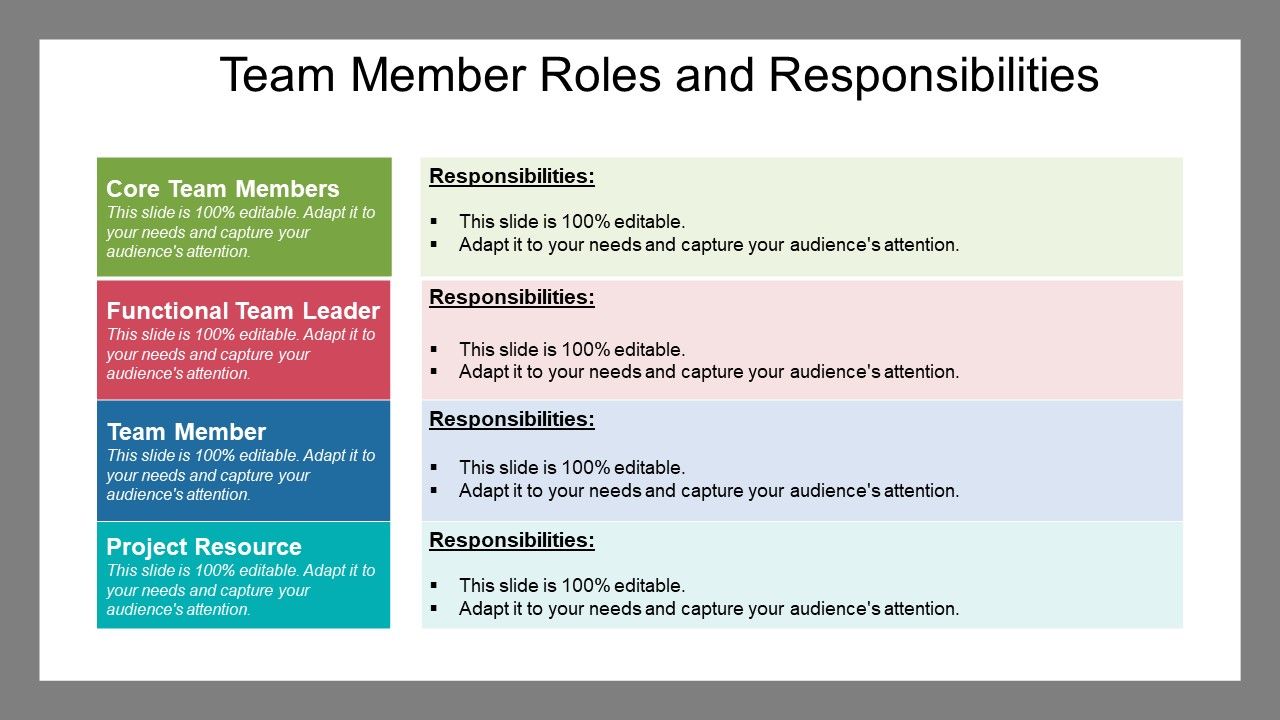
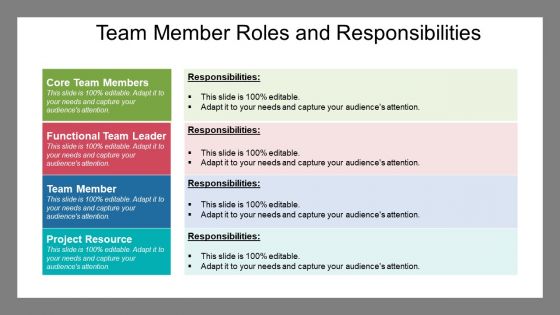
The corporate environment demands clarity in the bustling activity landscape. This slide intricately depicts each member's position, functions, and endeavors. It includes a visual display of the clear-cut hierarchy, highlighting the team's activities' roles, ranks, and duties to elucidate the positions of the core team member, functional team leader, and project resources.
The parameters of the position's roles and duties help to consolidate the communicative endeavors and the vibrancy of the team's role and responsibility administration. They define the team's accountability from the team member's perspective.
Check out our blog on Project Summary with Team Members Roles and Responsibilities to learn more details.
Start Managing Team Effectively
This PowerPoint Template is one effective method of presenting content and attracting the audience. Aligning the themes with the content and making them visually appealing help enhance the impact of the presentation, ensure clarity, and improve team members' understanding. Download now to enhance the productivity and organization of your team.
Take advantage of our blog on Agile DevOps Team Members' Roles and Responsibilities for better effectiveness.
Team member roles and responsibilities powerpoint themes with all 5 slides:
Give birth to joie-de-vivre with our Team Member Roles And Responsibilities Powerpoint Themes. Generate a carefree atmosphere.


FAQs for Team member roles and
So basically every project has the same core people, just with different titles depending on how fancy your company wants to sound. Project manager runs the show and keeps deadlines from going to hell. Stakeholders are the decision-makers who actually know what they want (hopefully). Then you've got your doers - developers, designers, whoever's building the thing. There's always some exec or sponsor writing the checks too. If you're doing agile, throw in a scrum master. Oh, and subject matter experts when things get technical. Honestly, figure out who's doing what upfront or you'll have chaos later.
Honestly, it's a game changer when people actually know what they're supposed to be doing. No more of that "wait, I thought you were handling this" chaos that drives everyone crazy. Decision-making gets way faster because folks stay in their lane. You won't have three people doing the same task anymore - which happens more than you'd think. Plus your team feels way more confident when they know exactly what's theirs to own. I'd start by just writing down who's doing what on your current stuff. You'll probably spot some weird gaps or people doubling up on work.
Honestly, I'd just start by asking people what they're actually good at and what gets them excited about work - sometimes the simple approach works best. StrengthsFinder is solid if you want something more formal, or try skills matrices where you map out everyone's expertise levels. Past performance reviews can give you clues too, though I find watching how people naturally jump in during meetings tells you more. The main thing is matching people's talents with what actually needs doing, not just whoever's been around longest or happens to be free. Oh, and definitely do one-on-ones specifically about strengths - you'd be surprised what people reveal when you ask directly.
Yeah, roles totally change depending on what phase you're in. At the start, strategists and analysts run the show mapping everything out. Once you hit execution though? Your doers and specialists become the stars while planners fade into the background. Project managers get super hands-on near deadlines - honestly can be a bit much but someone's gotta crack the whip. QA and testing people also jump in heavy toward the end. Don't force people to stick with their original role if the project needs something different. Just talk openly about who should lead what and when.
Ugh, role ambiguity is the worst - it turns everything into a mess. People start doing the same work twice, deadlines get missed, and then everyone's blaming each other when stuff falls apart. Your team gets super stressed because they can't figure out if they're doing well or how they even matter. Honestly, I've seen it tank morale so fast. The solution isn't rocket science though. Just have actual conversations with each person about what they're responsible for and who makes what decisions. Map out how their job connects to everyone else's. Oh, and don't just do it once - things change.
Oh man, project management tools are a lifesaver for this stuff. Asana or Monday.com let you assign tasks so everyone knows exactly what they're doing. RACI matrices work too - sounds fancy but it's just spelling out who does what. I swear most workplace drama comes from people having no clue who owns which piece of work! We use Slack channels by team and shared calendars showing coverage. Even basic dashboards help. The trick is actually getting everyone to use whatever system you pick consistently (good luck with that lol). Pick something simple your team won't abandon after a week.
Honestly, cross-functional roles are a game changer for teams. You won't have those annoying bottlenecks where everyone's waiting for the one person who knows how to do something. Team members get to learn new skills, which keeps things interesting for them too. When someone calls in sick or you're in crunch mode, other people can actually step in and help. I've seen this save projects so many times. Maybe start with like 2-3 people who could swap some responsibilities? Set up casual sessions where they teach each other stuff. Oh, and it makes everyone way more valuable in the long run.
Honestly, you've gotta make space for these conversations to actually happen. I'd start with dedicated team meetings just for talking through who does what - not those rushed check-ins, but real discussions about where things overlap or get confusing. People are probably already frustrated but staying quiet about it! Try asking stuff like "What feels unclear about your role?" and "Where do you bump into others' work?" Quarterly reviews work well too. Oh, and make sure everyone feels safe speaking up - that's huge. Otherwise people just keep silently stewing about boundaries.
Honestly, get everything in writing first - verbal agreements are useless when things get messy. Focus on what you're both trying to accomplish instead of getting territorial about it. Regular check-ins help catch problems before they blow up. Manager needs to step in if this keeps happening though, maybe redesign who does what. Don't let it fester because that just makes everything worse later. Oh and definitely set up that alignment meeting this week with whoever you're bumping into. Trust me, waiting just makes it awkward.
Oh man, yeah this stuff gets messy fast. Some cultures are super hierarchical - like, you don't even think about questioning your boss. Others expect everyone to jump in with opinions, even if you're the newest person there. Then you've got the whole individual vs group thing too. Honestly, I've seen teams implode over this without anyone realizing why. Best thing? Just talk about it upfront. Ask how people prefer to make decisions and communicate. Sounds obvious but most people skip this step and then wonder why everything feels awkward.
Honestly, communication is everything - like actually listening to people, not just waiting for your turn to talk. You'll also need some emotional intelligence because people are weird and drama happens. Being able to make quick decisions helps a lot too. Oh, and get comfortable with feedback - both giving compliments and telling someone they messed up (that part sucks but whatever). Delegation is clutch once you figure out who's good at what. The good news? You don't have to nail all this immediately. Just work on it bit by bit.
Honestly, feedback loops are game-changers for this stuff. Regular check-ins help people catch when they're duplicating work or when tasks are slipping through the cracks. Weekly role reviews work great - even just asking "how'd that project handoff go?" reveals so much about who's actually responsible for what. Your team will start seeing the real picture instead of what everyone assumes is happening. I've found quarterly responsibility audits super helpful too, though that might sound formal. The trick is making feedback specific to roles, not just throwing around general performance comments. It's basically like holding up a mirror to your team dynamics.
Honestly, good documentation is like having a roadmap so nobody's confused about who's doing what. You know those awkward "wait, I thought you were handling that" moments? Yeah, this prevents those. Write down who owns what and you've got instant accountability. It's also a total lifesaver when Jim suddenly calls in sick or quits without notice (happens more than you'd think). The trick is keeping it somewhere people can actually find it - not buried in some random folder. Just start by listing what everyone currently does and compare notes. You'll probably discover weird gaps or two people doing the same thing.
Honestly, just do quick role check-ins at the start of each sprint. Get everyone together and see what's actually happening vs what's supposed to be happening - trust me, there's always a gap. Mid-sprint check-ins help too if things get messy. Use your retros to call out when people are stepping on each other's toes or when responsibilities are fuzzy. Document the changes but keep them small and frequent. Way better than doing some massive reorganization later that'll just stress everyone out and probably won't stick anyway.
Definitely write up a role doc before they start and go through it together in week one. I learned this lesson the hard way - our last hire spent THREE WEEKS thinking someone else was handling all client communication (nightmare). The boundaries are honestly just as crucial as the actual responsibilities, so spell out what's NOT their job too. Oh and don't forget to set up check-ins at 30, 60, and 90 days. You'll want to revisit role clarity as they get comfortable. If you haven't documented your team roles yet, now's the time.
-
Great product with effective design. Helped a lot in our corporate presentations. Easy to edit and stunning visuals.
-
Nice and innovative design.
-
Good research work and creative work done on every template.
-
Great designs, Easily Editable.