

Time cost quality in project management powerpoint images




Try Before you Buy Download Free Sample Product
 Impress Your
 Audience
 100%
100% Editable
 Save Hours
 of Time


Gesture confidently with our Time Cost Quality In Project Management Powerpoint Images. They generate complete belief.
People who downloaded this PowerPoint presentation also viewed the following :
Time cost quality in project management powerpoint images with all 5 slides:
Find buyers for your ideas with our Time Cost Quality In Project Management Powerpoint Images. They allow you to hawk them convincingly.


FAQs for Time cost quality in project
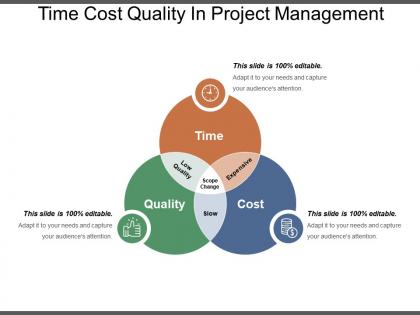
So basically you've got three things that control every project: scope, time, and budget. What you're building, when it's due, and how much cash you have. They're all tied together though - mess with one and the others shift too. Add features? Takes longer or costs more. Crazy deadline? Cut stuff out or pay up. I learned this the hard way on a project last year, honestly. The trick is telling everyone upfront about these trade-offs. Otherwise they'll expect miracles and you'll look like the bad guy when reality hits.
So it's like this constant balancing act between scope, time, and budget. Want more features? Cool, but you'll need extra time or money. Tight deadline and budget? Then you gotta be brutal about cutting features. I learned this the hard way on my last project - stakeholders always think they can magically have it all. Be upfront about these trade-offs from day one. Don't sugarcoat it when they ask for changes. Show them exactly how adding that "quick feature" will push back your launch date or blow the budget. Trust me, setting expectations early saves so much drama later.
Honestly, you gotta figure out what they care about most first - deadline, budget, or getting every feature. Can't have all three, trust me on this one. Once you know their top priority, the other stuff becomes negotiable. Fast and cheap? Features get cut. Want everything perfect with full scope? Time or money has to give. I learned this after way too many projects went sideways lol. The trick is having this conversation upfront instead of when everything's already on fire. Make the trade-offs super obvious early and get them to agree before chaos hits.
You know how project management works? It's like squeezing a balloon - mess with one thing and something else pops out. Cut your timeline? You'll need more budget or less scope. Want to add features without pushing the deadline? Costs are gonna skyrocket. The brutal truth is you can't win at all three - time, budget, and scope - at once. I learned this the hard way on my last project, honestly. Figure out what your stakeholders care about most first, then make your trade-offs from there. Otherwise you'll just be spinning your wheels.
Draw them that triangle thing on the first day - you know, scope/time/budget. Most people actually get it once they see it visually. Tell them straight up that fixing one side screws up another side. When they inevitably want to add stuff later (because they always do), don't just say yes. Give them the real choice: "Sure, we can add that feature, but it means two extra weeks." Let them decide what matters most instead of you guessing. I do quick check-ins weekly where we talk about any new requests against what we've got left for time and money.
So Agile basically locks in time and budget, then you adjust what features actually get built through those sprint cycles. Makes sense when priorities keep shifting. Waterfall tries to nail down everything upfront - scope, time, money - which honestly bites you in the ass when things inevitably change. Lean's all about cutting waste to make the whole thing more efficient. Here's the thing though - you gotta figure out what your stakeholders actually care about most. Time? Budget? Getting every single feature? Then pick whatever approach protects that thing while staying flexible on the rest.
So quality basically sits in the middle of that whole project triangle thing. You can hit your deadline and stay under budget, but if the end result is garbage, what's the point? Every time you mess with scope, time, or cost, quality takes a hit somehow. Cut the timeline too short? Quality drops. Slash the budget? Same deal. I've seen this happen so many times - teams get tunnel vision about hitting dates and costs, then act surprised when everything falls apart. The trick is actually thinking about these trade-offs upfront instead of accidentally screwing yourself over later.
Think of risks as another constraint alongside scope, time, and cost. Spot them early so you're working with realistic parameters from the start. I like adding buffer zones around the whole triangle - sounds super exciting, I know, but it actually saves your ass later. Assess how risks might mess with your scope, push deadlines, or drain your budget. Then bake those insights into your planning. Don't wait until everything's falling apart to think about risk. Make it part of those initial triangle conversations when you're still figuring out what's even possible.
Honestly, the worst mistake is assuming you can nail all three at once - faster, cheaper, AND perfect quality. Spoiler alert: you can't. Most people get tunnel vision about deadlines while totally ignoring how rushing screws up everything else. What really kills projects though? Not being straight with stakeholders about these trade-offs. They'll expect magic if you don't set realistic expectations upfront. I've watched so many PMs overpromise then wonder why everything falls apart. Just be honest from the start about what's actually possible and get everyone on the same page about priorities.
Honestly, it all comes down to managing expectations about scope, time, and budget. Good communication means stakeholders actually understand the trade-offs instead of just demanding miracles. Say your timeline's tight - if you explain why cutting scope makes sense, they won't freak out when you can't deliver everything instantly. Bad communication? You'll get stuck with people expecting the impossible: cheap, fast, AND flawless work (spoiler: doesn't exist). Be upfront about realistic trade-offs from day one. That way they feel like they're part of the decision-making instead of getting blindsided later when reality hits.
Honestly, it depends what's gonna hurt you most if you mess it up. Black Friday launch? Time's everything - I'd cut features or throw money at it before missing that date. Medical software though? Quality wins every single time because nobody wants to accidentally kill someone over a bug (morbid but real). Startups usually get boxed in by budget, so everything else has to flex around whatever cash they have. The trick is figuring out your biggest constraint early and being super upfront with everyone about what you're sacrificing to make it work.
Honestly, get yourself some decent project management software - Asana or Monday work great for tracking scope changes as they happen. Toggl's solid for time tracking too. The budget dashboards are clutch because they'll warn you before you completely blow your budget (learned that one the hard way). Gantt charts might sound boring but they're actually perfect for seeing how scope creep messes with your timeline. Don't pick a bunch of random tools that don't talk to each other - that's just asking for spreadsheet hell. Find one platform that handles scope, time, and budget together. You'll spot those trade-offs way faster.
Track your deliverables against what you planned for scope. Time-wise, I'd use burn-down charts and compare actual milestones to your timeline. Budget gets a weekly check - monitor spend rate and forecast what's left. Honestly, dashboard reports showing all three together are a game changer. Stakeholders can see the trade-offs instantly. Weekly updates are key, and flag anything risky so you can adjust the other constraints. Oh, and use red/yellow/green status - executives love that stuff. Makes their lives easier and yours too.
Honestly, your team vibe makes or breaks the whole scope-time-budget juggling act. Good communication means you'll nail those tricky trade-off decisions way faster. But when there's drama or people aren't talking? Total disaster - decisions drag on forever, scope keeps growing because nobody speaks up, and deadlines get pushed while everyone's bickering about what matters most. I've seen it happen so many times. The key is making sure people feel safe calling out unrealistic timelines or crazy scope changes before they explode into huge problems. Strong team dynamics are like rocket fuel for project success.
Honestly, you can't just ignore any part of it without screwing yourself over. Miss your deadlines? Stakeholders will lose faith in you real quick. Budget gets blown and suddenly you're halfway through with no money left - trust me, that's a nightmare. Scope creep is probably the sneakiest one though. Features keep getting added and before you know it, your simple project is this massive beast that's way behind schedule. The whole point is forcing yourself to actually make trade-offs instead of crossing your fingers and hoping it works out. Oh, and definitely hash out which constraints are non-negotiable with your team before you start anything.
-
Great experience, I would definitely use your services further.
-
Use of icon with content is very relateable, informative and appealing.