

Time cost quality tradeoff powerpoint presentation




Try Before you Buy Download Free Sample Product
 Impress Your
 Audience
 100%
100% Editable
 Save Hours
 of Time


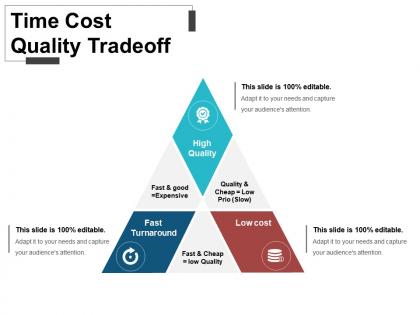
Analyze the tough challenges faced by project managers using this Time Cost Quality Tradeoff PowerPoint Presentation. This time-cost-quality optimization model will help you to decide the best approach to meet the project goals. Highlight the key problems and difficulties faced by project engineers using this effective tradeoff triangle PPT slide. Also, provide suggestions to overcome some practical problems. Help to develop an approach for the project activities in order to minimize the project’s total cost and duration using this cost duration PPT layout. Take the assistance of this trade-off PowerPoint slide and explain the triple constraint of project management by incorporating time, cost quality triangle. Ensure the quality of work by describing features such as the project’s budget, deadline, and scope using this attractive slide. Discuss the interactive procedures and analysis of construction projects by employing this project trade-off metrics slideshow. Therefore, download this attention-grabbing PowerPoint presentation which will help you to achieve a successful project.
People who downloaded this PowerPoint presentation also viewed the following :
Time cost quality tradeoff powerpoint presentation with all 5 slides:
Our Time Cost Quality Tradeoff Powerpoint Presentation ensure only facts filter through. They help dismiss all conjectures.
FAQs for Time cost quality
So this triangle basically shows how time, cost, and quality are all connected - mess with one and the others get impacted. Your client wants it done faster? You're either spending more money or sacrificing some quality. Super simple concept but clients somehow never get it lol. I've found it's actually pretty useful when someone starts making crazy demands. Just pull up the triangle and walk them through what's realistic. Like "okay, you want to add all this stuff... here's what that means for your timeline and budget." Gets everyone on the same page before things get messy.
Ugh, yeah the triangle thing is so real. Touch one corner and the other two immediately feel it - they're all connected whether you like it or not. Tight deadline means you're either throwing more money at it or accepting that some stuff won't be perfect. Higher quality? Sure, but you'll need extra time to polish things or budget for better people/materials. Budget cuts are the worst though - suddenly you're either pushing deadlines or watching your scope shrink. I always try to spell out these tradeoffs early so stakeholders can't later be like "why can't we just do it faster AND cheaper?"
Yeah totally! Apple does this all the time - they'll push back iPhone launches to nail the features instead of rushing something half-baked. Construction's probably the most obvious example though. Your city needs that bridge fixed fast? They're either paying crews overtime or using whatever materials they can get quickly. Planning events is the same deal - we learned this the hard way with our conference last year. Went cheap and fast, ended up with a sketchy venue and mediocre food. The trick is figuring out what actually matters most for your project and just being honest about it upfront.
Look, you gotta have the awkward conversation upfront about what's actually possible. Fixed timeline means something's gotta give - either quality or you need more people. First thing I do is figure out what quality stuff is absolutely critical vs what would just be nice to have. Stakeholders never want to make these choices but oh well. Hit the core functionality hard, then add polish if there's time left. Way better to set realistic expectations now than promise the moon and crash later. Each sprint, ask yourself: what's the bare minimum quality that still works for users? That's your north star.
Honestly, prevention beats fixing stuff later every single time. Spend more time upfront getting your planning and requirements straight - way cheaper than scrambling to fix things afterward. Build in peer reviews and testing as you go instead of waiting till the end. Cross-train your team so everyone's skills get better used. Most defects happen in predictable spots, so figure out where yours usually creep in first. That's where I'd start anyway. The whole trick is catching problems before they become expensive headaches.
Yeah so scope is basically the fourth piece that messes with everything else. Add more features mid-project? Now you need extra time, more money, or quality takes a hit. It's like cramming more clothes into a suitcase that's already bursting - something's gonna break (or in this case, your timeline lol). Works the other way too. Stakeholders want it faster and cheaper? You'll probably have to cut some features to keep things decent. Smart PMs use any scope change as a reason to sit everyone down and reset expectations. Otherwise you're just setting yourself up for disaster.
Honestly, I'd go with Gantt charts first - they're super clear for showing how messing with timelines screws with everything else. Those 3D matrix things plotting quality/cost/time look cool but get confusing real quick (learned that the hard way). Monday.com and Asana have some decent triangle features that update automatically when you change stuff around. Risk registers are solid too if you want to game out different scenarios. But seriously, start simple with a basic Gantt chart. Stakeholders actually get it, and you'll spend less time explaining why moving deadlines breaks your budget.
Yeah, it really depends on what would literally sink your project if you messed it up. Healthcare and aerospace? Quality wins every time - nobody wants a buggy pacemaker, you know? Tech startups flip that completely and just ship fast, then fix stuff later. Manufacturing usually tries to balance everything but honestly leans cost-heavy. Media companies are slaves to deadlines since they can't exactly reschedule the Super Bowl. Before jumping into any project, figure out what your industry absolutely won't forgive. That's your real constraint right there.
Dude, stakeholder engagement literally makes or breaks projects. Get them involved early - yeah, it's annoying spending half your time in calls, but trust me on this. You'll catch scope creep and weird requirements before they explode your timeline. Plus engaged stakeholders actually approve stuff faster and give clearer direction. I learned this the hard way on my last project when we treated stakeholder meetings like an afterthought. Huge mistake. Build those check-ins right into your schedule from the start. The upfront time investment saves you from budget-killing surprises later.
Ugh, the classic mistake is thinking you can nail all three at once - faster, cheaper, AND better quality. Physics doesn't work that way lol. People always underestimate the domino effect too. Add more people to go faster? Congrats, you just created a coordination nightmare. What really kills projects though is not telling stakeholders upfront that they can't have everything. They'll expect magic otherwise. Pick two priorities from the start and stick with them. Track how changes mess with the third thing so you're not flying blind when making decisions.
You've got to talk to people early and often - that's how you catch problems before they explode. Being upfront about what's actually possible (and what isn't) keeps everyone on the same page about priorities. I've watched so many projects completely fall apart because someone just assumed the client would be fine with pushing the deadline back. Spoiler alert: they usually aren't! Have those awkward conversations now instead of scrambling later. When you're honest about constraints from the start, you can all decide together which part of the project triangle needs to bend.
Think of risk management as your project's smoke detector - it goes off before everything's on fire. You'll want to ask "what could blow up here?" right from the start. That way when timelines get crazy (and they will), you're not scrambling to figure out what to cut. I learned this the hard way on a project last year. Anyway, spotting constraints early means you can actually negotiate with stakeholders instead of just disappointing them later. Build in some breathing room, have backup plans ready. Way better than playing defense when things inevitably go sideways.
So basically, whip out that triangle whenever clients want the impossible. Show them how changing one thing screws with the others - like if they want it faster, something's gotta give with either budget or scope. Physics doesn't care about their deadlines, you know? Walk through real numbers: "Cut 30% off timeline? Here's what happens to cost or features." Make it concrete instead of just saying "it's complicated." Oh, and always give them two options so they feel like they're deciding something rather than just getting shot down. Works way better than arguing.
So for time stuff, track if you're actually hitting deadlines - schedule variance, milestone dates, cycle time. Budget side is pretty straightforward: variance from planned costs, what you're spending per deliverable, how efficiently you're using resources. Quality's always the messy one though. Defect rates, customer satisfaction, how much rework you're doing, compliance scores if that matters for your project. Honestly don't try to track everything or you'll go crazy. Pick maybe 2-3 metrics per area that actually tell you something useful. Figure out which corner of the triangle matters most right now and focus there while keeping loose tabs on the rest.
So automation can actually flip the whole project triangle thing on its head. Instead of the usual painful trade-offs, you get more bang for your buck from the same resources. Yeah, there's upfront costs and learning curves (obviously), but once you've got it running, you can move faster without tanking quality or blowing your budget. I'd honestly just start by looking at where you're making the worst compromises right now - that's probably your best bet for where tech will actually help. Don't overthink it. Map out your biggest pain points first, then figure out what tools make sense.
-
Great product with effective design. Helped a lot in our corporate presentations. Easy to edit and stunning visuals.
-
Content of slide is easy to understand and edit.