


Time Quality Cost Cost Resources Time Schedule Quality Scope




Try Before you Buy Download Free Sample Product
 Impress Your
 Audience
 100%
100% Editable
 Save Hours
 of Time


Our Time Quality Cost Cost Resources Time Schedule Quality Scope are topically designed to provide an attractive backdrop to any subject. Use them to look like a presentation pro.
People who downloaded this PowerPoint presentation also viewed the following :
Content of this Powerpoint Presentation
Slide 1: This slide introduces Time, Quality, Cost. State Your Company Name and begin.
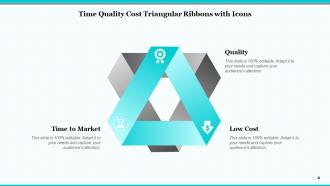
Slide 2: This slide shows Time Quality Cost Triangular Ribbons with Icons.
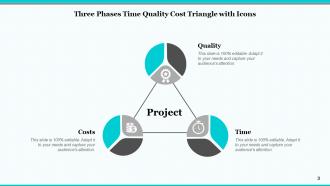
Slide 3: This slide presents Three Phases Time Quality Cost Triangle with Icons.
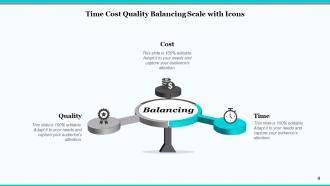
Slide 4: This slide displays Time Cost Quality Balancing Scale with Icons.
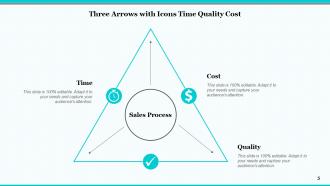
Slide 5: This slide represents Three Arrows with Icons describing Time, Quality, Cost.
Slide 6: This slide showcases Three Circles with Triangle descibing Time, Quality, Cost, Audits & Utilization Plan.
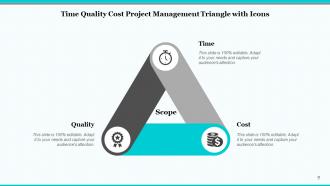
Slide 7: This slide shows Time Quality Cost Project Management Triangle with Icons.
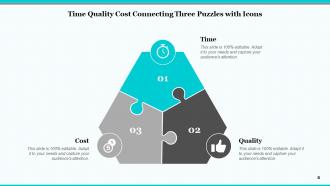
Slide 8: This slide presents Time Quality Cost Connecting Three Puzzles with Icons.
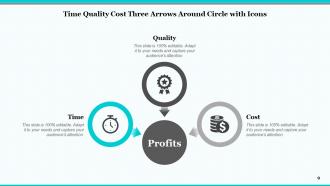
Slide 9: This slide displays Time Quality Cost Three Arrows Around Circle with Icons.
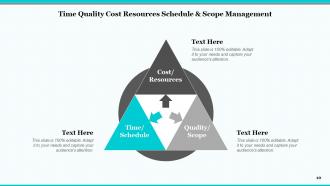
Slide 10: This slide represents Time Quality Cost Resources, Schedule & Scope Management.
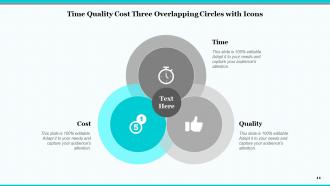
Slide 11: This slide showcases Time Quality Cost Three Overlapping Circles with Icons.
Slide 12: This is a Thank You slide with address, contact numbers and email address.
Time Quality Cost Cost Resources Time Schedule Quality Scope with all 12 slides:
Use our Time Quality Cost Cost Resources Time Schedule Quality Scope to effectively help you save your valuable time. They are readymade to fit into any presentation structure.

FAQs for Time Quality Cost Cost Resources Time
The key phases of a successful project management lifecycle include initiation, planning, execution, monitoring and controlling, and closure. These phases work together by establishing clear objectives, defining scope and resources, implementing strategies, tracking progress against milestones, and capturing lessons learned, ultimately delivering projects on time and within budget while enhancing organizational efficiency.
Agile methodologies enhance team collaboration through daily stand-ups, sprint planning sessions, and retrospective meetings that promote continuous communication and transparency. These practices enable cross-functional teams to identify bottlenecks quickly, adapt to changing requirements seamlessly, and deliver incremental value, with many organizations finding that agile frameworks significantly improve project outcomes and team engagement.
Risk management serves as the foundation for successful project planning and execution by identifying potential threats, assessing their impact, developing mitigation strategies, and establishing contingency plans throughout the project lifecycle. This proactive approach enables project managers to minimize disruptions, control costs, and maintain timelines, with many organizations finding that systematic risk management reduces project failures by up to 40% while enhancing stakeholder confidence and delivery outcomes.
Project managers can effectively handle scope creep by establishing clear project boundaries, implementing formal change control processes, maintaining regular stakeholder communication, and documenting all requirements upfront. Through structured change requests and impact assessments, organizations streamline decision-making while protecting timelines and budgets, with many finding that proactive scope management ultimately delivers better project outcomes and enhanced client relationships.
Effective project tracking tools include Asana, Trello, Monday.com, Microsoft Project, and Jira, each offering real-time dashboards, automated reporting, and collaborative workspaces. These platforms streamline project visibility by centralizing task management, resource allocation, and progress monitoring, with many organizations finding that integrated reporting capabilities significantly enhance stakeholder communication and strategic decision-making across departments.
Cultural differences impact project management in global teams by creating variations in communication styles, decision-making approaches, time orientations, and hierarchical expectations. These differences can lead to misunderstandings and delays, but also bring diverse perspectives and problem-solving methods, with many international organizations finding that structured cultural awareness training, flexible communication protocols, and inclusive leadership practices ultimately enhance team collaboration and project outcomes.
Effective stakeholder communication techniques include regular status updates, tailored messaging formats, structured feedback sessions, visual progress dashboards, and proactive risk notifications. These approaches streamline project transparency by establishing clear communication channels, managing expectations consistently, and ensuring timely information flow, with many organizations finding that strategic communication planning ultimately delivers stronger stakeholder buy-in and project success rates.
Project managers prioritize tasks by analyzing dependencies, deadlines, resource availability, and stakeholder impact, while using frameworks like critical path method and risk assessment matrices. Through strategic sequencing and regular reassessment, they ensure high-impact deliverables receive attention first, ultimately streamlining project execution and delivering outcomes that align with business objectives and timelines.
Project success metrics include schedule adherence, budget variance, quality standards, stakeholder satisfaction, and scope completion rates. These measurements enable organizations to evaluate performance comprehensively, with many companies finding that combining financial metrics like ROI with operational indicators such as team productivity and client approval ratings ultimately delivers better project outcomes and strategic alignment.
Project management strategies for remote teams require enhanced digital communication protocols, structured virtual check-ins, cloud-based collaboration platforms, clear milestone tracking, and asynchronous workflow management. Through tools like project dashboards and video conferencing, organizations streamline coordination across time zones, maintain team accountability, and ensure project visibility, with many companies finding that remote project management ultimately delivers greater flexibility and operational efficiency.
Best practices for conducting project retrospectives include creating a safe environment for honest feedback, focusing on specific events rather than personalities, documenting actionable insights, and ensuring all team members participate equally. These sessions enhance team performance by identifying process improvements, celebrating successes, and addressing challenges systematically, with many organizations finding that regular retrospectives significantly reduce project risks and accelerate delivery timelines.
A project charter establishes clear project objectives, scope, stakeholders, and success criteria, providing essential foundation and authorization for project initiation. It enables project managers to secure resources, align team expectations, and maintain stakeholder accountability throughout execution, with many organizations finding that well-defined charters reduce scope creep and deliver measurable improvements in project completion rates.
Project managers foster continuous improvement culture by implementing regular retrospectives, encouraging open feedback, celebrating learning from failures, and establishing clear improvement metrics. Through collaborative post-project reviews and cross-functional knowledge sharing sessions, teams identify process inefficiencies and innovation opportunities, ultimately delivering enhanced project outcomes and organizational agility.
**INPUT**: What challenges do project managers face when managing cross-functional teams? **OUTPUT**: Project managers face challenges including communication barriers across departments, conflicting priorities between team functions, resource allocation conflicts, varying work methodologies, and accountability issues. These complexities require strategic coordination and clear frameworks, with many organizations finding that structured communication protocols, unified project goals, and cross-departmental alignment ultimately streamline collaboration and enhance overall project outcomes. [Word count: 54 words]
Project management fosters innovation by establishing structured frameworks that encourage creative problem-solving, cross-functional collaboration, and iterative feedback loops throughout development cycles. Through agile methodologies and design thinking approaches, teams can experiment with novel solutions, rapidly prototype ideas, and pivot strategies based on stakeholder input, ultimately delivering breakthrough products and services that exceed traditional expectations.
-
Visually stunning presentation, love the content.
-
Qualitative and comprehensive slides.
-
Graphics are very appealing to eyes.