


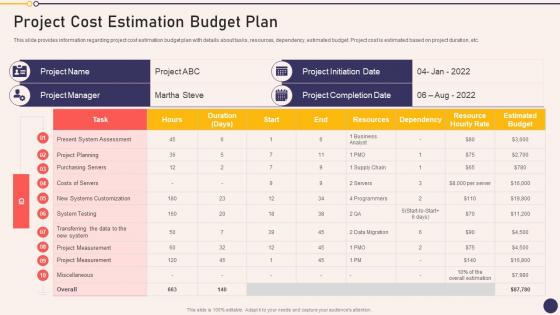
Project Cost Estimation Budget Plan Project Managers Playbook




Try Before you Buy Download Free Sample Product
 Impress Your
 Audience
 100%
100% Editable
 Save Hours
 of Time


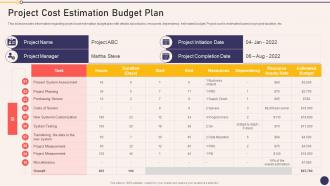
This slide provides information regarding project cost estimation budget plan with details about tasks, resources, dependency, estimated budget. Project cost is estimated based on project duration, etc.
People who downloaded this PowerPoint presentation also viewed the following :
Project Cost Estimation Budget Plan Project Managers Playbook with all 6 slides:
Use our Project Cost Estimation Budget Plan Project Managers Playbook to effectively help you save your valuable time. They are readymade to fit into any presentation structure.





FAQs for Project Cost Estimation Budget Plan
Okay so cost estimation really comes down to four key things. Break your project into super detailed work packages first - the more specific you get, the better your estimates will be. Labor costs are next (rates, hours, overhead - all of it). Don't forget materials, equipment, and any contractor fees. Here's where most people mess up though - you absolutely have to build in contingency money. I've seen too many projects crash because something unexpected happened. Also factor in those indirect costs like admin and project management time. Honestly, if you can get your work breakdown structure really solid upfront, everything else becomes so much easier to estimate accurately.
Fixed costs don't budge no matter what - office rent, software licenses, your PM's salary. Variable costs swing with your project size. More work means more materials, contractors, shipping, whatever. Some costs are honestly weird to categorize though. I always track them separately so you can see what's locked in versus what might change. Super helpful when stakeholders start asking for extras (and they will). You'll know exactly where you have wiggle room and where you're stuck. Makes those budget conversations way less painful.
Look, historical data is like your project fortune teller. Past projects show you the real patterns - scope creep hits about 15% over budget, certain vendors always go long. You'll forget so much between jobs, it's kinda ridiculous. This stuff helps build actual contingencies instead of just guessing. Shows you what cost drivers really bite vs the ones that just stress you out. The trick is tracking the right metrics from day one. Honestly, start documenting now even if your estimates seem bulletproof - future you will thank you.
Dude, you definitely need stakeholder input for cost estimates. They know the actual requirements and weird constraints you'd never think of. Finance folks understand what's realistic budget-wise, while your tech people can spot the complex stuff that'll eat time. End users? They'll tell you what they actually need vs what someone thinks they need. Get them involved early though - like, way earlier than feels necessary. When people help build the estimates, they won't fight you on them later. Trust me on this one. Document everything they tell you because their insights will save you from those brutal "oh wait, we forgot about X" moments that destroy budgets.
So you'll want to build contingency reserves and run Monte Carlo simulations for different risk scenarios. I usually start with three-point estimates - optimistic, realistic, pessimistic - for each major cost component. Then assign probability distributions to them. @RISK or even Excel can run thousands of iterations showing your probable cost range. Honestly gets pretty addictive once you figure it out. Build a risk register too where you assign dollar values to specific risks and their likelihood. Be transparent about assumptions and update as you learn more - stakeholders need to understand why you're asking for that 15-20% buffer, you know?
Ugh, timeline estimates are the worst - we always think things'll take way less time than they actually do. Don't forget about the sneaky costs either, like training people or buying equipment. I learned this the hard way lol. Scope creep will absolutely destroy your budget when requirements change but nobody updates the numbers. Also, double-check any old data you're using because that stuff gets stale fast. Talk to people who've actually done similar projects before you finalize anything. Oh, and always tack on at least 10-20% extra for when things inevitably go sideways.
Dude, you've gotta try estimation software - it's so much better than wrestling with Excel formulas all day. Microsoft Project is solid, or find tools that tap into your old project data for realistic budgets and timelines. The cool part? You can mess around with "what-if" scenarios and see how changing stuff affects your numbers instantly. Plus they track actual vs estimated costs, which helps you get better at this over time. Honestly, I was skeptical at first but now I can't imagine going back to doing everything manually. Pick one tool for your next project and you'll see the difference right away.
Dude, you NEED contingency money - like 10-20% extra depending on how messy your project could get. Seriously, scope creep is real and it's coming for your budget. I learned this the hard way on my last big project. Figure out what's most likely to go wrong first, then put actual dollar amounts on those risks. Without buffer money, you're either gonna blow past your budget or end up cutting quality (and nobody wants that). Oh, and don't feel bad about padding - it's not pessimistic, it's smart planning.
Dude, scope changes will absolutely destroy your budget if you're not tracking them properly. Requirements shift, features get added, stuff gets removed - and you need to reassess costs right away each time. Here's the thing though: one tiny feature addition might need infrastructure changes that cost 10x more than the feature itself. I've watched projects blow past their budget by 50% from "minor" scope creeps that nobody bothered estimating. Document every change request with cost impacts and get sign-off first. Oh, and always build in some padding for scope drift because it's gonna happen whether you like it or not.
So there are a few ways to tackle cost estimation. Bottom-up is where you break down every single task and estimate each piece - takes forever but it's pretty accurate. Top-down works backwards from your total budget or uses data from similar projects you've done before. There's also parametric (using formulas based on project stuff) and analogous estimation where you just compare to past projects. Honestly? I'd probably start with analogous to get a rough idea first, then do bottom-up for the really important parts where you can't afford to be wrong.
Labor costs will absolutely destroy your budget if you're not careful with them. They're usually 60-80% of your total project cost, so even tiny rate changes hurt. Like if your dev goes from $100 to $120/hour - boom, that's an extra $20K on a 1,000-hour project. I've watched estimates fall apart because people used old rate cards from six months ago. Double-check your current rates before you finalize anything. Oh, and pad longer projects a bit since rates love to creep up mid-project.
Check your numbers against real costs at every big milestone - you'll catch problems early. Weekly variance tracking sounds boring but trust me, it's saved my butt so many times. When scope shifts, update that baseline right away. For sketchy tasks, use three estimates: best case, worst case, and what'll probably happen. Your team knows the actual work better than you do, so get them involved in reviews. Write down what you're assuming because half of it will be wrong later (learned that the hard way). Oh, and start keeping notes on what went sideways - makes your next project way easier to estimate.
So basically you take your baseline costs and multiply them by inflation each year - compound it forward through your whole timeline. I usually grab historical data showing 2-4% annually, though construction materials can be weird and spike differently than labor. Honestly, anything over 3 years gets sketchy fast if you don't account for this. Regional stuff matters too - what's happening in your area specifically? I'd probably be conservative with the estimates and then throw a contingency buffer on top just to be safe. Seen too many projects go sideways because people thought costs would magically stay flat.
Dude, here's what works for me - executives just want the big picture with major risks highlighted. Project managers? They need all the messy details. Charts and graphs are your best friend because honestly, people's eyes glaze over at spreadsheets. Give ranges instead of exact numbers, and explain what assumptions you're making. Confidence levels help too so they get how uncertain things are. Oh, and always connect your estimates to stuff they actually care about - business outcomes and value. The key is making it visual and being ready to explain your reasoning. Works every time.
Check your Earned Value weekly - that's your actual work done vs what you planned. CPI tells you if you're spending efficiently, SPI shows if you're on schedule. Budget variance is where it gets real though, like seeing exactly where your money's going (sometimes painfully obvious lol). Don't wait for month-end reviews - that's way too late. Track your burn rate and forecasted costs so you catch problems early. Trust me, small overruns turn into nightmares fast if you're not watching closely.
-
Visually stunning presentation, love the content.
-
Professionally designed slides with color coordinated themes and icons. Perfect for enhancing the style of the presentations.