


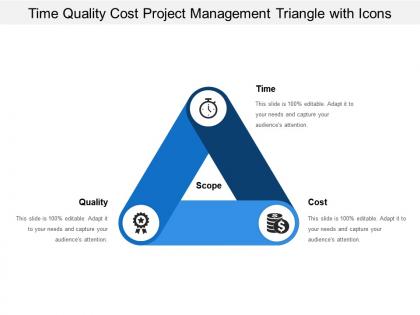
Time quality cost project management triangle with icons




Try Before you Buy Download Free Sample Product
 Impress Your
 Audience
 100%
100% Editable
 Save Hours
 of Time


Add to your charisma with our Time Quality Cost Project Management Triangle With Icons. The audience will admire your articulateness.
People who downloaded this PowerPoint presentation also viewed the following :
Time quality cost project management triangle with icons with all 5 slides:
Advice is easily accepted with our Time Quality Cost Project Management Triangle With Icons. You don't have to force it down.
FAQs for Time quality cost project management
So the Time Quality Cost Triangle is this "pick two" thing that'll save your sanity in project management. Want it fast and high-quality? Gonna cost you. Cheap and fast? Quality takes a hit. It's honestly such a lifesaver when stakeholders get unrealistic expectations. You can literally point to it and go "look, if we're moving up the deadline, either we need more budget or we're cutting corners somewhere." I always map these three out at the start now - gets everyone on the same page about what actually matters most. Way better than scrambling later when everything goes sideways.
Honestly, you can't win at all three - something's gotta give. Figure out what's most important first. Hard deadline? Budget locked down? Or is quality absolutely non-negotiable? Once you know that, you can decide where to bend on the other two. The biggest mistake I see people make is trying to nail everything perfectly. Just sets you up for failure, tbh. Be super upfront with everyone about these trade-offs right from the start. Like, spell it out clearly so nobody's shocked when you have to make tough calls later. Write it down, get everyone to agree, and you'll save yourself so much drama.
So here's the thing - focus on one corner and the other two usually suffer. Rush for speed? Quality tanks or costs explode to hit that deadline. Want perfect quality? Time drags and expenses pile up from all the testing. Keep costs low and you're either cutting corners or pushing deadlines way out. That "pick two" rule is annoyingly accurate most of the time. Honestly, the smart move is deciding upfront which compromises you can live with instead of hoping you'll magically nail all three and then acting shocked when reality hits.
Dude, you absolutely have to keep stakeholders in the loop when dealing with the project triangle. Here's the thing - when scope starts creeping or deadlines shift (and they will), you can't just handle it solo. People need to understand what's happening and help decide which constraint gets adjusted. I've watched so many projects completely implode because PMs thought they could absorb changes without telling anyone. Bad move. Being upfront about how changing one thing affects everything else means way fewer nasty surprises later. Get ahead of trade-offs before they bite you, not after the damage is done.
Yeah so healthcare is totally locked into quality - they literally can't cut corners on patient safety even if budgets are tight. Software teams usually mess with features instead of missing launch dates, which honestly makes sense. Manufacturing has their processes pretty dialed in so they balance everything more evenly. Construction though? Total nightmare - one delay and suddenly you're bleeding money everywhere. The trick is figuring out what your industry treats as the "can't touch this" constraint, then you'll know where you can actually make trade-offs when things go sideways.
Honestly, just start with the basics - Gantt charts and resource allocation stuff to see your trade-offs visually. Earned Value Management is clutch for tracking how tweaking one thing screws with everything else. Decision matrices sound super nerdy (because they are) but you literally just score different scenarios and it works. When quality's the main concern, Quality Function Deployment helps prioritize against time and budget. Monte Carlo simulations are cool if you want to go all-out with risk analysis, though that might be overkill. But real talk? Even a basic spreadsheet comparing scenarios will show you where your biggest headaches are gonna be.
So the triangle thing is actually super useful for reality-checking deadlines. When stakeholders want everything fast, I just ask them straight up: "what are you willing to sacrifice?" Tight deadline means either quality takes a hit (more bugs, less polish) or you need more money for extra resources. Honestly, those "we need it yesterday" conversations happen constantly and this visual saves me every time. Map out the three constraints - if time's locked down, something else has to give. I always make them pick their priority constraint upfront before I commit to anything. Way better than dealing with complaints later when they realize they can't have their cake and eat it too.
Honestly, the worst mistake is trying to nail all three perfectly - time, budget, quality. Won't happen. Change one thing and watch the others go haywire. Rush the timeline? Quality tanks or you're paying crazy overtime fees. What really gets me is when teams don't agree upfront on what matters most. I've watched projects completely derail because priorities kept switching halfway through. Total nightmare. Pick your main focus early and stick with it. Then pad the other two areas because something will definitely go sideways. Oh, and make sure everyone's actually on the same page about priorities from day one.
Honestly? Both Lean and Agile basically throw the old Time-Quality-Cost triangle out the window. They're saying you don't have to pick just two anymore. Agile gets working software out fast but keeps quality up through constant testing and feedback. Lean cuts out all the waste to save money without screwing up time or quality. Pretty smart, right? Instead of those brutal upfront trade-offs, you can use small iterations and automation to actually improve all three at once. Worth trying on your next project - oh, and definitely get feedback super early rather than waiting until the end.
Toyota's lean manufacturing is the classic example - they crushed it by focusing on continuous improvement and cutting waste. Apple does this too with the iPhone, deliberately using premium materials and taking longer development time to justify those crazy prices. The 2012 London Olympics actually pulled it off, which is honestly shocking for a project that massive. Most mega-projects like that go way over budget or behind schedule. My advice? Pick one thing to nail down first, then work the other two around it. Trying to perfect everything at once is just setting yourself up to fail. Way better to be strategic about it.
Honestly, tech can help you dodge some of those classic project triangle headaches. Automation speeds things up without tanking quality. Project management tools give you way better insight into where your resources are going. AI stuff is pretty wild for spotting problems before they blow up - though I'll admit some of it feels overhyped. Cloud platforms cut costs while making collaboration smoother. The trick is picking tools that actually fix your real problems instead of just adding more chaos. Figure out what's killing you first, then grab whatever directly tackles that mess.
Build buffers from day one - extra time, money for quality checks, contingency funds. Figure out what your stakeholders care about most because you'll definitely have to make tradeoffs later. Agile sprints work great since you can pivot fast when things change. Communication is everything - keep people posted when the three factors start pulling against each other. Oh, and document scope assumptions upfront and get approval. That way when someone wants "just a tiny tweak" (spoiler: it's never tiny), you've got something to point to. Honestly, the triangle tension is gonna happen no matter what you do.
Okay so here's the thing - you can't really "save up" quality with services like you do with actual products. With physical stuff, companies can test everything beforehand and fix issues before it ships out. Services are way trickier though. Your customers are experiencing the quality right as it happens. Like if you're at a restaurant and the service is super slow, that kills the whole experience even if the food ends up being incredible. There's no going back to the workshop to tweak things - once you've delivered that service, that's it. Honestly makes service businesses way more stressful in my opinion.
First thing - get your baseline numbers locked down before changing anything. I'd track delivery times and cycle schedules for time, defect rates for quality, and budget variance for cost. Here's the thing though: when you fix one area, it usually messes with the others (which is honestly why this framework is so helpful). Pick maybe 2-3 metrics per area max - trust me, you don't want to drown in spreadsheets. Monitor everything for a few project cycles to spot the real patterns. The relationships between these three are where the magic happens.
Yeah, the whole triangle thing is getting pretty shaken up these days. AI can actually pump out faster results without tanking quality - which used to be like, pick one, you know? Remote teams handle time and resources way differently too since everyone's scattered. Agile makes those rigid trade-offs less of a thing because you're tweaking scope every sprint instead of locking everything down from day one. Honestly feels kinda outdated when you're doing two-week cycles. I'd just use it as rough guidance rather than some strict law, especially with how development works now.
-
The Designed Graphic are very professional and classic.
-
Designs have enough space to add content.