

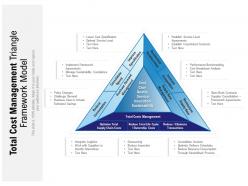
Total cost management triangle framework model





Try Before you Buy Download Free Sample Product
 Impress Your
 Audience
 100%
100% Editable
 Save Hours
 of Time


Our Total Cost Management Triangle Framework Model are topically designed to provide an attractive backdrop to any subject. Use them to look like a presentation pro.
People who downloaded this PowerPoint presentation also viewed the following :
Total cost management triangle framework model with all 2 slides:
Use our Total Cost Management Triangle Framework Model to effectively help you save your valuable time. They are readymade to fit into any presentation structure.
FAQs for Total cost management
Total Cost Management includes cost planning, resource allocation, risk assessment, performance monitoring, and continuous optimization strategies. These components work together by establishing clear budgets, tracking expenditures against targets, and identifying cost-saving opportunities throughout project lifecycles, with many organizations finding that integrated TCM approaches deliver enhanced operational efficiency and improved profit margins.
TCM integrates into project management through comprehensive cost planning during initiation, continuous budget monitoring throughout execution, and strategic value engineering at key milestones. This approach enables project managers to identify cost optimization opportunities early, streamline resource allocation, and maintain financial control, with many organizations finding that integrated TCM delivers improved project outcomes and enhanced profitability.
Common TCM implementation challenges include resistance to organizational change, lack of cross-functional collaboration, inadequate data integration systems, insufficient stakeholder buy-in, and limited visibility into indirect costs. These obstacles often stem from siloed departmental structures and legacy processes, with many organizations finding that comprehensive training programs and phased implementation approaches help overcome initial resistance while delivering measurable cost optimization results.
TCM contributes to more informed decision-making by providing comprehensive visibility into direct costs, indirect expenses, lifecycle implications, and resource allocation across all organizational functions. Through detailed cost analytics and forecasting models, executives can evaluate true project profitability, assess strategic investments more accurately, and optimize budget allocation, ultimately enabling data-driven decisions that enhance operational efficiency and competitive positioning.
Data analytics enables effective Total Cost Management by identifying spending patterns, predicting cost trends, optimizing resource allocation, and uncovering hidden inefficiencies across operations. Through advanced analytics platforms, organizations streamline procurement decisions, enhance supplier negotiations, and automate budget forecasting, with many companies finding that data-driven insights reduce overall costs while improving strategic decision-making capabilities.
Effective total cost estimation methodologies include bottom-up estimating, parametric modeling, three-point estimation, analogous estimating, and reserve analysis. These approaches enhance accuracy by combining historical data analysis, risk assessment, and detailed work breakdown structures, with many project managers finding that strategic combination of multiple methodologies delivers significantly improved cost forecasting and budget control.
Organizations measure TCM success through key performance indicators including cost variance analysis, budget adherence rates, return on investment metrics, operational efficiency improvements, and stakeholder satisfaction scores. Through comprehensive dashboards and regular assessments, companies across manufacturing, healthcare, and financial services track cost reductions, streamlined processes, and enhanced resource allocation, ultimately delivering measurable competitive advantages and sustainable growth.
Traditional cost management focuses on reducing direct expenses and immediate costs through budget controls and spending restrictions. Total Cost Management takes a comprehensive approach by examining direct costs, indirect expenses, operational inefficiencies, and long-term strategic investments, with organizations in manufacturing and healthcare finding that this holistic methodology delivers sustained profitability and competitive advantage.
TCM aligns with sustainability goals by optimizing resource allocation, minimizing waste across operations, and enhancing long-term cost efficiency through strategic planning. This integration enables organizations to reduce environmental impact while improving profitability, with many companies finding that sustainable practices ultimately deliver competitive advantages and operational resilience.
SAP Cost Management, Oracle Hyperion, IBM Planning Analytics, Microsoft Power BI, and Anaplan represent leading Total Cost Management solutions, each offering comprehensive budgeting, forecasting, and cost analysis capabilities. These platforms streamline financial planning by automating data integration, providing real-time visibility, and enabling scenario modeling, with many organizations finding that strategic software implementation ultimately delivers enhanced cost control and competitive operational efficiency.
TCM enhances risk management by providing comprehensive cost visibility, enabling proactive identification of budget variances, and establishing robust financial controls throughout project lifecycles. Through integrated monitoring systems, organizations can detect potential overruns early, implement corrective measures swiftly, and maintain strategic reserves, ultimately delivering improved project outcomes and enhanced stakeholder confidence.
Involving all stakeholders in TCM delivers comprehensive cost visibility, enhanced accountability, improved decision-making alignment, and stronger buy-in across departments and external partners. This collaborative approach enables organizations to identify cost reduction opportunities more effectively, streamline resource allocation, and minimize resistance to cost management initiatives, ultimately delivering sustainable savings and operational efficiency.
TCM influences supplier relationships by establishing transparent cost visibility, creating performance-based partnerships, and enabling data-driven negotiations rather than purely price-focused discussions. Through comprehensive cost analysis, organizations can collaborate with suppliers on value optimization, identify mutual cost reduction opportunities, and build strategic alliances that deliver competitive advantages while fostering long-term operational efficiency.
Successful TCM implementations include Boeing's aerospace cost reduction through integrated supplier management, Toyota's lean manufacturing optimization, and GE's Six Sigma-driven operational efficiency programs. These organizations achieved 15-30% cost reductions by streamlining procurement processes, enhancing resource allocation, and implementing data-driven decision frameworks, with many finding that strategic TCM integration delivers sustained competitive advantage across complex operational environments.
Continuous improvement principles enhance Total Cost Management through systematic cost analysis, regular process optimization, and data-driven decision making across all business functions. Organizations implement kaizen methodologies, lean practices, and performance benchmarking to identify cost reduction opportunities, streamline operations, and eliminate waste, with many finding that iterative improvements deliver sustained competitive advantage and operational efficiency.
No Reviews