

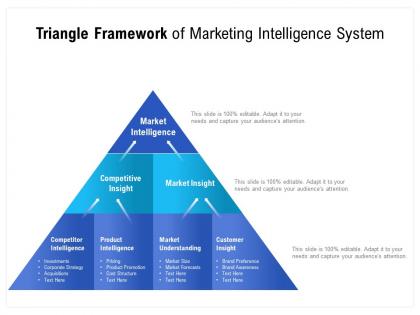
Triangle framework of marketing intelligence system




Try Before you Buy Download Free Sample Product
 Impress Your
 Audience
 100%
100% Editable
 Save Hours
 of Time


Our Triangle Framework Of Marketing Intelligence System are topically designed to provide an attractive backdrop to any subject. Use them to look like a presentation pro.
People who downloaded this PowerPoint presentation also viewed the following :
Triangle framework of marketing intelligence system with all 2 slides:
Use our Triangle Framework Of Marketing Intelligence System to effectively help you save your valuable time. They are readymade to fit into any presentation structure.

FAQs for Triangle framework of
So the Triangle Framework is basically scope, time, and cost - they're all connected. Change one thing and the others get affected too. Scope = what you're actually building. Time = your deadlines. Cost = budget and resources, obviously. Here's what I wish someone told me earlier - you literally can't nail all three at once. Want bigger scope? You'll need more time or money, period. The trick is being upfront about these trade-offs from day one. That way when stakeholders inevitably want changes, you can have real conversations about what's possible instead of just saying yes to everything.
Honestly, the Triangle Framework is a lifesaver for this exact situation. You've got scope, time, and budget - when one shifts, the others have to move too. Can't have it all, you know? What I love about it is how it makes those awkward conversations so much easier. Stakeholders want more features? Just show them the triangle and walk through what happens to your timeline or budget. It's visual, so they actually get it instead of just hearing "no" from you. Next time someone drops scope changes on you, pull that thing up. Makes the whole trade-off discussion way less painful.
So the Triangle Framework is clutch for messy situations where everyone wants different things. Works great for project management, strategic stuff, or when you're dividing up resources and need to balance three competing factors at once. Honestly? It's saved my butt so many times when everything feels chaotic. You can actually show people the trade-offs instead of just arguing in circles. Sprint planning becomes way less painful - especially when leadership wants the impossible trifecta of everything done perfectly by tomorrow. Budget meetings too, though those are still brutal regardless. But yeah, try it next time stakeholders are being unrealistic. Game changer for those awkward conversations.
Yeah totally! Triangle Framework works great with agile, you just apply it differently. Instead of thinking project-wide, use it for each sprint or feature. Fix your time (sprint length) and cost (team size), then let scope be flexible based on what you can actually ship. Way more realistic than waterfall honestly - I've seen too many teams burn out trying to hit impossible targets. Just be upfront with stakeholders about which constraint you're prioritizing each sprint. Seriously, try mapping it out in your next planning session. Makes those "we need everything yesterday" conversations so much easier to navigate.
Honestly, the Triangle Framework is kind of outdated for messy, complex projects. It acts like scope, time, and cost are the only things that matter - but what about quality? Or whether your team burns out halfway through? I've seen projects that hit all three targets but still flopped because they ignored stakeholder buy-in or created a maintenance nightmare. Real work has way more variables than three neat little constraints. Don't get me wrong, it's fine for basic planning conversations. Just don't let it blind you to everything else that actually makes projects successful.
So you know that old scope/time/cost triangle from PM class? The Triangle Framework is basically that but way better. It adds quality, risk, and stakeholder satisfaction into the mix - honestly makes way more sense for real projects. Same basic idea though: mess with one thing and everything else shifts. I've found it super helpful for those awkward conversations where clients want everything perfect, fast, AND cheap (lol). You can actually show them the trade-offs visually. When stuff inevitably changes mid-project, you'll have a better way to explain why their "simple" request isn't so simple.
Honestly, just start with a basic triangle diagram - it's the easiest way to show how all three points connect. Flowcharts work great for mapping out the decision-making stuff too. I've seen people kill it with before/after case studies that show real examples. Interactive whiteboards are clutch, or even those sticky note exercises during workshops (people love getting hands-on for some reason). Build complexity gradually though - don't dump everything at once. Your audience will pick up the relationships way faster when they can actually see how it all fits together visually.
So basically the Triangle Framework is three parts: context (the why), content (actual info), and connection (making sure everyone gets it). Works way better than just throwing information at people and crossing your fingers. You're hitting all the bases - background, facts, and that gut check to see if it actually landed. Honestly saves so much time later when you don't have confused teammates asking "wait, what?" I'd test it out next meeting. Structure your updates around those three things and watch how much smoother everything goes. Game changer for team communication.
Honestly, stakeholder engagement is huge for the Triangle Framework - like, it's one of the three main things holding it all together. Your stakeholders are the ones defining what success actually means, so you can't just make scope, time, and budget decisions without them. The whole thing falls apart if you're flying solo because you'll miss stuff that only they know about. Regular check-ins are key - not just kickoff and wrap-up meetings, but throughout the project phases. I learned this the hard way on a project last year where we thought we knew what they wanted. We didn't.
Real-time data is a total game changer for the Triangle Framework. You're not stuck with your original scope-time-resources decisions anymore. When new info hits, you can actually pivot - maybe cutting scope because budget's tighter than you thought, or discovering you've got extra time thanks to delays somewhere else. Honestly, most people set up dashboards and then ignore them, which drives me nuts. The trick is getting alerts for stuff that actually matters, then using that data to rebalance your triangle instead of just hoarding spreadsheets. It beats flying blind any day.
Look, the whole "pick two sides" thing is BS - real projects are way messier than that. Usually one constraint actually matters most, even if nobody wants to admit it upfront. Plus these priorities shift constantly as you figure stuff out along the way. I've seen teams stress about treating it like some sacred math formula when really? Just use it to start honest conversations with stakeholders. Figure out what they actually care about most and where you can bend when things go sideways. Because they will.
Honestly, three circles that overlap work great, or you could do the triangle thing with labels at each corner. I'm partial to the triangle myself - shows how everything connects way better than boring bullet points. Plus it matches your whole framework name, which is kinda neat. For presentations, definitely go triangle. Your audience will actually get it instead of zoning out. Just throw some arrows between the corners to show the flow. Oh, and don't overthink the design - clean labels are really all you need. Simple stuff sticks in people's heads better anyway.
So for the Triangle Framework, I'd track schedule variance first - are you hitting deadlines or not? Budget variance is obvious too. Quality stuff like defect rates or how happy stakeholders actually are. Here's the thing though - these three are constantly fighting each other. Fix one and the others usually suffer. Also watch scope creep and how often people request changes, since that messes with everything. Honestly, just throw together a weekly dashboard tracking this stuff. You'll spot pretty quick when things are going sideways and need fixing.
Yeah, I've used the Triangle Framework for risk stuff before and it's pretty solid. You basically map your risks against scope, time, and budget to spot where you're vulnerable. Scope creep? You're looking at timeline delays or going over budget. When risks actually hit, it helps explain trade-offs to stakeholders - like "okay, this vendor screwed us for two weeks, so we either cut features or need more money." I'd plot your top 3 risks on it to see different impact scenarios. Makes the whole mess way clearer, honestly.
Don't try to do everything at once - that's a recipe for disaster. Map your workflow to Triangle's three phases first (yeah it's confusing initially but you'll get it). Pick one team to test it out for 2-3 sprints. Keep your current tools, just change how you transition between phases. Document everything because you'll definitely forget what worked when you roll it out wider. The assessment criteria and milestone gates are honestly the trickiest part, so give people time to adjust. Start small, learn fast, then expand.
No Reviews