


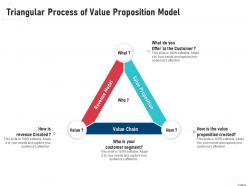
Triangular process of value proposition model





Try Before you Buy Download Free Sample Product
 Impress Your
 Audience
 100%
100% Editable
 Save Hours
 of Time


Our Triangular Process Of Value Proposition Model are topically designed to provide an attractive backdrop to any subject. Use them to look like a presentation pro.
People who downloaded this PowerPoint presentation also viewed the following :
Triangular process of value proposition model with all 2 slides:
Use our Triangular Process Of Value Proposition Model to effectively help you save your valuable time. They are readymade to fit into any presentation structure.

FAQs for Triangular process of
A strong value proposition model includes clear customer segmentation, specific pain point identification, unique solution differentiation, quantifiable benefits, and compelling emotional resonance. These elements work together by targeting precise market needs, demonstrating measurable outcomes like cost reduction or efficiency gains, and creating competitive advantage, with many organizations finding that well-crafted propositions significantly enhance customer acquisition and retention rates.
Businesses communicate unique value through clear messaging that highlights specific benefits, competitive differentiators, customer pain point solutions, and quantifiable outcomes. Through targeted content marketing, personalized sales presentations, and strategic digital campaigns, companies like SaaS providers and retail brands demonstrate measurable results, ultimately building trust and accelerating customer acquisition in increasingly competitive markets.
B2B value propositions emphasize ROI, operational efficiency, cost reduction, and long-term partnerships, while B2C focuses on emotional benefits, convenience, personal satisfaction, and immediate value. B2B companies typically highlight productivity gains, scalability, and strategic advantages through detailed case studies, whereas B2C brands prioritize lifestyle enhancement, user experience, and brand connection, ultimately delivering targeted messaging that resonates with distinct decision-making processes.
Companies measure value proposition effectiveness through customer feedback surveys, conversion rate analysis, market share growth, customer retention metrics, and competitive positioning assessments. These measurements enable organizations to track customer perception alignment, purchase decision drivers, and revenue impact, with many finding that regular value proposition testing through A/B campaigns and focus groups delivers actionable insights for strategic refinement.
Customer feedback plays a crucial role in refining value propositions by revealing gaps between perceived and delivered value, identifying unmet needs, and validating messaging effectiveness. Through surveys, interviews, and behavioral analytics, companies can adjust their positioning, enhance product features, and strengthen competitive differentiation, ultimately ensuring their value proposition resonates authentically with target markets.
Visual presentation templates enhance value proposition communication by providing structured frameworks, consistent branding, clear data visualization, and professional design elements that simplify complex concepts. These templates enable organizations to streamline their messaging, reduce preparation time, and deliver compelling presentations that resonate with stakeholders, ultimately improving pitch success rates and accelerating decision-making processes across sales teams.
Common mistakes include being too generic, focusing on features rather than customer benefits, failing to differentiate from competitors, using internal jargon customers don't understand, and making claims without supporting evidence. These pitfalls ultimately weaken market positioning, with many organizations finding that testing value propositions with actual customers before launch significantly improves clarity, relevance, and competitive advantage.
A value proposition model integrates into marketing strategies by aligning messaging across channels, informing content creation, and guiding campaign development to consistently communicate core benefits. This strategic alignment enables organizations to create cohesive brand experiences, target specific customer segments more effectively, and measure campaign performance against defined value drivers, ultimately delivering stronger market positioning and improved conversion rates.
Tools for crafting compelling value propositions include value proposition canvas, customer journey mapping, competitive analysis frameworks, personas development, and A/B testing platforms. These frameworks enhance understanding by identifying customer pain points, differentiating from competitors, and validating messaging effectiveness, with many organizations finding that systematic approaches ultimately deliver stronger market positioning and improved conversion rates.
Market research contributes by identifying customer pain points, preferences, competitive gaps, and unmet needs that inform strategic positioning. Through surveys, focus groups, and behavioral analysis, companies uncover specific value drivers, validate messaging effectiveness, and refine their unique selling points, ultimately enabling them to craft compelling propositions that resonate with target audiences and deliver measurable competitive advantage.
Storytelling strengthens value propositions by creating emotional connections, demonstrating real-world impact, and making abstract benefits tangible through customer success narratives, problem-resolution scenarios, and transformation journeys. These narrative approaches enable businesses to showcase measurable outcomes, build trust through authentic experiences, and differentiate their offerings, ultimately delivering more compelling presentations and stronger stakeholder engagement.
Companies align their value propositions with market trends through continuous market research, customer feedback analysis, competitive intelligence gathering, and trend forecasting methodologies. By regularly monitoring consumer behavior shifts, emerging technologies, and industry developments, businesses can strategically adapt their offerings, messaging, and positioning, ultimately maintaining competitive relevance while delivering enhanced customer value in evolving markets.
A strong value proposition significantly enhances customer loyalty and retention by clearly communicating unique benefits, addressing specific pain points, and differentiating from competitors. When customers understand precisely how a product delivers value, they develop stronger emotional connections and trust, with many businesses finding that well-articulated value propositions reduce churn rates while increasing repeat purchases and long-term customer lifetime value.
Businesses differentiate their value propositions in saturated markets by focusing on unique customer experiences, specialized service delivery, strategic partnerships, and innovative pricing models. Through targeted market segmentation and personalized solutions, companies in sectors like financial services, retail, and healthcare create competitive advantages that resonate with specific customer needs, ultimately delivering enhanced loyalty and market positioning.
Startups can leverage customer interviews, MVP testing, competitor analysis, lean validation methods, and targeted positioning to create compelling value propositions cost-effectively. Through focused market research and iterative feedback loops, resource-constrained companies can identify unique differentiators, validate core benefits, and communicate clear value, with many successful startups finding that strategic simplicity often outperforms expensive market research.
-
Content of slide is easy to understand and edit.
-
Great product with effective design. Helped a lot in our corporate presentations. Easy to edit and stunning visuals.
-
Topic best represented with attractive design.