

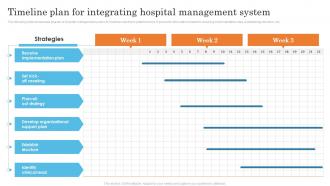
Timeline Plan For Integrating Hospital Management System





Try Before you Buy Download Free Sample Product
 Impress Your
 Audience
 100%
100% Editable
 Save Hours
 of Time


The following slide showcases phases of hospital management system to maintain electronic patient record. It presents information related to receiving implementation idea, establishing structure, etc.
People who downloaded this PowerPoint presentation also viewed the following :
Timeline Plan For Integrating Hospital Management System with all 6 slides:
Use our Timeline Plan For Integrating Hospital Management System to effectively help you save your valuable time. They are readymade to fit into any presentation structure.





FAQs for Timeline Plan For Integrating
Look, HMS success basically boils down to everything talking to each other properly. Patient records need to sync with billing, scheduling has to connect with lab results - you know the drill. Skip anything that requires your staff to juggle multiple logins because they'll mutiny. Real-time data flow is huge here. Also make sure whatever you pick has solid reporting so you can spot the money drains. Honestly though? The biggest thing is finding something your clinical team won't absolutely hate using, because if they're fighting the system all day, your investment was basically worthless.
So EHR integration basically connects all your hospital systems into one smooth data flow. Lab results pop up instantly in patient charts. Billing gets the right codes automatically. No more nurses entering the same info five times - honestly, that alone makes it worth it. Doctors can pull up real-time updates from wherever they are. Yeah, the setup's a pain initially, but once you're running? Way fewer errors, patients move faster, and your admin work drops dramatically. I'd start by figuring out where your data gets stuck most often - that's where you'll see the biggest wins.
Oh man, data compatibility is gonna be your worst nightmare - nothing talks to each other properly. Your team will hate you at first because learning new systems sucks when you're already buried in work. Implementation downtime is brutal too, like doing heart surgery while the patient's running a marathon or something. Budget-wise? Double whatever they quote you. I learned that the hard way. Do a full tech audit first and add 20% buffer time minimum. Trust me on this one.
Honestly, data interoperability can make or break everything in healthcare. When systems actually communicate, doctors get complete patient info right away instead of hunting through different databases. Your staff won't waste time doing the same data entry twice, and lab results move smoothly between departments. It's pretty wild how much faster diagnoses happen when everything connects properly. Plus tracking patients from admission to discharge becomes seamless - no more annoying gaps in records. I'd start by figuring out which systems are totally disconnected and focus on linking your most critical ones first.
Look, patient engagement will make or break your HMS - I've seen this play out so many times. If patients can actually use the system to check records, book appointments, whatever, they'll engage with it. Better data, less manual work for staff. No-show rates can drop like 30% when people are actually involved in their care. Mobile access is huge here - everyone's on their phones anyway. The whole dynamic shifts when patients feel like partners instead of just... patients, you know? Start with a solid patient portal that doesn't suck to navigate.
So these systems basically turn everything into one big communication hub. Your nurses can message doctors directly instead of chasing them around (honestly such a game changer). Real-time alerts pop up when something's urgent, and everyone sees the same dashboards so nobody's out of the loop. Phone tag becomes a thing of the past. The system automatically saves all conversations too, which is clutch for records. Oh, and definitely train your main teams on messaging first - don't try to do everything at once or it'll be chaos.
Honestly, real-time analytics is a game changer for hospitals. Instead of waiting days for reports, you'll get instant data on patient flow, bed occupancy, and staffing. Bottlenecks become visible as they happen - you can actually fix problems instead of just reading about yesterday's disasters (which used to make me want to scream). The best part? Better patient outcomes since you catch critical stuff immediately. Infection patterns, readmission risks - all that shows up right away. My advice though - don't try monitoring everything at once. Pick your worst pain points first and build from there.
So instead of dealing with those massive server rooms, cloud solutions move everything online - patient files, scheduling, billing, all of it. Doctors can access stuff from anywhere, which is perfect when they're running between clinics. Updates happen automatically too, and honestly the disaster recovery beats praying your server room stays dry. What I'd do is figure out what's driving you crazy first - maybe it's slow file access or scheduling conflicts? Then find cloud platforms built for those specific problems. The best part is you won't need new hardware every time you expand.
End-to-end encryption is your starting point - both for storage and when data moves around. Set up role-based access so people only see what they actually need. Multi-factor authentication will annoy everyone, but honestly one data breach and you're screwed. Audit trails for tracking who accessed what, plus automatic session timeouts. Security assessments should happen regularly - I'd say quarterly pen tests if your IT team can swing it. Oh, and don't treat this like a one-and-done thing. It's ongoing work that never really stops.
Honestly, compliance isn't something you can just slap on later - it has to be your starting point. HIPAA, FDA device rules, Joint Commission standards... all that needs to be built into your architecture from the beginning. Audit trails, encryption, access controls - they're non-negotiable and have to actually work. The annoying part? Compliance often makes things clunky for users, so you're always fighting that battle between following rules and making something people don't hate using. Oh, and definitely loop in your compliance people early. Trust me, retrofitting this stuff is a nightmare you don't want.
Honestly, start small with just one or two departments first - going full hospital right away is asking for disaster. Get your staff trained on the actual system, not those boring online modules everyone clicks through without learning anything. I'd run both systems side by side for a few weeks because tech always breaks when you need it most. Communication is huge too - keep everyone in the loop so they're not freaking out about changes. Oh, and make sure you have backup plans ready. Trust me, something will go wrong no matter how prepared you think you are.
Dude, this stuff literally saves your sanity. Real-time stock tracking means no more "oh crap we're out of gauze" moments at 2am. When supplies hit low levels, reordering happens automatically - no more manual counting for hours. Your HMS usage data feeds straight into procurement too, which sounds boring but actually prevents you from either running out of critical stuff OR having warehouses full of expired supplies nobody uses. Staff can focus on patients instead of inventory spreadsheets. Honestly? Start small with your most essential supplies first, then expand from there.
You'll probably see 15-30% savings, which is pretty solid. The biggest win? No more duplicate data entry - seriously, the paperwork thing is out of control at most places. Billing errors drop way down too, and that alone saves thousands each month. Better inventory tracking cuts waste. Your staff can actually focus on patients instead of drowning in admin work, which honestly makes everyone happier. Most places break even in 18-24 months. I'd figure out what you're spending on admin stuff now so you know where the big savings will hit.
Honestly, mobile access is a game changer for clinical staff. Instead of constantly running back to computers, nurses can update vitals and medication records right at the bedside - way more natural than the old clipboard routine. Doctors can check test results and adjust treatment plans from anywhere in the hospital. Response times get faster since everything happens in real-time. Documentation errors drop too because staff aren't trying to remember details later. I'd suggest starting with just one unit as a pilot - you'll see the workflow improvements pretty quickly. It's one of those changes that just makes sense once you see it in action.
Honestly, telemedicine integration is huge for patient satisfaction. Your HMS can handle video appointments, record sharing, and remote monitoring all in one place. No-shows drop since patients don't need to drive anywhere - which your front desk will love, trust me. Both virtual and in-person visits get managed from the same dashboard, plus billing syncs automatically so less paperwork. I'd figure out what telemedicine features your patients actually care about first. Then find HMS vendors who've already built those partnerships instead of trying to piece it together yourself.
-
Innovative and attractive designs.
-
Graphics are very appealing to eyes.