

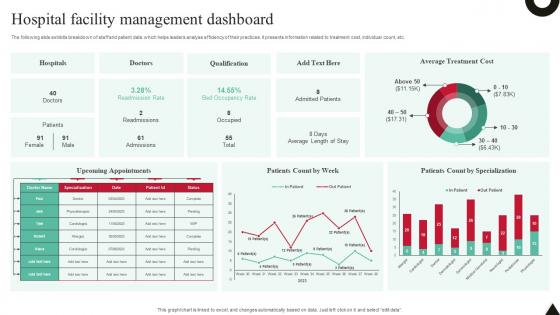
Hospital Facility Management Dashboard




Try Before you Buy Download Free Sample Product
 Impress Your
 Audience
 100%
100% Editable
 Save Hours
 of Time


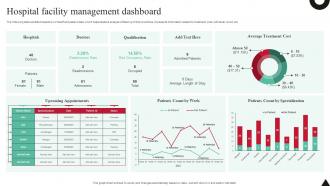
The following slide exhibits breakdown of staff and patient data which helps leaders analyse efficiency of their practices. It presents information related to treatment cost, individual count, etc.
People who downloaded this PowerPoint presentation also viewed the following :
Hospital Facility Management Dashboard with all 7 slides:
Use our Hospital Facility Management Dashboard to effectively help you save your valuable time. They are readymade to fit into any presentation structure.





FAQs for Hospital
So you're basically the person keeping everyone from dying due to building failures - no pressure lol. HVAC maintenance is huge since bad air systems can spread infections like crazy. Emergency power has to work perfectly, medical equipment needs regular calibration, and fire safety is obviously critical - sprinklers, alarms, all that stuff. Water quality testing is a big one too because Legionella outbreaks are nightmare scenarios. You'll also handle environmental hazards like structural problems or slip risks. Honestly, I'd start with a full safety audit to see what you're working with first.
Look, start with whatever's driving you nuts right now - maybe equipment breaking down constantly? Get some IoT sensors on that stuff so you'll actually know what's happening before things crash. CMMS platforms are honestly amazing for ditching all those paper work orders (my buddy saved like 10 hours a week just from that). Your HVAC can run itself with occupancy sensors, which is pretty cool. Mobile apps let your team flag problems instantly instead of hunting someone down to report it. Oh, and predictive maintenance software catches issues early - way cheaper than emergency repairs. Don't try to do everything at once though.
Dude, preventive maintenance in hospitals is literally life or death - no joke. HVAC keeps everything sterile, generators power life support, medical gas systems can't just stop working. It's way more intense than normal buildings because there's zero room for mistakes. Honestly, I've seen what happens when hospitals cut corners on this stuff and it's not pretty. You need rock-solid scheduling and documentation for everything. Start by checking what you're already doing and see if any critical systems are being missed. The redundancy planning alone will save your butt when things go sideways.
Honestly, start tracking your occupancy rates and patient flow - most managers just wing it and wonder why nothing works. Get some space management software to see what's actually happening in real-time. Then redesign based on real data, not whatever looked nice in the original plans. Flexible spaces are huge - rooms that can switch between different functions, modular clinical areas, that kind of thing. Oh, and don't wait for problems to hit you. Set up monthly check-ins with your space data and make little tweaks as you go. Way better than waiting for some massive renovation project.
Infection control and fire safety will probably drive you crazy the most. HVAC's a nightmare too - those air pressure differentials between rooms are constantly acting up. Joint Commission is obsessed with documentation, so don't let people just initial maintenance logs without actually doing the work (I've seen that backfire so many times). Life safety violations pop up a lot with emergency exits and backup power stuff. Oh, and equipment maintenance records - they'll absolutely nail you if those aren't current. Set up some kind of automated reminder system for inspections and actually fix whatever they tagged you for last time.
So our facilities team actually shadows nurses during shift changes - sounds weird but they catch stuff like badly placed supply carts that slow everything down. They do regular huddles with clinical staff and have people embedded on each unit. Cross-functional committees help too, where docs and nurses can bring up whatever's bugging them. Honestly the best fixes come from random conversations like "god this process is annoying." The trick is getting facilities people who actually get clinical work, not just building stuff. Maybe ask yours to watch a patient admission with you?
Start with an energy audit - seriously, you'll be shocked where money's disappearing. HVAC upgrades are your biggest win since hospitals basically run AC 24/7. Smart controls help tons. LED lighting everywhere, plus occupancy sensors in places like break rooms (not patient areas obviously). Get some monitoring systems so you can actually see usage patterns instead of guessing. Oh, and train your staff on conservation stuff - people waste less when they get why it matters. My buddy at City General said their lighting project alone cut costs 30%. Focus on the big energy hogs first.
Look, your facility setup really does make a huge difference for patients. Clean spaces, proper lighting, and working HVAC systems help people feel less stressed when they're already dealing with health stuff. Good signage is clutch too - getting lost in a hospital when you're anxious about an appointment is the worst. I've been there! Quiet areas where patients can actually rest? That speeds up recovery. Here's the thing though - you can't just fix things when they break. Stay ahead of maintenance issues and design spaces with patients in mind. Your building is part of the healing process whether you realize it or not.
Oh man, HVAC is probably your biggest thing - good filtration and airflow stops so much airborne stuff. Hand sanitizer stations literally everywhere (I know, I know, but seriously). Deep clean with hospital-grade stuff constantly, especially door handles and elevator buttons - those are nasty. You need solid protocols for isolating contaminated areas too. Train everyone on PPE properly because half the time people mess that up. Honestly though, whatever systems you pick have to be realistic. There's zero point making these perfect protocols that are impossible to actually follow day-to-day.
Ugh, budget constraints are the worst - you're constantly having to choose what gets fixed first. Patient safety stuff always wins, obviously, then regulatory requirements, then everything else fights for scraps. I've learned to get tight with department heads before budget season so I know what they actually need vs. what they're just dreaming about. Everything feels urgent in a hospital too, which makes it extra stressful. You'll want to start categorizing your maintenance requests now - trust me on this one, it saves so much time later when you're trying to justify spending. The whole thing's basically one giant priority juggling act.
Honestly, smart HVAC systems are where it's at right now - the energy savings are insane. LED retrofits are still big too, plus all the water-saving stuff like low-flow fixtures and greywater systems. Solar's getting popular but yeah, those upfront costs are brutal for finance teams. Most hospitals are also cutting back on single-use items when there's safer reusable options. LEED certification is basically expected now for any new builds. Oh, and waste reduction programs are everywhere. But seriously, just start with an energy audit first. It'll show you the low-hanging fruit without emptying your budget completely.
Look, you've gotta bake emergency prep right into daily operations. Backup power, supply stockpiles, evacuation routes your team could walk blindfolded. Everything critical needs redundancy - water, power, comms, medical gases. Cross-train your maintenance crew because disasters are basically Murphy's Law on steroids. When shit hits the fan, you're juggling patient moves, utility management, and keeping vital areas running with half your staff. Oh, and definitely audit your current protocols first. Hunt down those single failure points and create backups for the backups. Trust me on this one.
Dude, you HAVE to invest in training your FM staff properly. Any screw-up with HVAC, electrical, or infection control hits patients directly - I've watched preventable disasters happen from undertrained teams. Your people need solid certifications for complex systems and safety protocols. Plus healthcare regs change constantly, so ongoing education isn't optional. Yeah, it costs money upfront, but honestly? Undertrained staff costs way more in the long run. Your team will feel more confident too, which makes everything run better. Budget for both initial certs and refresher training - trust me on this one.
Track your response times and completion rates - that's your baseline data right there. Patient surveys matter way more than people think since they're living with these services every day. I'd also watch if vendors actually hit their SLA targets and budget limits. Staff feedback is gold too, honestly. Site inspections help catch stuff surveys miss. Budget-wise, you want to see if they're staying on track. The trick is mixing hard numbers with the softer relationship stuff - gives you a complete picture when it's renewal time. Don't rely on just one metric type.
Wayfinding's probably your biggest headache - people get lost and stressed trying to find radiology or whatever. Privacy matters too, both visual and sound-wise. Nobody wants their business overheard in hallways. Infection control drives everything from materials to airflow patterns, which gets expensive but you can't skip it. Natural light helps with patient anxiety, plus decent waiting areas that don't feel like prison. Some hospitals are honestly designed like mazes - drives me crazy. Walk through your place like you've never been there before. You'll immediately see what's broken.
-
I discovered this website through a google search, the services matched my needs perfectly and the pricing was very reasonable. I was thrilled with the product and the customer service. I will definitely use their slides again for my presentations and recommend them to other colleagues.
-
Exclusive and extensive collection of templates. Really helped me create a professional presentation in just no time.