


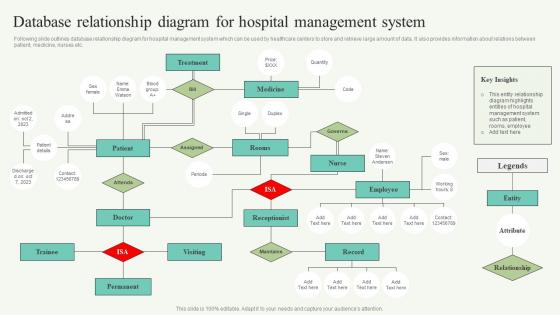
Database Relationship Diagram For Hospital Management System




Try Before you Buy Download Free Sample Product
 Impress Your
 Audience
 100%
100% Editable
 Save Hours
 of Time


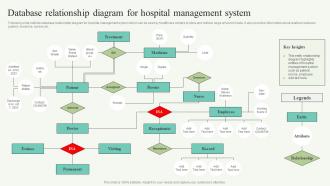
Following slide outlines database relationship diagram for hospital management system which can be used by healthcare centers to store and retrieve large amount of data. It also provides information about relations between patient, medicine, nurses etc.
People who downloaded this PowerPoint presentation also viewed the following :
Database Relationship Diagram For Hospital Management System with all 6 slides:
Use our Database Relationship Diagram For Hospital Management System to effectively help you save your valuable time. They are readymade to fit into any presentation structure.





FAQs for Database Relationship Diagram For
So there's basically three types you'll deal with: one-to-one, one-to-many, and many-to-many. Most common is one-to-many - like customers having multiple orders. One-to-one is pretty straightforward, just linking single records together (user and their profile). Many-to-many though? Ugh, that's where it gets messy. You need junction tables and honestly it's kind of a headache at first. Students taking multiple courses is the classic example everyone uses. Really though, just figure out which relationship your data actually needs before you start messing around with foreign keys and stuff.
So basically, it's about how many records link up. One-to-one means each record in table A matches exactly one in table B - like how each person gets one passport. One-to-many is when one record connects to several others, like a customer placing multiple orders. Honestly, you'll use one-to-many way more often since that's just how most real stuff works. The one-to-one thing is mainly useful when you're splitting up huge tables or need to store extra data separately. When you're designing your schema, just think about whether your entities have a single connection or multiple ones - that'll point you in the right direction.
So foreign keys are like connectors between tables - they reference another table's primary key to show relationships. Take a customers table and orders table. You'd stick a customer_id foreign key in orders that points back to the customer_id in your customers table. The cool part? Your database won't let you accidentally delete a customer who still has orders floating around. Honestly saves you from so many headaches down the road. It's all about keeping your data clean automatically so you don't end up with random orphaned records everywhere.
Okay so there's this whole normalization thing with three forms - sounds boring but it's actually pretty useful. Break your data into separate tables where each one handles just one type of thing. First form gets rid of repeating stuff, second removes weird partial dependencies, third kills transitive ones (honestly took me forever to remember what transitive even means). Don't store the same info in multiple places - that's where foreign keys come in handy for linking everything together. Figure out your main entities first, give each table its own primary key. Trust me, you'll avoid so many headaches later when you need to update something.
Honestly, the biggest win is flexibility - you can link stuff both ways without copying data everywhere. Perfect for users with multiple roles or products in different categories. But here's the thing - you're stuck with that extra junction table hanging out between everything. Makes your queries messier and can tank performance if you screw up the indexing. Three-table joins are also way harder to debug than simple two-table ones, trust me on that. Bottom line: use them when you actually need those bidirectional relationships, but don't make simple one-to-many setups complicated just because it seems fancier.
When you delete a parent record, cascading actions decide what happens to the child records. CASCADE DELETE will automatically wipe out all related data - so bye bye customer means bye bye all their orders too. RESTRICT blocks the whole thing if kids exist. There's also SET NULL which just clears the foreign key references (works great for optional stuff). Honestly, CASCADE can bite you if you're not careful - I've seen people accidentally nuke way more data than they meant to. I'd start with RESTRICT and handle deletions manually until you're 100% sure your cascade rules won't cause chaos.
ER diagrams are clutch for this - they'll save you so much headache with complex schemas. Check out dbdiagram.io or Lucidchart, though honestly your database tool probably already has something built in. Color-code different entity types and keep your symbols consistent (one-to-many vs many-to-many). Don't try to show everything at once though - that's a recipe for confusion. Start with your core entities and main relationships, then add layers. I usually create separate views for different business processes. Way easier to wrap your head around.
Oh this is actually super useful! You use self-referential relationships when records in a table need to connect to other records in that same table. Like employees and their managers - they're all in the employee table, right? Same thing happens with comment replies, folder structures, family trees. Honestly took me forever to wrap my head around it at first. You just create a foreign key that points back to the table's own primary key. The tricky part is handling top-level records (like the CEO who doesn't report to anyone) - you'll need to allow nulls there.
So indexes are basically shortcuts that save your database from scanning every single row when you're doing complex queries. Picture trying to find something in a book - you'd use the index instead of flipping through hundreds of pages, right? Same idea here. JOIN operations get way faster when you index your foreign keys, plus any columns you're constantly filtering or sorting on. Honestly, foreign keys should be your first priority for indexing. Then focus on whatever columns show up in your WHERE clauses all the time. Makes a huge difference, especially when you're joining multiple tables together.
So denormalization is kinda wild - you duplicate data across tables which makes reads blazing fast since there's way fewer joins. Perfect for apps that do tons of reading. The downside though? Updates become this huge pain because now you're changing the same info in like 3 different spots. Plus your database balloons in size. Oh and you lose that nice clean relationship structure too, which honestly bugs me more than it should. I'd only do it if you've got serious performance issues and don't mind dealing with messier update code.
Dude, ORMs are seriously clutch. You don't have to write all those annoying JOIN queries anymore - just work with objects instead. Want a user's orders? Just do `user.orders` and boom, it grabs everything automatically. Your database tables become classes, and relationships turn into simple object properties. I probably should've learned this stuff way earlier honestly. SQLAlchemy's solid if you're using Python, or Django ORM if you're going that route. Trust me, it'll save you so much headache with relationship management once you get the hang of it.
Three main things to nail down: constraints, normalization, and smart updates. Foreign key constraints are lifesavers - they stop orphaned records from messing up your data. Normalize tables properly so you're not copying the same info everywhere (learned this the hard way). Transactions are clutch when updating related stuff to keep everything in sync. Cascade deletes work great but honestly they kinda scare me sometimes. Don't forget indexes on foreign keys or queries will crawl. I'd start by checking what constraints you already have - probably fewer than you think.
So you've got a few ways to tackle this. Making one of the foreign keys nullable is probably the easiest - just create the first record without the reference, then update it once you've got the second one in place. Junction tables are solid for many-to-many stuff that creates these loops. Honestly, I used to think circular refs were bad design, but they're everywhere in real data. If your database does deferred constraints, that's another route. Figure out which relationship matters less - that's usually what you want to make nullable first.
Think of referential integrity as your database's safety net. It stops you from accidentally deleting a customer who still has orders floating around, or creating orders that point to customers that don't exist. Basically prevents your data from becoming a complete mess. You'll thank yourself later if you set these up right from the beginning - trust me on this one. Cleaning up broken relationships after the fact is honestly such a pain. These constraints might seem annoying at first, but they're totally worth it when your data stays consistent.
So your database choice totally shapes how you handle table relationships. PostgreSQL and MySQL? They've got your back with foreign keys and automatic referential integrity - the database just enforces everything for you. NoSQL is way more hands-on though. You're writing all that relationship logic yourself in your app code. MongoDB's actually gotten decent at this stuff with their lookup features, but honestly you're still doing way more work than with regular SQL. I'd say just think about how messy your data relationships are gonna be and whether you want the database or your code handling all the constraints.
-
Keep doing the good work guys. Surpass the needs and expectations always!!
-
Happy to incorporate such stunning templates in my presentation. Made my presentation look professional and engaging.