

Tips To Maintain Effective Eye Contact In Nonverbal Communication Training Ppt




Try Before you Buy Download Free Sample Product
 Impress Your
Audience
 100%
Editable
 Save Hours
of Time


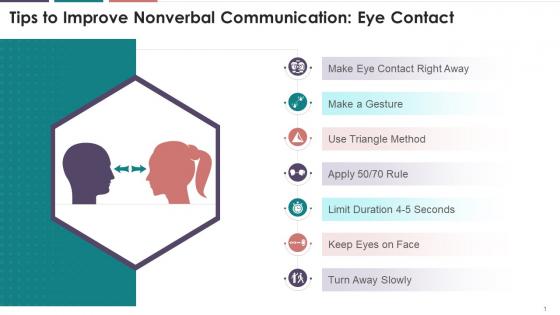
This slide showcases the multiple recommendations to improve nonverbal communication using eye contact. The numerous tips listed are applying the 50 and 70 rule, keeping eyes on the face, and using the triangle method.
People who downloaded this PowerPoint presentation also viewed the following :
Tips To Maintain Effective Eye Contact In Nonverbal Communication Training Ppt with all 17 slides:
Use our Tips To Maintain Effective Eye Contact In Nonverbal Communication Training Ppt to effectively help you save your valuable time. They are readymade to fit into any presentation structure.







FAQs for Tips To Maintain Effective Eye Contact In Nonverbal
Honestly, eye contact makes such a huge difference when you're speaking. It builds trust and keeps people actually listening to you instead of scrolling their phones. I used to just stare at the back wall like a weirdo, thinking I was being sneaky - spoiler alert: everyone could tell! Try this "lighthouse" thing where you slowly scan different sections of the room. Make eye contact with individuals for like 2-3 seconds, then move on. You'll also pick up on whether people are confused or bored, which is super helpful. It feels awkward at first but becomes natural pretty quickly.
Look, eye contact is honestly game-changing for presentations. People feel like you're actually talking TO them instead of AT them. I've seen audiences completely zone out when speakers just stare at their notes or slides the whole time. What works is scanning around the room - make quick contact with different sections but don't be creepy about it. For video calls, stare at your camera not the screen (feels weird but trust me). There's this "lighthouse technique" where you sweep your gaze across everyone like a lighthouse beam. Sounds cheesy but it actually works pretty well.
Oh man, this stuff is so tricky! In Western countries, looking someone in the eye shows you're confident and trustworthy. But tons of Asian, African, and Indigenous cultures see direct eye contact as rude - especially with older people or bosses. Middle Eastern cultures have their own gender rules about it too. Mediterranean folks are way more intense with eye contact than like, Scandinavians or whatever. I always try to do a quick Google search about wherever I'm going beforehand. Honestly though, your best bet is just watching what locals do and copying them. Works every time.
Don't just stare at one person the whole time - I learned this the hard way! What works is dividing your audience into sections and spending like 3-5 seconds looking at each zone before moving on. I used to just stare at the back wall which was awful. Try the "lighthouse technique" where you sweep your gaze slowly across the room. Pick one friendly face in each section to start with if that helps. Just don't dart around frantically - that screams nervous energy and it's super distracting for everyone.
Oh man, I struggled with this too! Try the "lighthouse technique" - just sweep your gaze around the room, pausing like 3-5 seconds in each section. Find some friendly faces to focus on instead of trying to look at literally everyone. Way less overwhelming that way. There's this 50/70 rule that actually works: eye contact 50% when you're talking, 70% when listening. If you're still nervous, look at foreheads or eyebrows - nobody can tell the difference, I swear. I used to just stare at the back wall and looked ridiculous on video lol. Start by hitting one person in each corner first.
Dude, eye contact is huge for looking confident. You're basically showing people you believe what you're saying and aren't scared of their reactions. Makes you seem way more authoritative too. Hold someone's gaze for like 3-5 seconds, then move to the next person - don't be that creepy starer though lol. It forces people to actually listen instead of scrolling Instagram. Well, most people anyway. The whole thing just screams "I'm present and engaged" without you having to say it. Pretty powerful stuff when you nail the balance.
Dude, when you avoid eye contact during presentations, people think you're either lying or don't know what you're talking about. It's that same awkward vibe when someone won't look at you in regular conversation - super uncomfortable. Your audience basically checks out because they feel ignored, and honestly, you miss all the good stuff like seeing if they're confused or actually getting it. Try that lighthouse thing where you slowly look around the room and pause on different sections. Makes everyone feel included without being weird about it.
Just glance at your slides, don't stare at them like they're gonna disappear lol. Quick look to see what's next, then turn back and actually talk TO your audience. I used to be awful at this too - basically had full conversations with my PowerPoint instead of people. Try the "look, turn, talk" thing. Works pretty well. Check your slide fast, face the crowd, then speak while making eye contact. If you need to point something out, do it quick but keep talking to humans, not the wall. Your slides are backup dancers, not the main act - they support what you're saying, not something you read word for word.
Look at the camera lens, not the screen - I know it's super weird at first! Stick a little arrow or dot near your camera so you remember. There's this thing called the "lighthouse technique" where you glance between the camera and different spots on screen every few seconds. Makes your eye movement look more natural. Practice talking to your camera during test calls to get used to it. Oh, and start your main points by looking straight at the lens - honestly makes such a difference for connecting with people. The whole thing feels awkward initially but you'll get the hang of it.
Okay so eye contact is like, the biggest thing for seeming genuine. People literally think you're more trustworthy when you actually look at them. I know it's awkward, but when you keep looking away it makes people wonder what you're hiding - even if you're just being shy. You want to hit around 60-70% eye contact during conversations. Don't go full serial killer stare, but enough to show you're actually listening. Pro tip that saved my life: if direct eye contact feels too intense, look between their eyebrows instead. They can't tell the difference but it's way less uncomfortable for you.
Okay so eye contact is basically magic for public speaking. It makes your brain release oxytocin which calms you down - like a built-in anxiety killer. Your audience pays way more attention and actually remembers what you said better. Plus they'll trust you more because you seem genuine instead of... I don't know, sketchy? Just don't go full serial killer with it though lol. Stick to like 3-5 seconds per person then move on. Oh and it has to feel natural or you'll weird everyone out.
Okay so basically split your attention three ways - audience, other panelists, and the moderator. Most of your eye contact should go to the audience since they're why you're there. Look at fellow panelists when you're responding to something they said or agreeing with them. The moderator needs attention during questions and when they're trying to move things along (they're basically herding cats up there). Don't fall into that trap where you only look back and forth between panelists - I see this all the time and it's awkward. Try sweeping your gaze around different sections of the room so everyone feels included.
Oh man, eye contact makes SUCH a difference in presentations. Trust me - I bombed one once because I kept staring at my slides like an idiot. Your audience needs to feel like you're talking TO them, not AT them. Makes you seem way more confident too. What works for me is looking at different sections of the room, maybe 3-5 seconds per person before moving on. Don't just ping-pong between the same two spots though. Practice with friends first if you're nervous about it - seriously helps you get comfortable before the real thing.
Your body language has to match the eye contact or it just looks weird. Relax your shoulders and lean in a bit - shows you're actually interested. Don't cross your arms or fidget with stuff (trust me, I used to tap pens constantly in meetings and it was so distracting). Open gestures are way better. Your face matters too - like nodding or smiling slightly while they talk. Everything needs to feel natural together, not forced. Honestly, crossed arms make you look closed off even if you're making great eye contact. Practice it next conversation - people definitely open up more when you get this right.
Oh man, the classic mistakes? Don't stare at your slides the whole time - nobody wants to talk to the back of your head. Also avoid that creepy thing where you lock eyes with one poor person for way too long lol. Some people try looking over everyone's heads but that's just as weird. What works is actually making eye contact with individual people for like 3-5 seconds, then moving on. I do this triangle thing - left side, center, right side, repeat. Don't forget the people sitting on the edges either! When you're nervous, just find a couple friendly faces to come back to. Way less intimidating than trying to connect with everyone at once.
-
Nice and innovative design.
-
Excellent design and quick turnaround.