


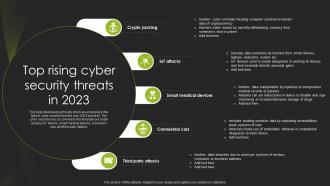
Top Rising Cyber Security Threats In 2023





Try Before you Buy Download Free Sample Product
 Impress Your
 Audience
 100%
100% Editable
 Save Hours
 of Time


This slide illustrates top threats which are emerging in the field of cyber security from the year 2023 onwards. The cyber security risks as covered in this template are crypto jacking, IoT attacks, smart medical devices, connected cars and third party attacks
People who downloaded this PowerPoint presentation also viewed the following :
Top Rising Cyber Security Threats In 2023 with all 6 slides:
Use our Top Rising Cyber Security Threats In 2023 to effectively help you save your valuable time. They are readymade to fit into any presentation structure.





FAQs for Top Rising Cyber Security
AI attacks are getting scary good - they're using machine learning to write phishing emails that actually fool people. Supply chain hits are everywhere too, where hackers go after smaller vendors to reach the big targets. Smart but seriously messed up. Cloud infrastructure is the new goldmine for ransomware since that's where everyone's moving their stuff. Your biggest risk might be some random third-party company you barely think about. Get your team trained on spotting weird emails and actually audit who has access to what. Oh, and check your vendor contracts - you'd be surprised how many have zero security requirements.
Dude, ransomware groups are getting scary organized this year. Instead of hitting random people, they're targeting hospitals and power grids - places that basically have to pay up. The worst part? They steal all your data first, encrypt everything, then threaten to dump it online if you don't cough up the money. Triple extortion or whatever they call it. But honestly, most attacks still start with someone clicking a sketchy email. So train your team, keep backups offline (like actually disconnected), and have a plan ready. You'd be surprised how much that basic stuff helps when things go sideways.
So basically, hackers are getting scary good with AI - they're pumping out super convincing phishing emails and deepfakes that fool people way easier now. Plus their automated scanning finds vulnerabilities crazy fast. But the good news? Security teams are using AI too for real-time threat detection and automated responses. Honestly feels like we're in this constant tech arms race. My company just upgraded our AI security tools last month and thank god we did. You really can't rely on old-school manual defenses anymore - they're just too slow against these AI-powered attacks.
Yeah so remote work totally screwed up cybersecurity tbh. People are connecting from sketchy home wifi, coffee shops, whatever - not like the locked-down office anymore. Phishing emails are everywhere now targeting WFH people specifically. Plus ransomware hits someone's home computer and boom, it spreads to company stuff. Oh and credential theft through unsecured connections is huge now. Zero-trust architecture helps a lot, and definitely make everyone use VPNs for company access. It's honestly a nightmare compared to before but those two things will cover most of your bases.
Ransomware's still the worst - they lock up your files until you pay. Those phishing emails are getting scary good too, like I almost fell for one last week that looked totally real. Then there's BEC scams where hackers pretend to be your boss or a vendor, sending fake invoices or requesting wire transfers. Train your team to spot this stuff, back everything up religiously, and put two-factor authentication on all your important accounts. Seriously, the basics will save you way more headaches than you'd think.
Dude, start by actually mapping out who you're working with - every vendor, software tool, the works. Most companies are clueless about this stuff, which is honestly scary. Before bringing anyone new on board, do proper risk assessments. Your existing partners? Audit them regularly for security issues. Set up monitoring to catch weird activity from third-party access points. Also create response plans specifically for when vendors get compromised (not if, when). Seriously though, just inventory your current vendors first - I bet you'll find some you forgot about. That alone will probably freak you out a bit.
Dude, social engineering is seriously the scariest thing about cybersecurity. Why would hackers bother cracking your firewall when they can just call Karen in accounting and pretend to be IT? People will literally hand over passwords or click sketchy links because someone sounded official on the phone. It's wild how much easier manipulation is than actual hacking. Your fancy security tech won't mean anything if employees are getting tricked left and right. Best thing you can do? Train everyone regularly and don't make people feel stupid for reporting weird requests.
So zero-trust is basically being super paranoid about security - nobody gets trusted automatically, even if they're already "inside" your network. Everyone has to prove who they are every time they want access to something. Yeah, it sounds annoying but it actually works really well against hackers who steal passwords or try to sneak around once they're in. The old way of just protecting the perimeter is pretty much dead at this point. Start with figuring out what your most important stuff is, then lock it down with minimal access rights. That'll give you the biggest bang for your buck.
Your phone is basically a gateway to everything - banking, work email, all your personal stuff. Most people don't realize how risky that is. If someone hacks your phone, they can steal your credentials, spread malware, even get into your company's systems if you use it for work. The problem is nobody updates their phones like they should (I'm guilty of this too). Auto-updates are your friend here. Use strong authentication and honestly? Start thinking of your phone as a computer, because that's what it is. One breach can snowball fast.
Honestly, the malware scene is getting pretty wild these days. Criminals are using AI to constantly morph their code so it slips past detection - basically making it impossible for old-school antivirus to keep up. Ransomware-as-a-service is everywhere now, which means even script kiddies can launch serious attacks. There's also this nasty trend toward fileless malware that just hangs out in your system's memory. Supply chain hits are huge too - they'll poison software updates. Oh, and deepfake phishing emails? That's a thing now. You really need endpoint detection tools, not just traditional antivirus. Those signature-based systems are basically useless at this point.
Monthly phishing sims work way better than those mind-numbing annual trainings everyone hates. When someone clicks a sketchy link, they get instant feedback - honestly, that's when it actually sticks. We started doing these tabletop things where teams walk through real attack scenarios. Super helpful. Make reporting suspicious emails something people get kudos for, not something that makes IT groan. Oh, and definitely test where your team's at first - some groups are surprisingly savvy while others... well, let's just say they need more help. Keep everything tied to what they actually do day-to-day.
Hospitals and banks are getting absolutely wrecked this year. Ransomware crews love targeting healthcare because they know hospitals can't just shut down - people literally die. Financial services are dealing with the same mess. Manufacturing got hit hard too, which makes sense since everyone rushed to go digital during COVID and probably skipped some security steps. Oh, and utilities like power companies are prime targets now. Government and schools? Total disaster zone with all the remote work stuff. Honestly, if you're in any of these fields, you'd better get your incident response plan sorted and train your people ASAP.
Yeah, so governments are freaking out about this stuff right now. New cybersecurity agencies everywhere, mandatory breach reporting - the whole nine yards. The EU's rolling out stricter rules while the US is all about those public-private partnerships to share threat info faster. Smaller countries are scrambling to keep up too. International cooperation is actually happening now with joint task forces hunting ransomware groups (which is kinda cool honestly). Oh, and if you're in a regulated industry? Get ready for a ton more compliance headaches coming your way.
For SIEM stuff, Splunk and Sentinel are solid choices - they'll handle your log analysis pretty well. CrowdStrike or SentinelOne work great for endpoint protection. SOAR tools are kinda having a moment right now since they automate incident response, which honestly is a lifesaver. Threat intel feeds are worth looking into too for attack pattern context. NDR solutions with behavioral analysis can help with network monitoring. Oh, and make sure whatever you pick actually integrates - nobody wants a bunch of tools that can't talk to each other. I'd probably start with a good SIEM first, then build out from there.
Honestly, data protection is all about layers. Strong passwords for everything - yeah I know, pain in the ass but necessary. Turn on two-factor auth wherever you can. Those annoying software updates? Actually do them. Social media's a big one - check your privacy settings and think twice before posting personal stuff. Public wifi is sketchy so use a VPN. Don't click random email links, obviously. Oh and scan your bank statements regularly because fraud's everywhere now. Trust me though, if something online feels weird, it probably is. Your instincts are usually right about this stuff.
-
It's always a delight to see new templates from you! I am extremely pleased with the fact that they are easy to modify and fit any presentation layout in seconds!
-
The way SlideTeam professionals work is exceptional. Thanks for being so helpful!