

Transforming Industries With AI ML And NLP Strategy Powerpoint Presentation Slides





Try Before you Buy Download Free Sample Product
 Impress Your
Audience
 100%
Editable
 Save Hours
of Time


Check out our professionally designed Transforming Industries with AI, ML and NLP Strategy PowerPoint Presentation. This presentation encapsulates the transformative potential of Artificial Intelligence AI, Machine Learning ML, and Natural Language Processing NLP in revolutionizing industries and catalyzing remarkable growth by automating repetitive tasks, streamlining processes, and refining decision-making. It offers a comprehensive understanding of AI, ML, and NLP technologies and their multifaceted applications across diverse sectors such as supply chain, healthcare, finance, banking, marketing and sales, and retail. Additionally, the AI-driven Transformation deck delves into the financial aspects, encompassing the costs and budgetary considerations associated with integrating these technologies into various industries, illustrating their influence on existing operations. It emphasizes utilizing AI algorithms for in-depth analysis of extensive datasets, extracting invaluable insights that empower data-driven decision-making and strategic initiatives by uncovering patterns, trends, and correlations. Furthermore, the presentation showcases tailored dashboards depicting the enhanced performance of various industries post-implementation of these technologies. Lastly, the Digital transformation deck underscores how enterprises harness the potential of these cutting-edge technologies to metamorphose their operations, gain a competitive edge, and unlock untapped potential for growth and innovation. Get access to this 100 percent editable template now.
People who downloaded this PowerPoint presentation also viewed the following :
Content of this Powerpoint Presentation
Slide 1: This slide introduces Transforming Industries with AI, ML & NLP Strategy. State your company name and begin.
Slide 2: This is an Agenda slide. State your agendas here.
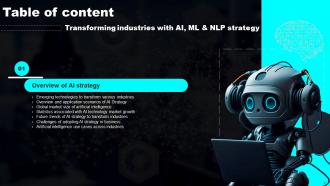
Slide 3: This slide shows Table of Content for the presentation.
Slide 4: This slide shows title for topics that are to be covered next in the template.
Slide 5: This slide covers the latest artificial intelligence technologies to transform and enhance efficiency operational efficiency of various industries.
Slide 6: This slide displays an overview of AI strategy in business to transform various processes. It involves machine learning, natural language processing (NLP) etc.
Slide 7: This slide presents the current market size of AI technology to evolve business processes and enhances operational effectiveness.
Slide 8: This illustrates a brief industry overview of AI market. It includes elements such as CAGR, increase in number of employees working from home etc.
Slide 9: This slide covers future trends of AI capabilities to transform business processes. It involves key trends such as reinforcement learning, chat GPT etc.
Slide 10: This slide presents challenges of AI deployment and adoption in business. It involves key challenges such as company culture, lack of data quality and skilled people.
Slide 11: This slide showcases various use cases of artificial intelligence technology in diverse industries.
Slide 12: This slide shows title for topics that are to be covered next in the template.
Slide 13: This slide covers an overview of machine learning to digitally transform all processes. It involves four types of machine learning.
Slide 14: This slide displays the evolvement of machine learning to enable computers in making decisions without being programmed. It involves the application of ML in various industries.
Slide 15: This slide covers applications of machine learning across various industries. It involves areas such as data-driven insights, medical diagnosis, fintech etc.
Slide 16: This slide presents key drivers of AI adoption and statistics associated with machine learning. It involves increasing amount of embedded AI, competitive push etc.
Slide 17: This slide shows title for topics that are to be covered next in the template.
Slide 18: This slide showcases an overview of NLP- natural language processing along with its key benefits. It includes forecast demand, zero human intervention etc.
Slide 19: This slide depicts the global natural language processing market size from 2019 to 2025, including the application in text classification.
Slide 20: This slide represents the benefits of using NLP in diverse industries to modernize various processes.
Slide 21: This slide shows title for topics that are to be covered next in the template.
Slide 22: This slide covers the role of automation in supply chain and logistics management. It includes major benefits such as lower operating costs, reduced working cost etc.
Slide 23: This slide describes use cases of machine learning to transform supply chain processes. It involves automated quality inspections, real time visibility etc.
Slide 24: This slide covers comparative table for selecting the best warehouse automation tool. It includes strategies such as goods-to-person technology, voice picking, drones, etc.
Slide 25: This slide displayed three steps process for deploying machine learning in supply chain. It involves key steps such as optimize supply chain structure, establish KPIs etc.
Slide 26: This slide presents the use case of incorporating AI technology in manufacturing industry. It includes attributes such as company overview, challenges faced etc.
Slide 27: This slide shows title for topics that are to be covered next in the template.
Slide 28: This slide presents an overview of AI in the healthcare industry to streamline manual operations along with AI initiatives.
Slide 29: This slide mentions the reasons for introducing blockchain in healthcare management practices. It includes reasons such as protecting data, enabling data sharing etc.
Slide 30: This slide presents certain key facts and figures of AI technology integration within the healthcare industry. It covers aspects such as CAGR, revenue share etc.
Slide 31: This slide showcases the post-impact of implementing AI technologies in healthcare operations. It includes technology benefits such as cost reduction, improves treatment etc.
Slide 32: This slide displays integrating AI technology in healthcare industry. It includes attributes such as challenges faced, solutions delivered etc.
Slide 33: This slide shows title for topics that are to be covered next in the template.
Slide 34: This slide covers electronic health record systems to enhance efficiency. It involves key benefits of EHRs such as reduced number of mistakes etc.
Slide 35: This slide displays an evolving market size of health information systems across different countries.
Slide 36: This slide showcases the strategies to implement electronic health records (EHRs). It includes strategies such as integrate reliable EHR system etc.
Slide 37: This slide presents the techniques to implement HIE to improve information management. It includes strategies such as data standardization, secure data exchange etc.
Slide 38: This slide shows title for topics that are to be covered next in the template.
Slide 39: This slide covers implementing a patient portal system to streamline complex healthcare services. It involves key components such as medical procedures and timetables.
Slide 40: This slide showcases various patient portal software along with their key features to select the finest one to use.
Slide 41: This slide depicts the importance of incorporating AI technologies in the efficient management of patient engagement in healthcare systems.
Slide 42: This slide shows title for topics that are to be covered next in the template.
Slide 43: This slide showcases remote patient monitoring system architecture to improve workflow efficiency. It involves key benefits of integrating RPM system.
Slide 44: This slide covers statistics associated with remote patient monitoring devices along with key takeaways.
Slide 45: This slide displays the role of AI in healthcare monitoring devices. It uses include medical records, product development, health monitoring etc.
Slide 46: This slide shows title for topics that are to be covered next in the template.
Slide 47: This slide covers advantages of optimizing natural language processing in financial services such as banking and insurance companies.
Slide 48: This slide displays strategic use of NLP technology in banking, fintech and insurance companies. It involves loan application & fraud detection etc.
Slide 49: This slide covers applications of natural language processing (NLP) in finance sector. It involves use cases such as risk assessment etc.
Slide 50: This slide shows title for topics that are to be covered next in the template.
Slide 51: This slide covers overview to digital transformation of banking industry to enhance financial services. It involves key benefits.
Slide 52: This slide presents deploying AI capabilities to improve banking and financial processes. It involves applications of AI.
Slide 53: This slide covers virtual assistants and chatbots to offer personalized banking services to customers. It involves key features.
Slide 54: This slide presents utilizing wearable devices for making financial transaction and business processes to ease operations.
Slide 55: This slide showcases the post-impact of implementing AI technologies in banking operations. The improved operations include peer to peer payments etc.
Slide 56: This slide displays a case study of banking operations. It includes current challenges in operations along with solutions delivered and impact.
Slide 57: This slide shows title for topics that are to be covered next in the template.
Slide 58: This slide covers overview to how technology is transforming retail industry to enhance customer experience. It involves key features such as contactless ordering.
Slide 59: This slide presents the impact of implementing technology solutions to enhance operational efficiency of retail industry.
Slide 60: This slide covers AI integrated smart packaging system. It provides information about cloud center, datacenter, monitoring center etc.
Slide 61: This slide displays the integrating AI power product recommendation engine to enhance retail sales. It involves product suggestion techniques.
Slide 62: This slide showcases a case study of using artificial intelligence technology in the retail sector. It includes attributes.
Slide 63: This slide shows title for topics that are to be covered next in the template.
Slide 64: This slide covers top AI trends to enhance sales productivity and generate more revenue. It involves CRM platforms, intelligent communication tools etc.
Slide 65: This slide displays key strategies to enhance sales with deploying effective technology in organization. It involves approaches such as track customers with CRM etc.
Slide 66: This slide covers current AI capabilities to enhance marketing campaigns effectiveness and acquire more customers. It involves latest AI trends.
Slide 67: This slide showcases case study analysis in which company uses chatbot tool to optimize their offline and online store operations.
Slide 68: This slide shows title for topics that are to be covered next in the template.
Slide 69: This slide presents the relevance of utilizing AI in Government sector. It includes benefits such as data analysis and insights, fraud detection, smart cities etc.
Slide 70: This slide covers top technology trends to enhance customer service and enhance retention rate. It involves omnichannel support, video chats 7 co browsing and AI chatbots.
Slide 71: This slide showcases the relevance if AI in transforming the field of education. It includes several use cases such as personalized learning, intelligent virtual assistants etc.
Slide 72: This slide presents various use cases of artificial intelligence and machine learning technology in cyber security management.
Slide 73: This slide shows title for topics that are to be covered next in the template.
Slide 74: This slide showcases the cost associated with implementing health information system. It involves solutions such as HMS implementation, electronic health record software etc.
Slide 75: This slide covers the cost analysis of implementing digital banking system AI-driven software's. It involves software such as Ayasdi, Arago, Callsign, Cloudwalk etc.
Slide 76: This slide showcases the comparative analysis of supply chain AI-driven tools to improve process efficiency.
Slide 77: This slide shows title for topics that are to be covered next in the template.
Slide 78: This slide covers the KPI dashboard to analyze improved performance after implementing health information technology system in organization.
Slide 79: This slide displays the KPI dashboard to analyze supplier quality by leveraging machine learning. It involves details such as suppliers with most and least complaints etc.
Slide 80: This slide depicts a performance dashboard to track manufacturing operations, including production volume, order volume, active machines, sales revenue etc.
Slide 81: This slide highlights the estimated growth of banking operations which includes average savings account balance, transaction activity rate etc.
Slide 82: This slide shows all the icons included in the presentation.
Slide 83: This slide is titled as Additional Slides for moving forward.
Slide 84: This is a Quotes slide to convey message, beliefs etc.
Slide 85: This slide contains Puzzle with related icons and text.
Slide 86: This is Our Goal slide. State your firm's goals here.
Slide 87: This is Our Vision, Mission & Goal slide.
Slide 88: This is an Idea Generation slide to state a new idea or highlight information, specifications etc.
Slide 89: This slide depicts Venn diagram with text boxes.
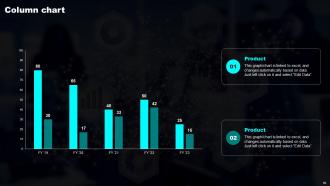
Slide 90: This slide displays Column Graph with two products comparison.
Slide 91: This is a Thank You slide with address, contact numbers and email address.
Transforming Industries With AI ML And NLP Strategy Powerpoint Presentation Slides with all 99 slides:
Use our Transforming Industries With AI ML And NLP Strategy Powerpoint Presentation Slides to effectively help you save your valuable time. They are readymade to fit into any presentation structure.













FAQs for Transforming Industries With AI ML And NLP Strategy
So AI is basically the big umbrella term - anything that tries to copy how humans think, like those recommendation algorithms or chatbots. Machine learning falls under that, but it's more specific. ML learns from data to make predictions without you having to code every single scenario (which honestly sounds exhausting). NLP is where it gets interesting though - it's a type of ML that handles language stuff. Translation, voice assistants, figuring out if a review is positive or negative. The boundaries get pretty messy in real projects, but here's how I think about it: AI for big picture planning, ML when you've got data to work with, NLP for anything involving text or speech.
AI is seriously changing healthcare and finance right now. Doctors are using it to spot diseases in scans faster than humans can, and it predicts when patients might get worse. Drug discovery is way quicker too. Finance? Pretty much everything on Wall Street uses some kind of machine learning now - fraud detection, trading algorithms, credit scores. The whole thing is wild honestly. Both fields can crunch massive amounts of data to make predictions that used to be impossible. If you're working in either area, you should probably start learning some basic ML stuff because it's becoming pretty essential.
So NLP is what makes chatbots actually get what customers mean instead of just keyword hunting. When someone says "can't log in" vs "trouble accessing account," it knows they're the same issue - pretty neat stuff. The sentiment analysis catches when people are getting pissed off too, so it can bump them to a real person. Plus it remembers context so customers don't have to keep repeating themselves (thank god). Oh, and start with your most common questions first - you'll see way better accuracy there. Makes the whole thing feel less robotic honestly.
So there's actually a bunch of stuff you can do with ML for predictions. Customer churn, demand forecasting, fraud detection - that kind of thing. Basically the algorithms dig through your old data looking for patterns, then make predictions about what's coming next. Some of these models get crazy accurate once you throw enough good data at them. I'd probably start with regression for number predictions or classification for yes/no stuff. Oh, and pick something that'll actually move the needle profit-wise - don't waste time on vanity metrics. Clean data is huge though, garbage in garbage out situation.
Honestly, you can't just slap privacy controls on later - build them in from the start. Figure out what personal data you actually need and why. Get real consent, not that sneaky fine-print stuff. Your models will develop bias if you're not actively checking (I've seen this mess up projects big time). People deserve to know how your AI is making decisions about them - transparency isn't optional. Set up some kind of ethics committee to spot problems early. Oh, and document everything properly for audits.
Honestly, data quality issues are gonna be your worst enemy. Plus your old systems probably hate each other - integration becomes this whole mess when nothing was built for ML. Model drift is annoying too - your accuracy just slowly tanks as data changes. Oh and scaling from prototype to production? Way harder than anyone tells you. Start with one tiny use case first. Get your data pipelines working before you do anything fancy. Also have a rollback plan ready because stuff *will* break at 2am somehow.
So NLP basically teaches computers to understand the emotions behind what people write - like whether someone's happy, pissed off, or just meh about something. It looks at word choices and context to figure out the mood. Companies use it everywhere now: tracking what people say about their brand on social media, sorting through customer reviews, that kind of stuff. Oh, and it's getting weirdly good at catching sarcasm too. Honestly, I'd start by running it on your own customer feedback - you'll probably spot trends you totally missed before.
Start with good, diverse data that matches what you'll actually use the model for. Tokenization and cleaning are boring but necessary. Honestly, just use BERT or another pre-trained model as your base - training from scratch is usually a waste of time. Split your data right for validation and tune hyperparameters systematically. Watch out for overfitting though. Oh, and test on real examples from your actual use case before you deploy anything. That last part will save you headaches later.
Look, AI's basically created this weird split in tech jobs right now. Machine learning engineers and data scientists are making insane money - like, genuinely crazy salaries. But here's the thing: even regular dev work is shifting. Frontend roles? You're probably dealing with AI integrations now. QA teams are using AI testing tools left and right. Honestly, you don't need to panic and become some AI wizard tomorrow. Just start playing around with AI tools in whatever you're doing now. I've been doing that myself and it's actually pretty fun once you get into it. Stay curious, mess around with stuff, and you'll be fine.
Honestly, the main headaches are gonna be data issues and explainability. Your model's only as smart as what you fed it, and training data is usually messy or biased somehow. Black box problem is real too - try explaining to your boss why the AI picked option A over B. Good luck with that! Computational costs will destroy your budget faster than you think. I learned that one the hard way. Models also completely fall apart when they see something new. Always keep humans in the loop and seriously, triple your compute budget estimate.
So explainable AI is basically letting people see why your model decided something. Like, if it's denying loans or flagging resumes, users need actual reasons - not just "computer says no." People won't trust a black box, honestly. Plus regulations are cracking down on this stuff anyway. Here's the thing though - build transparency in from the start. I've seen teams try to add explainability later and it's such a pain. Way easier to design for it upfront than retrofit the whole thing.
Honestly, data diversity makes or breaks ML models. I've watched perfectly good algorithms crash and burn in production because they only saw one type of data during training. Your model needs exposure to different demographics, edge cases, weird scenarios - basically all the messy stuff it'll encounter in the real world. Otherwise it just memorizes narrow patterns instead of actually learning. More diverse data = way better predictions across different user groups. Oh, and definitely check your datasets for gaps before you start training. Trust me on this one - homogeneous data is a recipe for disaster.
Look, you gotta measure the obvious stuff first - cost savings, revenue bumps, how much faster things get done. But honestly? The best benefits usually pop up where you least expect them. I'd track the softer stuff too like customer happiness and how quickly your team makes decisions. Get your baseline numbers locked down before you flip the switch, then check back at 3, 6, and 12 months. Don't freak out if month two looks meh - most AI projects need at least six months before they really start paying off. Sometimes longer if we're being real about it.
Multimodal AI is gonna explode - think systems that handle text, voice, images, video all at once. GPT-4V already does this pretty well. Conversational AI will remember way longer chats and actually get your tone. The progress right now is honestly insane. Real-time language processing becomes the norm, plus we'll see more industry-specific models instead of generic ones. Oh, and here's the big thing - AI stops being just another tool. It'll start jumping in to help before you even ask. My advice? Start messing around with multimodal tools now so you're not scrambling later.
Dude, just start with the cheap cloud stuff - ChatGPT, Zapier, Google's AI tools. Way better than building something from scratch. Chatbots can handle customer questions, AI schedules your social posts, basic data crunching gets done without hiring anyone. Tbh most "AI solutions" are just dressed-up versions of tools that already exist anyway. Don't try fixing everything at once though. Pick one annoying task that's eating your time. Most small businesses start seeing returns in like 3-6 months just from cutting out repetitive BS. Seriously, pick something this week and see what's out there.
-
Wide collection of templates available. SlideTeam has made it easier to create presentations in just a few minutes.
-
Informative presentations that are easily editable.