

Transportation Business Plan Powerpoint Presentation Slides BP





Try Before you Buy Download Free Sample Product
 Impress Your
 Audience
 100%
100% Editable
 Save Hours
 of Time


Check out our professionally designed Transportation Business Plan PPT, an informative business plan presentation to provide detailed insight into the event planning industry. This Transportation Industry PowerPoint lists all the essential elements, including market research, industry trends, growth revenue drivers, target market, competitive landscape, etc. In addition, the Freight Services presentation also includes Porters framework and its impact on the event industry, market gap and opportunities, go-to marketing strategy, sales funnel, etc. Furthermore, the Charter Bus Services Template gives users an insight into the financial aspect the event planning business plan also portrays a financial summary section in which a detailed 5-year analysis has been executed considering the market scenarios. Lastly, the Transportation Industry PowerPoint presentation covers the revenue model, profit and loss statement, cash flow statement, break-even analysis, DCF valuation, balance sheet, etc. Download the detailed event planning start-up b-plan ppt now.
People who downloaded this PowerPoint presentation also viewed the following :
Content of this Powerpoint Presentation
Slide 1: The slide introduces Transportation Business Plan. State Your company name Here.
Slide 2: This is an Agenda slide. State your agendas here.
Slide 3: The slide displays Table of contents for the presentation.
Slide 4: The slide renders Title of contents further.
Slide 5: The slide continues Table of contents.
Slide 6: This slide provides a quick overview of services the company will be providing to customers.
Slide 7: This slide summarizes the mission and vision of the company.
Slide 8: The purpose of the slide is to portray start-up details including name, incorporation date, web address, start-up investment, services etc.
Slide 9: This slide represents the strategic and operational objectives of a transportation business.
Slide 10: This slide’s highlights market inefficiencies in the transportation industry.
Slide 11: This slide illustrates the advantages that the business offers its consumers or customers in the form of top-notch services.
Slide 12: This slide showcases the crucial transportation business success criteria that provide them a competitive edge in the industry.
Slide 13: This slide represents a prime business site for launching a transport company with the least amount of failure risk.
Slide 14: The slide renders Title of contents further.
Slide 15: This slide covers a thorough assessment of the transportation industry in addition to its market trends.
Slide 16: This slide continues a thorough assessment of the transportation industry in addition to its market trends.
Slide 17: This slide depicts a thorough assessment of the transportation industry in addition to its market trends further.
Slide 18: This slide renders another thorough assessment of the transportation industry in addition to its market trends.
Slide 19: This slide again shows a thorough assessment of the transportation services industry in addition to its market trends.
Slide 20: This slide covers a thorough assessment of the freight and logistics industry in addition to its market trends further.
Slide 21: This slide also renders a thorough assessment of the charter bus services industry in addition to its market trends.
Slide 22: This slide continues a thorough assessment of the charter bus services industry in addition to its market trends.
Slide 23: This slide illustrates a guide to stakeholders about the constraints witnessed by the industry.
Slide 24: This slide covers numerous growth factors that have contributed to the company's success in terms of technological advancements, growing global trade, etc.
Slide 25: The slide renders Title of contents further.
Slide 26: This slide provides an evaluation of how the company's services will fit into a certain market and where they will find the most buyers.
Slide 27: This slide continues an evaluation of how the company's services will fit into a certain market and where they will find the most buyers.
Slide 28: This slide presents an evaluation of how the company's services will fit into a certain market and where they will find the most buyers further.
Slide 29: This slide's goal is to illustrate the market potential for the transportation sector in terms of TAM, SAM, and SOM.
Slide 30: The slide depicts Title of contents further.
Slide 31: This slide's goal is to give a quick peek of some of the top rivals in the market to learn more about their goods, services, marketing strategies, and sales.
Slide 32: This slide's goal is to highlight the features of the top rivals in the market.
Slide 33: The slide depicts Title of contents further.
Slide 34: The study of the transportation start-up's strengths, weaknesses, opportunities, and threats is presented on the slide.
Slide 35: The slide depicts Title of contents further.
Slide 36: The slide highlights Porter framework and its effects on the transportation sector
Slide 37: The slide renders Title of contents further.
Slide 38: This slide outlines a successful go-to-market strategy for delivering transportation services to customers.
Slide 39: This slide continues a successful go-to-market strategy for delivering transportation services to customers.
Slide 40: This slide outlines pricing strategies for freight and charter bus services provided to the target audience.
Slide 41: This slide emphasizes customer journey to monitor user behavior and significant touch points at several levels.
Slide 42: The slide renders Title of contents which is to be discussed further.
Slide 43: This slide is intended to make it easier for project managers to update stakeholders on project statuses and obtain their transportation approvals.
Slide 44: The slide displays Title of contents which is to be discussed further.
Slide 45: This slide gives a brief overview of several crucial financial presumptions that must be made.
Slide 46: The slide presents the transportation industry's practical revenue model, which lists the costs incurred as well as the numerous revenue streams.
Slide 47: The slide highlights the company's break-even analysis.
Slide 48: The slide renders the company's break-even analysis in a graphical representation.
Slide 49: The slides give a brief view of the expected profit and loss statement to show the company's financial performance over the following five years.
Slide 50: The slides conmtinues the expected profit and loss statement to show the company's financial performance over the following five years.
Slide 51: The slides highlight the cash flow statement of the company.
Slide 52: The slides continues the cash flow statement of the company.
Slide 53: The slides provide a picture of the business's financial situation at a particular point in time.
Slide 54: The slides continues a picture of the business's financial situation at a particular point in time.
Slide 55: This slide covers the affect of probable future events on the performance of the transportation start-up.
Slide 56: This slide is used to determine how much money an investor would receive from a certain investment after accounting for time value of money.
Slide 57: The slide displays Title of contents further.
Slide 58: The goal of this slide is to create a functional hierarchical framework for the company to guarantee efficient operations.
Slide 59: The slide emphasizes the important work duties and obligations of the personnel.
Slide 60: The slide continues to emphasize the important work duties and obligations of the personnel in order to guarantee operational effectiveness and efficiency.
Slide 61: The slide describes Title of contents further.
Slide 62: The slide shows the stakeholder exit alternatives, including IPOs, mergers, acquisitions, private offerings, and employee stock ownership plan.
Slide 63: The slide depicts Title of contents.
Slide 64: The purpose of this slide is to highlight the shorter version of existing words to save time and take up less space.
Slide 65: This slide shows all the icons included in the presentation.
Slide 66: This slide is titled as Additional Slides for moving forward.
Slide 67: This slide shows Post It Notes. Post your important notes here.
Slide 68: This is Our Target slide. State your targets here.
Slide 69: This is a Timeline slide. Show data related to time intervals here.
Slide 70: This slide presents Roadmap with additional textboxes.
Slide 71: This slide depicts Venn diagram with text boxes.
Slide 72: This is a Thank You slide with address, contact numbers and email address.
Transportation Business Plan Powerpoint Presentation Slides BP with all 80 slides:
Use our Transportation Business Plan Powerpoint Presentation Slides BP to effectively help you save your valuable time. They are readymade to fit into any presentation structure.
-

Transportation Business Plan
-
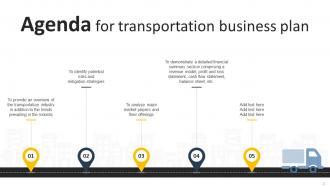
Agenda for transportation business plan
-
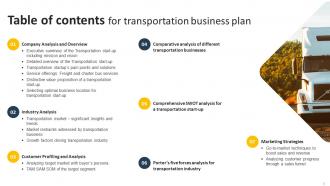
Table of contents for transportation business plan
-
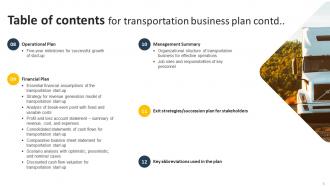
Table of contents for transportation business plan contd
-
Transportation Business Plan Bp
-
Transportation Business Plan Bp
-
Transportation Business Plan Bp
-
Transportation Business Plan Bp
-
Transportation Business Plan Bp
-
Transportation Business Plan Bp
-
Transportation Business Plan Bp
-
Transportation Business Plan Bp
-
Transportation Business Plan Bp
-
Transportation Business Plan Bp
-
Transportation Business Plan Bp
-
Transportation Business Plan Bp
-
Transportation Business Plan Bp
-
Transportation Business Plan Bp
-
Transportation Business Plan Bp
-
Transportation Business Plan Bp
-
Transportation Business Plan Bp
-
Transportation Business Plan Bp
-
Transportation Business Plan Bp
-
Transportation Business Plan Bp
-
Transportation Business Plan Bp
-
Transportation Business Plan Bp
-
Transportation Business Plan Bp
-
Transportation Business Plan Bp
-
Transportation Business Plan Bp
-
Transportation Business Plan Bp
-
Transportation Business Plan Bp
-
Transportation Business Plan Bp
-
Transportation Business Plan Bp
-
Transportation Business Plan Bp
-
Transportation Business Plan Bp
-
Transportation Business Plan Bp
-
Transportation Business Plan Bp
-
Transportation Business Plan Bp
-
Transportation Business Plan Bp
-
Transportation Business Plan Bp
-
Transportation Business Plan Bp
-
Transportation Business Plan Bp
-
Transportation Business Plan Bp
-
Transportation Business Plan Bp
-
Transportation Business Plan Bp
-
Transportation Business Plan Bp
-
Transportation Business Plan Bp
-
Transportation Business Plan Bp
-
Transportation Business Plan Bp
-
Transportation Business Plan Bp
-
Transportation Business Plan Bp
-
Transportation Business Plan Bp
-
Transportation Business Plan Bp
-
Transportation Business Plan Bp
-
Transportation Business Plan Bp
-
Transportation Business Plan Bp
-
Transportation Business Plan Bp
-
Transportation Business Plan Bp
-
Transportation Business Plan Bp
-
Transportation Business Plan Bp
-
Transportation Business Plan Bp
-
Transportation Business Plan Bp
-
Transportation Business Plan Bp
-
Transportation Business Plan Bp
-
Transportation Business Plan Bp
-
Transportation Business Plan Bp
-
Transportation Business Plan Bp
-
Transportation Business Plan Bp
-
Transportation Business Plan Bp
-
Transportation Business Plan Bp
-
Transportation Business Plan Bp
-
Transportation Business Plan Bp
-

-

-

-

-

-

-

-

FAQs for Transportation Business Plan Powerpoint
Okay so you'll need the standard stuff - executive summary, market analysis, financials, operations. But honestly, the route planning and service area mapping is where most people mess up. Get super specific about your fleet needs too - vehicles, maintenance schedules, insurance (which gets pricey fast). Pricing strategy matters more than you think. Oh and compliance is huge in transportation, like way more paperwork than other industries. Your biggest costs will be fuel, driver pay, and depreciation eating your margins. I'd actually start backwards - figure out what customers need in your area first, then see who you're up against.
Look, market trends totally dictate how transportation businesses succeed or fail. Fuel prices, new regulations, whether people want electric vehicles - it all matters. Your business plan needs to show you get this stuff. Analyze what's happening now (like everyone expecting same-day delivery, which honestly is getting ridiculous). Show investors how you'll adapt when automation hits or gas prices spike again. Include different scenarios because who knows what'll happen next year? Update your revenue numbers based on actual market data, not wishful thinking. Keep refreshing your market analysis section - trends change fast and you don't want to look outdated.
Fuel costs are killing everyone right now, plus finding drivers is nearly impossible. Then you've got all these new emissions rules and safety requirements to deal with. Apps like Uber Freight are eating into business while customers expect Amazon-level service – real-time tracking, cheap prices, fast delivery. Supply chain stuff is still messy too. Oh, and don't even get me started on trying to upgrade your tech systems while everything else is on fire. My take? Pick maybe two big problems and actually fix them instead of juggling everything at once. You'll just burn out otherwise.
Honestly, just pick tech that fixes your actual headaches. Fleet tracking if you're always wondering where your drivers are. Route optimization when fuel costs are killing you. Mobile booking apps if customers keep calling instead of booking online - super annoying for everyone. Don't get sucked into whatever's trending on LinkedIn right now. Map out what's genuinely broken first, then find solutions. Factor in what it'll cost and how long training takes. ROI matters obviously. Stick to maybe 2-3 things max. You'll go crazy trying to digitize everything at once.
You'll want revenue projections, operating expenses, cash flow, and break-even analysis for 3-5 years. Factor in fleet utilization rates, pricing per mile, seasonal changes - that stuff matters more than you'd think. Operating costs will kill you though - fuel, maintenance, insurance, driver wages, vehicle depreciation. These eat up most margins in transportation. Don't forget startup capital since trucks are expensive upfront. Build three scenarios: conservative, realistic, optimistic. Shows how fuel price swings or demand changes hit your bottom line. Honestly, the multiple scenarios saved my cousin when diesel spiked last year.
Honestly, there's a ton to cover here. You'll need commercial licenses and operating permits first. Insurance is huge - liability, cargo, workers' comp if you hire people. DOT regs kick in for interstate stuff, plus all the vehicle safety requirements. Environmental rules are getting tighter too, which is kind of a pain. Don't forget zoning laws if you're planning a depot somewhere. Labor regulations matter once you start bringing on drivers. My biggest advice? Talk to a transportation lawyer early on because this stuff varies wildly depending where you are and what exactly you're doing.
Honestly, just start by checking out their websites and social media - you'll learn a ton about pricing and what routes they cover. Mystery shopping is where it gets interesting though. Actually use their services if you can swing it, because online reviews only tell you so much. Check how big their fleets are, what hours they run, any weird special services they offer. Oh and don't skip the local business directories or transportation apps - sometimes smaller competitors hide there. Once you've got all this info, throw it into a basic spreadsheet. Makes it way easier to spot where nobody's really competing well.
Honestly, sustainability isn't just some trendy thing anymore - it's actually giving companies a real edge. Customers want greener options, investors are demanding it, and regulations keep tightening up. Electric trucks, better route planning, carbon credits... this stuff directly impacts your profits now. Fuel prices are nuts these days too, so a lot of efficiency upgrades basically pay for themselves. My advice? Pick one thing you can actually track and improve on first. Don't try to revolutionize everything at once - that's how you burn through cash without seeing results. Build momentum with small wins.
Dude, marketing can totally make or break you in transportation - it's crazy competitive. First thing though, figure out your niche. Local delivery? Long-haul? That changes everything. Google "freight companies near me" and you'll see what I mean about SEO being huge. LinkedIn's solid for B2B stuff, and Google Ads give you instant visibility. But honestly? The real money comes from relationships. Partner up with manufacturers or logistics brokers - way more consistent than random leads. Oh, and don't ignore local networking events. They're kinda boring but actually work.
Get route optimization software first - it'll cut your fuel costs big time. Peak demand planning is crucial, so build in some buffer capacity. I learned this the hard way, but don't overcommit your drivers and actually schedule realistic break times. Track your on-time delivery rates religiously. Map maintenance schedules early so trucks don't die on you during rush periods. Honestly? Having backup plans for critical routes is what separates the pros from everyone else. Vehicle utilization metrics matter too, but focus on the basics first.
Honestly, don't just slap customer service on at the end - it needs to be part of everything you do. Keep people in the loop with real-time updates about delays and arrival times. That communication stuff can seriously make or break you. Set up multiple ways to reach customers - apps, texts, phone support. Your drivers matter too since they're basically the face of your company most of the time. Oh and map out every single touchpoint where customers interact with you, then figure out how to make those moments less annoying. Mobile notifications are clutch for this.
Alright so funding options - you've got a few decent paths here. Bank loans are solid if your credit's good and you have collateral. SBA loans give you better rates but they're slow as hell to process. Equipment financing is probably your best bet though since the vehicles themselves become collateral. Angel investors are actually getting pretty into logistics startups these days, especially if there's any tech angle. Once you start landing contracts, factoring can give you quick cash but it's expensive. Oh and don't sleep on VCs - they're way more open to transportation plays than they used to be. Honestly I'd figure out your exact funding timeline first, then work backwards from there.
Don't skip the risk management section - seriously, I've watched startups crash because they ignored this stuff. Cover your driver training, vehicle maintenance schedules, and all your insurance details. Safety procedures and emergency plans too. What happens when someone gets in an accident or a truck breaks down? Background checks for drivers are huge. Honestly, hiring criteria might be boring to write about, but investors and regulators eat this up. They want proof you've actually thought about the messy scenarios before they happen, not after.
Look, you'll want to watch both the money stuff and how things actually run day-to-day. Track your on-time deliveries, fuel costs, how much your trucks are actually being used - that kind of operational stuff. Then obviously profit margins, cost per mile, what each shipment brings in. Customer satisfaction matters too since you need repeat clients. Honestly though? Start small. Pick maybe 3 metrics max that directly hit your wallet and obsess over those first. I made the mistake of tracking everything once and just got buried in spreadsheets. Way better to nail the basics before adding more.
Dude, partnerships are a game-changer for transportation businesses. You can team up with logistics companies for warehousing or tech firms for fleet software. Even working with competitors on shared routes makes sense sometimes. I know a guy who joined a fuel purchasing co-op and cut costs by 30% - honestly blew my mind when he told me. The whole point is offering bigger services without dropping crazy money upfront. Plus you'll tap into their customers and know-how. Just figure out what you're missing first, then find companies that fill those gaps.
-
Innovative and creative templates with high-quality designs. Helped me with my presentation as the slides were easy to edit.
-
The templates you provide are great! They have saved me tons of time and made my presentations come alive. Thank you for this awesome product. Keep up the good work!