

Trucking Business Plan Powerpoint Presentation Slides





Try Before you Buy Download Free Sample Product
 Impress Your
Audience
 100%
Editable
 Save Hours
of Time


The business plan track guides you through making the right educated guesses for every area of your business. Grab our insightfully designed Trucking Business Plan template. It contains detailed information on industry statistics, growth drivers, market trends, key restraints, and lucrative opportunities. Our Freight Trucking Market includes sections for entity details, target market, company summary, products and services offered, mission and vision, milestones, and so on. Furthermore, it exhibits an industry analysis section that includes in depth research on the trucking market. Additionally, our Truck trailer PPT showcases essential topics such as Porters framework, go to marketing strategy, and competitive landscape. Further, it covers a financial summary section, including a revenue model, economic impact, profit and loss statement, break-even analysis, etc. Download this 100 percentage editable presentation and get access to our highly researched and skillfully designed product.
People who downloaded this PowerPoint presentation also viewed the following :
Content of this Powerpoint Presentation
Slide 1: This slide introduces Trucking Business Plan. Commence by stating Your company name.
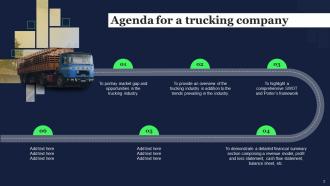
Slide 2: This slide depicts the Agenda of the presentation.
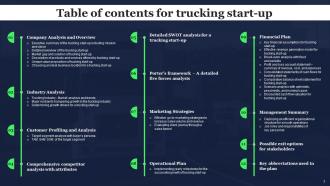
Slide 3: This slide incorporates the Table of contents.
Slide 4: This slide highlights the Title for the Topics to be covered further.
Slide 5: This slide shows the Executive summary of the trucking start-up including mission and vision.
Slide 6: This slide presents the Detailed overview of the trucking start-up.
Slide 7: This slide portrays the Market gap and solution of a trucking start-up.
Slide 8: This slide elucidates the Description of products and services offered by trucking start-up.
Slide 9: This slide talks about the Unique value proposition of trucking start-up.
Slide 10: This slide deals with Choosing an ideal business location.
Slide 11: This slide elucidates the Heading for the Components to be discussed next.
Slide 12: The purpose of this slide is to conduct a thorough assessment of the trucking industry in addition to its market trends.
Slide 13: This slide is used to conduct a thorough assessment of the trucking industry in addition to its market trends.
Slide 14: This slide conducts a thorough assessment of the trucking industry in addition to its market trends.
Slide 15: This slide elucidates the Major restraints hampering growth in the trucking industry.
Slide 16: This slide focuses on Determining growth drivers for a trucking start-up.
Slide 17: This slide portrays the Title for the Topics to be covered in the following template.
Slide 18: This slide reveals the Target segment analysis with buyer’s persona.
Slide 19: This slide continues the Target segment analysis with buyer’s persona.
Slide 20: This slide highlights the TAM SAM SOM of the target segment.
Slide 21: This slide showcases the Heading for the Contents to be discussed next.
Slide 22: This slide gives a glimpse of Comprehensive competitor analysis with attributes.
Slide 23: This slide displays the Comprehensive competitor analysis with attributes.
Slide 24: This slide mentions the Title for the Ideas to be covered in the upcoming template.
Slide 25: This slide covers the Detailed SWOT analysis for a trucking start-up.
Slide 26: This slide presents the Heading for the Ideas to be discussed further.
Slide 27: The slide highlights porter’s framework and its implications in the trucking industry..
Slide 28: This slide depicts the Title for the Components to be covered in the following template.
Slide 29: This slide deals with Effective go-to-marketing strategies to increase sales volume and revenue.
Slide 30: This slide focuses on Effective go-to-marketing strategies to increase sales volume and revenue.
Slide 31: This is yet another slide continuing the Effective go-to-marketing strategies to increase sales volume and revenue.
Slide 32: This slide talks about Evaluating client journey through a sales funnel.
Slide 33: This slide elucidates the Heading for the Topics to be discussed further.
Slide 34: This slide emphasizes on Implementing yearly milestones for successful growth of start-up.
Slide 35: This slide displays the Title for the Topics to be covered in the following template.
Slide 36: This slide provides a glimpse of important financial assumptions that are to be made while setting up the firm.
Slide 37: This slide shows the effective revenue model of the trucking start-up.
Slide 38: This slide highlights the break-even analysis of the firm.
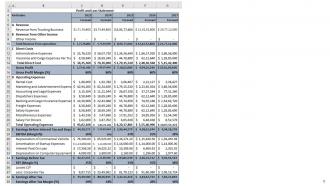
Slide 39: This slide provides a glimpse of the projected profit and loss statement.
Slide 40: This slide showcases the projected profit and loss statement.
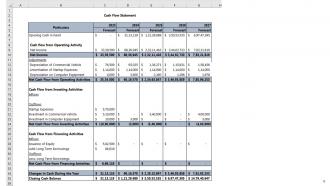
Slide 41: This slide states the Consolidated statements of cash flow of the trucking start-up.
Slide 42: This slide continues the Consolidated statements of cash flow of the trucking start-up.
Slide 43: This slide elucidates the Comparative balance sheet statement of the trucking start-up.
Slide 44: This is yet another slide continuing the Comparative balance sheet statement of the trucking start-up.
Slide 45: This slide reveals the Scenario analysis with optimistic, pessimistic, and nominal cases.
Slide 46: This slide continues the Scenario analysis with optimistic, pessimistic, and nominal cases.
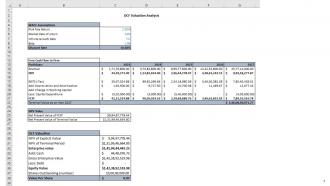
Slide 47: This slide displays the Discounted cash flow valuation of the trucking start-up.
Slide 48: This slide shows the Heading for the Components to be discussed next.
Slide 49: This slide deals with Deploying an efficient organizational structure for smooth operations.
Slide 50: This slide exhibits the Job roles and responsibilities of key personnel.
Slide 51: This slide continues the Job roles and responsibilities of key personnel.
Slide 52: This slide includes the Title for the Ideas to be covered in the following template.
Slide 53: This slide represents the exit strategy for stakeholders.
Slide 54: This slide reveals the Heading for the Ideas to be discussed next.
Slide 55: This slide shows the Key abbreviations used in the plan.
Slide 56: This is the Icons slide containing all the Icons used in the plan.
Slide 57: This slide is used for depicting some Additional information.
Slide 58: This slide incorporates the organization's Mission and Vision.
Slide 59: This slide displays the Column chart.
Slide 60: This is the Idea generation slide for encouraging innovative ideas.
Slide 61: This slide represents the firm's Roadmap.
Slide 62: This is the 30 60 90 days plan slide for effective planning.
Slide 63: This slide reveals the company Timeline.
Slide 64: This is the Thank you slide for acknowledgement.
Trucking Business Plan Powerpoint Presentation Slides with all 69 slides:
Use our Trucking Business Plan Powerpoint Presentation Slides to effectively help you save your valuable time. They are readymade to fit into any presentation structure.































































FAQs for Trucking Business Plan
So for your trucking business plan, hit the basics first - executive summary, market analysis, financial projections. Don't forget the regulatory stuff though, that's where people mess up. You need all your DOT requirements, licensing, insurance costs laid out. Services section should cover what you're hauling and who you're targeting. Honestly, the numbers are everything in trucking since margins are so tight. Include your startup costs, operating expenses, revenue forecasts - be super realistic about cash flow because it always takes longer than you think. Oh, and competitive analysis plus operational details like equipment and routes. The compliance section isn't sexy but it's critical.
Look, market analysis tells you where the real money is. You'll figure out which routes are actually in demand and what rates other truckers are getting. Plus you can find those sweet underserved niches nobody's thinking about. Honestly, you don't want to be competing with like 50 other drivers for scraps - been there, not fun. The data helps you make actual smart choices about what equipment to buy and how to price your services instead of just winging it. Start by checking freight volumes in areas you want to work, then you can build realistic projections from there.
Start with your revenue projections - figure out expected loads and rates first. Then pile on all the expenses: fuel, insurance, maintenance, driver wages, truck payments, permits. Cash flow statements will save your butt because trucking's so unpredictable. One month you're killing it, next month you're scrambling. Your break-even analysis needs to nail down exactly how many miles per month keep you afloat. Build in cushion for fuel spikes and seasonal slowdowns - trust me on this one. Oh, and always expect something expensive to break when you can least afford it.
First thing - figure out your actual costs per mile. Fuel, maintenance, insurance, driver wages, all that stuff. Then slap your profit margin on top. Most truckers I know shoot for 15-20% profit, but honestly depends on how much risk you can stomach. Check what competitors charge for similar routes, just don't copy them word for word. Your reliability or specialized equipment might justify higher rates. Oh and test different pricing with a handful of clients first - see what they'll actually pay versus what you think they should pay. Way better to start low and work your way up than price yourself out completely.
Dude, the paperwork is insane but here's what you absolutely need: DOT number and MC authority from FMCSA first - can't do interstate without those. Then grab your Unified Carrier Registration and whatever state permits apply to you. IFTA handles fuel tax stuff across states. Heavy Vehicle Use Tax catches everyone off guard too. Insurance minimums are brutal depending on your state - liability coverage isn't cheap. Oh, and budget way more than you think for all this compliance stuff. It honestly becomes second nature after a while, but those first few months? Total headache. Start early on the applications because everything takes forever.
Dude, tech can totally change your trucking game. GPS routing software saves you tons on fuel and gets deliveries done faster. Fleet management systems track everything - maintenance schedules, driver hours, compliance stuff. Since you're stuck with ELDs anyway, might as well use that data, right? Load matching apps are clutch for connecting with shippers directly. Less empty miles = more money. The digital freight platforms handle all that annoying paperwork too, which honestly saves so much time. I'd pick whatever fixes your biggest headache first, then add more systems later.
Look, branding is basically your reputation rolling down the highway. Shippers will literally judge you by whether your trucks look professional or sketchy - I've seen it happen. Clean, consistent visuals across everything (trucks, website, cards) show you're reliable and worth trusting. Good branding means you can charge better rates instead of always competing on price. Plus clients start referring you to others when you look legit. It's way cheaper than a race to the bottom on pricing, trust me.
Track your fuel costs obsessively - that's your biggest expense and it swings wildly. GPS route software will save you tons. Keep those trucks maintained too because roadside repairs? Absolute nightmare for your wallet. I'd negotiate better rates with your regular clients and keep crazy detailed records so you catch cost creep fast. Fuel cards help with discounts and tracking. Every single mile counts in this business, seriously. Oh, and audit your last three months first - you'll probably find money leaking somewhere stupid.
Pay and benefits are your starting point - can't skip that part. Get some decent trucks too because broken-down equipment = angry drivers who quit. I'd hit up driving schools for recruiting, maybe set up referral bonuses. Social media works better than you'd expect for finding drivers these days. Home time flexibility is huge if you can swing it. Honestly, just checking in with your current guys regularly makes a bigger difference than most owners realize. They don't want to feel invisible. Oh, and create some kind of advancement path - even small promotions help. Start with one recruiting method and expand from there.
Look, first thing - figure out what could really hurt you. Accidents, breakdowns, losing drivers, fuel going crazy, new regulations. Insurance is a no-brainer but get good coverage, not just whatever's cheapest. I'd also stash some cash for repairs and build relationships with other carriers who can help when you're in a bind. Don't put all your eggs in one customer basket either - learned that one the hard way. Write this stuff down somewhere and actually look at it every few months. Sounds boring but it's what keeps you from being another casualty story.
Dude, logistics literally runs your whole trucking game. Routes, timing, what loads you can even grab - it all flows from supply chain stuff. Remember when COVID hit? Demand went absolutely nuts in random places while normal routes just vanished. You've gotta roll with those changes and figure out where you fit in the bigger picture. Building good relationships with shippers is huge - those connections will save your ass when things get weird. Companies that last are the flexible ones. I'd honestly start figuring out your key partners right now before you really need them.
Look, fuel efficiency and route optimization are your bread and butter here. Get some decent route planning software - you'll cut fuel costs by 15% easy with proper driver training too. Electric trucks? Still pricey upfront but worth considering for short hauls. Find clients who actually care about green logistics since they'll pay more. Keep your maintenance game tight so trucks run smooth. Telematics will show you real numbers instead of guessing. Set actual deadlines and targets you can measure - otherwise you're just throwing money around hoping something sticks. The ROI tracking part honestly makes or breaks these sustainability investments.
Dude, you've gotta stay on top of preventive maintenance - oil changes, tire rotations, brake checks, all of it. Track everything religiously or you'll hate yourself later. Get a decent fleet management system to watch fuel efficiency and how your drivers are actually driving (some of them are... interesting). The paperwork is honestly the worst part, but keep those maintenance records spotless for DOT audits. Make sure drivers do their pre-trip inspections daily. Oh, and base your maintenance schedules on mileage plus whatever the manufacturer says. Trust me on this one.
Dude, most trucking companies are trash at customer service - they just move stuff and disappear. That's your opening right there. Answer your damn phone when people call, send updates without them having to ask, and actually respond fast when there's an issue. Seriously, the bar is so low it's underground. Simple stuff like confirming pickup times and giving real ETAs will make you look amazing compared to everyone else. Oh, and follow up after deliveries - nobody does that. Set up a basic system for staying in touch throughout each shipment and you'll crush it.
Focus on revenue per mile and profit margins first - that's how you know if you're actually making money or just spinning wheels. Fuel efficiency and on-time deliveries matter a ton too since they hit your profits directly. Driver retention is probably more important than people realize (turnover costs are insane). Also watch your deadhead miles and maintenance costs. Cash flow tracking is obvious but worth mentioning. Honestly, I'd start with maybe 3-4 of these that you can actually keep up with each month, then add more once you've got a rhythm going.
-
Designs have enough space to add content.
-
Topic best represented with attractive design.