

Understanding Digital Transformation Training ppt




Try Before you Buy Download Free Sample Product
 Impress Your
 Audience
 100%
100% Editable
 Save Hours
 of Time


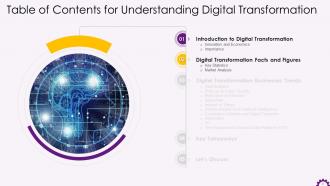
The training deck in-depth covers digital transformation in business organizations. It has PPT slides on digital transformation facts and figures covering key statistics and market analysis. Further, it covers digital transformation business trends such as data analytics, cyber security, blockchain, the internet of things IoT, artificial intelligence AI, contactless solutions, digital payments, automation, and the explosion of customer data platforms CDP. Further, the digital transformation ppt module has key takeaways and discussion questions to make the training session interactive. It also contains templates on about us, vision, mission, goal, 30-60-90 days plan, timeline, roadmap, training completion certificate, energizer activities, client training proposal, and evaluation form.
People who downloaded this PowerPoint presentation also viewed the following :
Content of this Powerpoint Presentation
Slide 4
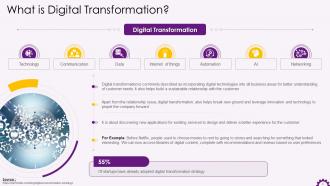
This slide depicts information about digital transformation. It emphasizes that digital transformation is about leveraging innovation and technology to propel the company forward and discovering new applications for existing services to design and deliver a better customer experience. It also mentions that 55 percent of start-ups have already implemented a digital transformation strategy.
Slide 5
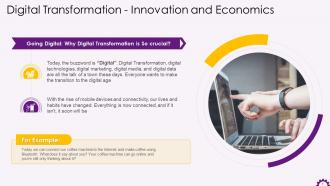
This slide illustrates the significance of digital transformation. It emphasizes how the term "digital" has become a buzzword today. It emphasizes how digital transformation, digital technologies, digital marketing, and digital data are currently all the rage. Everyone wants to make the switch to the digital age.
Slide 6
This slide showcases the frequently citied reasons to go digital. The reasons are improved customer experience and engagement, improve business decision making, increase efficiency, be more innovative, and transform the business.
Slide 7
This slide illustrates the significance of a digital transformation strategy. It emphasizes that a digital business strategy is defined as transforming a company's business, streamlining processes, and utilizing technologies to improve interactions with customers and employees. It also mentions that the lack of a digital transformation strategy is the most significant barrier to becoming a digitally mature company.
Slide 8
This slide displays data on the adoption of a digital-first business strategy. It highlights the percentages of digital-first business strategy adoption across industries.
Slide 9
This slide depicts how Amazon, a digital company, dominated the retail industry. It also highlights the valuation of Amazon in comparison to other retailers in the United States.
Slide 10
This slide depicts the pressing need for businesses to go digital. It demonstrates how, even during Covid-19, businesses were able to perform better due to digital transformation. It also states that companies that do not digitally transform will lag behind and eventually go out of business.
Slide 11
This slide depicts the importance of digital transformation. When done right, it results into enriched customer experience, smooth collaboration across departments, data-based insights, enhanced profitability and reduced costs, better agility and innovation, enhanced market penetration, improved decision making, and long-term returns.
Instructor’s Notes:
The importance of digital transformation are as follows:
- Data-based Insights: The use of digital technology allows for more accurate tracking of metrics and increases transparency. Businesses can use these insights to improve their processes and strategies. They can document everything and keep records for better strategic planning
- Smooth Collaboration across Departments: Businesses have access to more data due to digital transformation, and they can analyze which processes or techniques are more efficient. Implementing these efficient processes increases staff productivity. It also allows for open and smooth communication between different teams and departments
- Enhanced Profitability and Reduced Costs: When a company's technology and operations are digitized, it results in greater savings and increased sales. Because digital technology reduces the number of manual interventions, processes become faster and become more accurate. Thus, implementing IT solutions in organizations is highly beneficial
- Better Agility and Innovation: Customers expect better services as technology advances. Digital technology fosters agility and innovation in the workplace and the ability to meet customer demands. Businesses that want to stay relevant must adopt digital transformation services at the earliest
- Enhanced Market Penetration: Unexplored markets can be penetrated, and digital technologies can target newer customers. As business efficiency improves, the market penetration process becomes more effective. It aids in the expansion of customer base and recall of the product or service
- Evolving Customer Expectations: Customer expectations are rising, and every company is working hard to keep up. Consumers can now explore alternatives to meet their needs more efficiently than ever before. As a result, each company has to have customer retention as the key goal. It will only be possible if the company digitally transforms itself to meet the expectations of its customers
- Staying ahead of the Competition: Businesses can now lead because of technological and capability advancements that were unavailable five years ago. If they do not adapt to this shift, they will undoubtedly fall behind their competitors. If a company does not embrace digital transformations, someone else will
- Informed Decision Making: Businesses can benefit from big data by integrating data and analytics into their digital transformation strategy. With the right combination of analytical tools, this data can be transformed into essential business insights, allowing you to make better, faster decisions. The more profound analytical tools are embedded in company operations, the greater is their integration and impact
- Long Term Returns: Digital Transformation may necessitate a significant investment in money, workforce training, and revamping existing organizational procedures, but the benefits will be significant in long-term
Slide 12
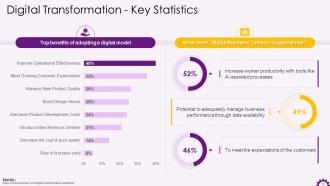
This slide depicts the key statistics on digital transformation. It also contains key statistics of the benefits of adopting a digital business model.
Slide 13
This slide illustrates vital data on digital transformation implementation. It also highlights statistics on who in businesses is hesitant to implement digital transformation initiatives.
Slide 14
This slide showcases vital statistics on digital transformation, such as on business opportunities, innovation, and net profit margin.
Slide 15
This slide illustrates statistics on digital transformation adoption and implementation. It also contains information regarding the usage of AI, migration of core HR applications to the cloud, and business leaders who are adapting to new markets and industries by leveraging digital platforms.
Slide 16
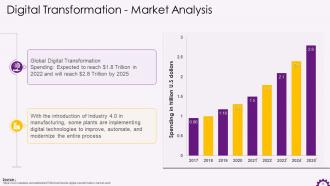
This slide illustrates the global digital transformation spending. It highlights that the global digital transformation spending is expected to reach $1.8 Trillion in 2022 and will reach $2.8 Trillion by 2025.
Slide 17
This slide showcases key statistics on the adoption of digital transformation. It mentions the percentage of businesses who have already implemented or plan to implement a digital-first business strategy.
Slide 18
This slide depicts the statistics on the benefits of digital transformation. Among the advantages mentioned are: Increased operational efficiency, faster time to market, and meeting customer expectations.
Slide 19
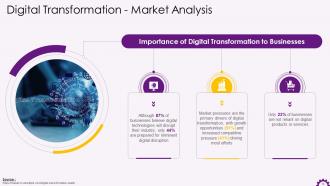
This slide illustrates statistics on the importance of digital transformation to businesses. It highlights the percentage of businesses that believe digital will disrupt their industry and those that are not reliant on digital products or services.
Slide 21
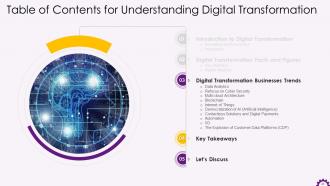
This slide depicts digital transformation trends. The digital transformation trends are the explosion of customer data platforms, refocus on cyber security, multi-cloud architecture, Blockchain, Democratization of AI (Artificial Intelligence), Internet of Things (IoT), contactless solutions and digital payments, automation, 5G, and data analytics.
Instructor’s Note:
The digital transformation trends are:
- Data Analytics: Data is the company's lifeblood, but it must be sorted, processed, and analyzed to be of any productive purpose for business. Intelligent data analytics can assist you in extracting valuable information from processed raw data. It improves decision-making and increases organizational productivity. It can aid in predicting customer behavior, the optimization of supply chain processes, and optimizing sales pipelines, among other things
- Refocus on Cyber Security: With the recent increase in cyber attacks. Cyber security team members must ensure that the organization's security practices keep pace with the rapid pace of digital transformation. To put it another way, the emphasis should be on "how can we safely speed up a process?" rather than "how can we speed up a process?"
- Multi-cloud Architecture: A multi-cloud architecture uses one or two private or public clouds to distribute software and workloads within an organization. A multi-cloud strategy is used for disaster recovery, data residency, and resilience. Businesses must look for cloud management and automation solutions to manage their cloud environments. These will also help them meet agility requirements and experiment with new delivery models
- Blockchain: Blockchain has emerged as the flavor of the times with its rapid technological adoption over the last year. Initially, associated with crypto currency, blockchain is now being used in industries, particularly financial institutions. Over the years, blockchain will have a significant role in cyber security and it will mature as more industries take to it
- IoT: It is growing, advanced technology and its importance has grown due to the COVID-19 crisis. Organizations across all industries intend to embrace IoT as one of the leading digital technologies. However, leaders in the healthcare and manufacturing industries have shown greater interest in IoT than leaders in the other industries
- Democratization of AI: AI democratization can accelerate digital transformation within a business, making it one of the most important change in business trends. To put it another way, democratizing AI means making it available to every organization and, ideally, every individual within the organization. This entails employing AI-powered tools to detect and recognize trends, make decisions, forecast, learn, and improve
- Contactless Solutions and Digital Payments: The rise of no-touch solutions and contactless digital payments are examples of digital transformation. People and businesses worldwide can now use digital payment methods to gain access to the digital economy. The transition to contactless solutions and digital payments will necessitate robust digital infrastructure support, hastening digital transformation
- Automation: By automating processes, businesses will accelerate digital transformation within their organizations. Business leaders will now need to implement automation practices to keep their businesses afloat and smooth operations
- 5G: 5G can transform business models and operations by enhancing how services are delivered to end-users. It will offer faster speed, lower latency, and greater density than 4G networks. It will also facilitate the adoption of telco cloud, a software-defined technology that will support both current 4G and next-generation 5G networks
- The Explosion of Customer Data Platforms (CDP): CDP is a centralized repository of customer information that can be used to create more personalized and engaging marketing campaigns for the customers. At first glance, CDPs appear to be solely for the marketing department, but this is not the case. Finance and IT departments can also use CDPs to make quick decisions about services, products, and other company investments
Slide 22
This slide illustrates the key takeaways for the session understanding digital transformation
Slide 23
This slide mentions various questions for discussion on the topic understanding digital transformation.
Slide 35 to 50
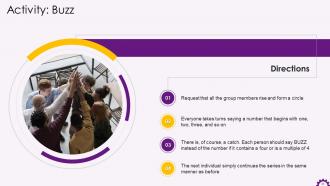
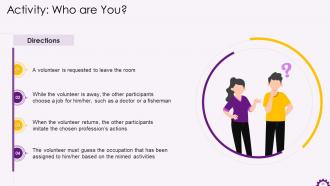
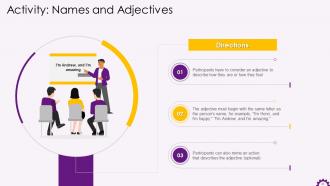
These slides contain energizer activities to engage the audience of the training session
Slide 51 to 78
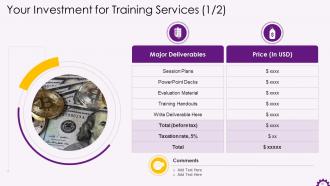
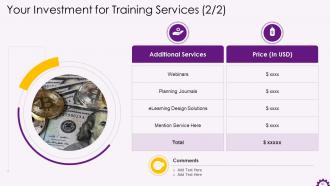
These slides contain a training proposal covering what the company providing corporate training can accomplish for the client.
Slide 79 to 81
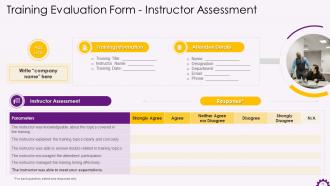
These slides include a training evaluation form for instructor, content and course assessment.
Understanding Digital Transformation Training ppt with all 86 slides:
Use our Understanding Digital Transformation Training ppt to effectively help you save your valuable time. They are readymade to fit into any presentation structure.























































FAQs for Understanding Digital
Honestly, you really need your leadership team locked in first - without them backing it, you're screwed from day one. Vision matters too, but it has to actually connect to what your business is trying to do. Tech infrastructure is obvious, but here's the thing - your people will make or break everything. If they hate change, good luck with that. Oh, and figure out your data situation early or you'll be buried under mountains of useless info. My advice? Don't try to transform everything at once. Pick one thing and nail it first.
Track your hard numbers first - process efficiency, cost savings, customer satisfaction, revenue from new digital stuff. But honestly? The culture piece matters just as much. Are people actually using the new tools or just pretending to? Monthly dashboards help with the data side. Also check if you're getting products out faster and responding to customers quicker than before. Don't skip the employee surveys either - they'll tell you what's really happening on the ground. Sometimes the soft metrics reveal more than spreadsheets do.
Honestly, leadership makes or breaks the whole thing. Without C-suite buy-in first, you're toast. They need to actually sell the vision - not just send some bland email about "embracing change." I've watched so many projects crash because executives treated it like checking a box instead of real strategy. Your leaders have to model new behaviors and be ruthless about ditching old processes that don't work anymore. Oh, and securing proper budget obviously matters too. People can smell fake enthusiasm from a mile away, so they better genuinely believe in it.
Honestly, start with what you're actually trying to achieve business-wise and work from there. Customer retention tanking? That's where your tech money should go first. I see so many companies get distracted by whatever new platform is trending - total waste. Pull your leadership into a room and hash out what winning looks like, then trace everything back to those goals. Every project should clearly answer "how does this help our main strategy?" Also, definitely schedule regular reality checks because things will drift (they always do).
Ugh, where do I even start? Employee pushback is brutal - nobody wants their workflow messed with. Your legacy systems will fight you every step of the way, and leadership rarely gives you a clear roadmap. Money's always tight for this stuff too. Skills gaps hit different departments hard, plus executives think you can wave a magic wand and boom, everything's digital by Tuesday. Security gets messy real quick when you're connecting all these platforms. Honestly though, pilot projects save your sanity. Get people excited early and don't promise the moon timeline-wise.
Customer feedback is literally your roadmap for digital transformation. Look at support tickets, surveys, usage data - find the patterns. What are your top three complaints? Those should be your first digital fixes. I've watched so many companies waste money building cool features that nobody wanted. Don't be them! Your customers are telling you exactly what hurts most. Fix those pain points first with tech that actually works. Oh, and set up feedback loops during the whole process, not just after you launch something. Way better than guessing what people need.
So AI and machine learning can seriously speed up your digital transformation. They automate all the tedious tasks and catch insights you'd miss otherwise. Customer behavior predictions, real-time optimization - that stuff actually works now. The data processing happens crazy fast too, which makes decision-making way quicker. You can automate customer service, personalize user experiences, and spot business patterns that matter. Honestly, I'd suggest picking one small process first. Get a win there, then expand. Way less overwhelming that approach.
Look, when you're moving everything online you're basically handing hackers a bigger target. More customer data, cloud storage, different platforms that need to connect - it's a lot of potential weak spots. GDPR fines alone can destroy your budget, not to mention what happens when customers lose trust. Honestly, I've seen companies get burned trying to bolt security on afterward instead of building it in from the start. Do a full security check before you move anything. Way cheaper than fixing a mess later.
Dude, focus on your people first - that's where most companies screw up. Leadership needs to actually show they care about this stuff, not just send emails about it. Find those people in each department who get excited about new things and let them spread the word. Communication is huge here. Tell everyone why you're doing it and what they'll get out of it. Train early, expect pushback (people are weird about change even when it helps them), but celebrate every small win like it's the Super Bowl. Oh, and start with your most flexible teams - they'll make you look good while you figure things out.
Honestly, digital transformation can be amazing for engagement - your team gets better tools, remote flexibility, and way less tedious work. But here's the thing: people can get weirdly isolated when everything moves online. I've watched it happen firsthand and it's not pretty. The culture usually becomes more data-focused and fast-moving, which sounds good on paper. Remote work makes people happier generally. Just don't let all that efficiency kill the random coffee chats and spontaneous brainstorming sessions. Those matter more than most leaders realize.
Honestly? Start with customer experience and making your daily grind less painful - that's where you'll see real results. Automate the boring stuff first (invoicing, inventory, whatever eats your time). Then figure out what your customers actually want instead of just guessing. Here's the thing though - don't go crazy buying a bunch of random software that won't work together. That's a nightmare waiting to happen. Cloud stuff is usually cheaper upfront and grows with you. Pick one thing, get it working smoothly, then move on to the next. Way less stressful than trying to overhaul everything at once.
Honestly, you've gotta bake feedback into everything you do. Grab data from users, employees, your systems - then actually do something with it instead of letting it collect dust. Monthly cross-functional team meetings work great for figuring out what's busted. Don't just do sprint reviews for tech stuff either - every department touched by digital needs this. I swear, half the companies I know are drowning in metrics but never change direction based on them. Quick wins deserve celebration, and when something's not working? Pivot fast. Oh, and start small - pick one broken process this week and ask your team what sucks about it.
Dude, flexibility is everything. Don't get stuck with some massive 3-year roadmap - break it into quick sprints so you can actually pivot when things change. The companies that crash? They think it's a one-time project you finish and walk away from. Keep your tech modular, get teams that can move fast across different areas. Customer feedback loops are huge too - you'll constantly need to adjust course. Oh and honestly, stop thinking there's some finish line. It's more like... ongoing evolution? Your transformation should feel alive, not like checking boxes on a project plan.
Dude, healthcare and retail are getting absolutely slammed right now. COVID basically forced hospitals to figure out telemedicine overnight - my doctor's office went from fax machines to video calls in like two months. Retail's obvious though, right? You either nail the online experience or you're dead. Banks are scrambling too because everyone expects their app to work like Instagram. Manufacturing's doing the whole smart factory thing with sensors everywhere. It's wild how fast things moved. These industries can't hide behind "that's how we've always done it" anymore when customers are used to Amazon-level convenience.
Dude, partnerships are seriously clutch for digital transformation. They fill gaps you didn't even realize existed. Getting access to specialized expertise and proven tech that would take forever to build in-house? Worth it. Fresh eyes from outside can catch blind spots your internal team totally misses - I've watched this literally save projects from disaster. Though honestly, the trick is finding partners who actually get your industry and company culture, not just the technical stuff. Figure out where you're weakest first. Then find people who crush it in those areas while you stick to what you're already good at.
-
Incredibly beautiful designs that will help you get noticed! These eye-catching templates are perfect for corporate presentations that can be altered to fit any occasion or taste.
-
Really like the color and design of the presentation.