


Digital Transformation in the Healthcare Industry Training ppt





Try Before you Buy Download Free Sample Product
 Impress Your
 Audience
 100%
100% Editable
 Save Hours
 of Time


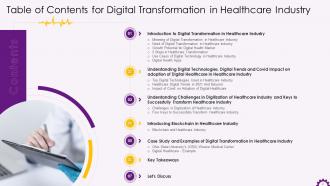
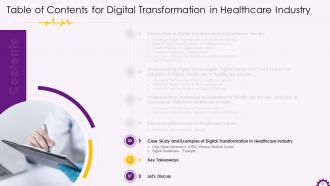
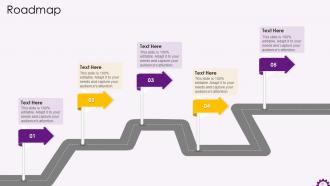
The PowerPoint training deck in-depth covers the digital transformation in the health industry. It covers the need and growth potential for digitalization in the medical sector. It has a five-stage approach to the healthcare industrys digital transformation, starting with a baseline, conducting a needs assessment, building the technology and process roadmap, executing and delivering, and ensuring ongoing holistic services and support. The PPT module also comprehensively covers the trending technologies in the healthcare sector telemedicine, nanomedicine, 5g enabled devices, tricorders, digital assistants, smarter pacemakers, and wearables. It also covers the usability of blockchain technology in the healthcare sector. The PPT deck also has case studies, key takeaways, and discussion questions to make the training session interactive. Further, it also contains about us, vision, mission, goal, 30-60-90 days plan, timeline, roadmap, training completion certificate, and energizer activities.
People who downloaded this PowerPoint presentation also viewed the following :
Content of this Powerpoint Presentation
Slide 4
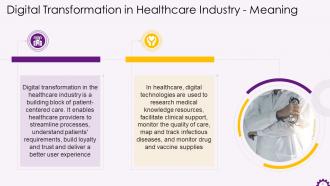
This slide explains the meaning of digital transformation in the healthcare sector. It states that digital transformation is essential for meeting the requirements of citizens to deliver health services efficiently and effectively. In healthcare, digital technologies are used to research medical knowledge resources, facilitate clinical support, monitor the quality of care, map and track infectious diseases, and monitor drug and vaccine supplies.
Slide 5
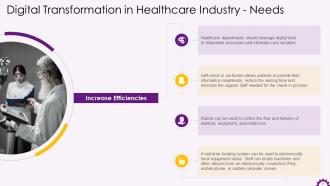
This slide explains the necessity of digital transformation in healthcare. It states that digital healthcare is required for improving access, processes are simplified, providing care on patients’ terms, helping patients stay well, offering continuous patient engagement, increasing efficiencies, and raising staff productivity.
Slide 6
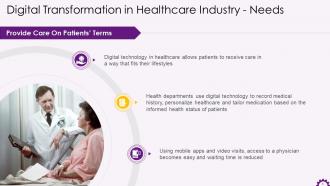
This slide explains how digital solutions in healthcare are helping in providing care on terms that the patient seeks. Digital technology allows patients to receive care in a way that fits their needs, comfort, and lifestyles.
Slide 7
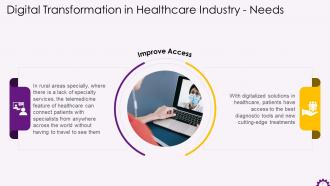
This slide explains how access to healthcare has become easy with digitalized solutions. In remote or backward areas, where there is a lack of specialty services, digital healthcare techniques like telemedicine can connect patients with specialists from anywhere in the world, without the need to travel.
Slide 8
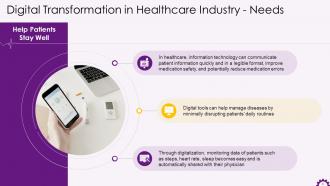
This slide explains how digital healthcare assists patients in staying well. It states that through digitalization in healthcare, monitoring data of patients such as steps walked in a day, heart rate, sleep becomes easy and is automatically shared with their physician.
Slide 9
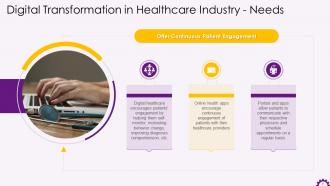
This slide mentions that digital transformation in healthcare offers continuous patient engagement. Portals and healthcare apps allow patients to communicate with their respective physicians and schedule appointments continuously.
Slide 10
This slide illustrates how digital health simplifies processes and provides a better experience for healthcare providers and patients. Technologies such as the medical helpline, chatbots, and texting apps reduce patient stress and improve their overall experience.
Slide 11
This slide explains how digital transformation in healthcare is increasing efficiencies. Healthcare departments should leverage digital tools to streamline processes, eliminate care variation, and reduce patients' waiting time.
Slide 12
This slide mentions the relevance of the digitalization of healthcare in increasing staff productivity. Automating processes and structured tasks will reduce the burden of employees and allow focus on more significant activities that will impact patients’ experience and improve staff productivity.
Slide 13
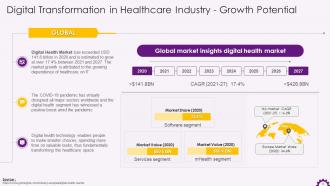
This slide mentions statistics relating to the growth potential of digital healthcare market worldwide. It mentions that digital health technology enables people to have smarter choices, spending more time on valuable tasks, thus fundamentally transforming the healthcare space.
Slide 14
This slide mentions the statistics relating to the growth potential of digital healthcare market in the US.
Slide 15
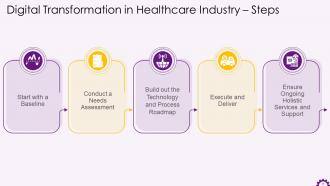
This slide mentions the five-step process to be followed in healthcare transformation. The steps are start with a baseline, conduct a needs assessment, build out the technology and process roadmap, execute and deliver, and ensure ongoing holistic services and support.
Slide 16
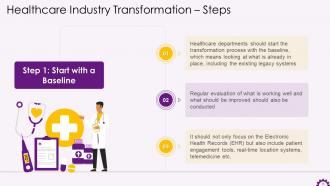
This slide mentions the significance of starting with a baseline for the healthcare departments. It states that the healthcare departments should begin the transformation process with the baseline, which means looking at what is already in place and regularly evaluating what is working well and what should be improved.
Slide 17
This slide explains why conducting a needs assessment is significant in healthcare transformation. Healthcare departments should engage with the design team in prioritizing each department's wish-list within the budget allocated. The design team should nail down the metrics such as Return on Investment (RoI), staff, and patient safety satisfaction and then decide.
Slide 18
This slide states that the design team and healthcare departments should build the technology and process roadmap before initiating the process of digital transformation. This will help the design team to lock-in issues can be resolved with a particular process, what areas need new technology or, what will require a combination of the two.
Slide 19
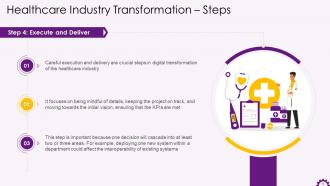
This slide explains the significance of careful execution and delivery of each step in the transformation process. It includes being mindful of details, keeping the project on track, and moving towards the initial vision. In all this activity, it is also critical to ensure that all Key Performance Indicators (KPIs) are being met.
Slide 20
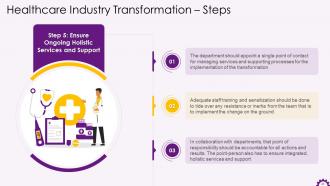
This slide explains that the healthcare department after transformation should continuously ensure that the services are properly implemented and are comprehensive in nature satisfying the needs and requirements of the patients. It suggests that the design team should appoint a single point of contact for managing services and supporting processes in the transformation process.
Slide 21
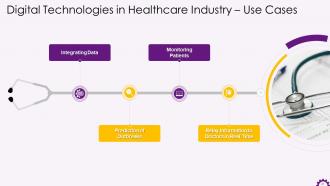
This slide mentions the use cases of digital technologies in healthcare. Digital healthcare can integrate data, predict outbreaks, monitor patients, and relay information to doctors in real-time.
Slide 22
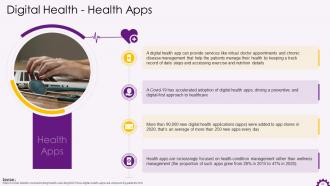
This slide mentions the meaning and prevalence of digital health apps in the healthcare industry. A digital health app can provide services like virtual doctor appointments and chronic disease management that help the patients manage their well-being. Apps help individuals access daily record of exercise and nutritional intake, helping in clear indicators of health.
Slide 23
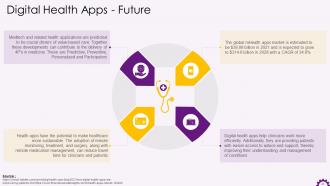
This slide illustrates the growth potential for digital health apps in the healthcare industry. Health apps have the potential to make healthcare more sustainable. The adoption of remote monitoring, treatment, and surgery, along with remote medication management, can reduce travel time for clinicians and patients
Slide 25
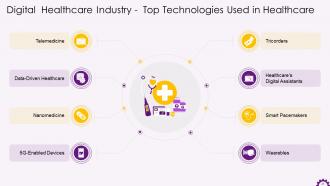
This slide mentions the top technologies used in digital healthcare. The trending technologies are telemedicine, data-driven healthcare, nanomedicine, 5G-enabled devices, tricorders, healthcare’s digital assistants, smarter pacemakers, and wearables with a purpose.
Slide 26
This slide explains the meaning of telemedicine as a technology used in digital healthcare. It says that telemedicine is the use of telecommunications technology and information technologies to provide remote clinical services to patients. Physicians use telemedicine for the transmission of digital imaging, video consultations, and remote medical diagnosis.
Instructor’s Notes:
- Telemedicine refers to the art of caring for patients remotely when the patient and the healthcare provider are not physically present
- Telemedicine is conducted in numerous ways. The most basic form is a simple video call. However, most countries require a secured HIPAA (Health Insurance Portability and Accountability Act) compliant video conference tool for telemedicine process
Benefits:
- Telemedicine provides easy access to citizens in remote areas
- It allows informed decision-making
- It simplifies the health decision-making process
- It encourages communication between healthcare providers and patients regarding the prevention, diagnosis, or management of a health condition
Slide 27
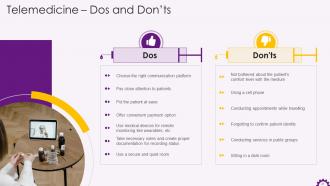
This slide mentions the dos and don’ts of telemedicine services in healthcare. Health providers should pick the right communication platform, make the patients comfortable, offer convenient payment modes, use secure platforms, etc. Also, the Health officials should avoid using cell phones, sit in a dark room, and prefer not to look in hurry during the consultation process.
Slide 28
This slide explains the significance of big data in digitalization of healthcare. Big data is used extensively in healthcare to help identify and address both high-risk and high-cost patients. It is also used to identify high-risk areas where patients should be provided with more efficient healthcare to reduce spending and increase patient satisfaction
Instructor’s Notes:
- Big data is used extensively in healthcare to help identify and address both high-risk and high-cost patients
- Big data is used to identify high-risk areas where patients should be provided with more efficient healthcare to reduce spending and increase patient satisfaction
- As the data collection in healthcare continues to accelerate, its use becomes more widespread, and its potential for improving treatments, patient services, and patient outcomes also grows exponentially
Slide 29
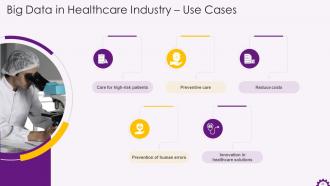
This slide mentions the areas in which big data can be used in healthcare. It provides care for high-risk patients, innovative solutions in healthcare, preventive care, reduces costs, and helps in prevention of human errors.
Slide 30
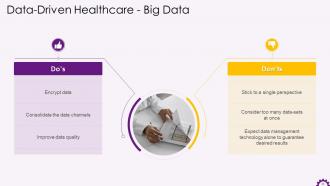
This slide mentions the dos and don’ts of data management in healthcare. It emphasis on encryption of data before transfer, consolidation of data channels, and improving the data collection and quality. The officials should also make sure that they do not stick to a particular perspective, consider too many data sets at once, and expect complete results from technology alone.
Slide 31
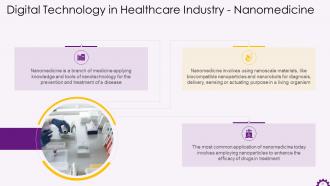
This slide explains the meaning and significance of nanotechnology in the field of medical sciences. Nanomedicine involves using nanoscale materials, like biocompatible nanoparticles and nanorobots, for diagnosis, delivery, sensing or actuating purpose in a living organism.
Slide 32
This slide explains the relevance of 5G-Enabled devices in digital healthcare. 5G-enabled devices offer an opportunity to the healthcare system to upgrade to a more convenient, accessible, and reliable experience both the healthcare providers and patients. It reduces waiting time for treatments, increasing the number of daily appointments that health professionals can handle.
Slide 33
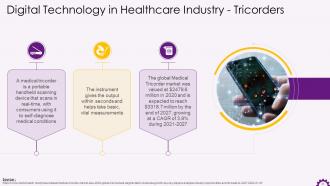
This slide explains the meaning and use of medical tricorders as an upcoming technology in medical sciences. It mentions that a medical tricorder is a portable handheld scanning device that scans in real-time and is used by consumers to self-diagnose medical conditions. It brings immediate results and takes basic, but vital measurements.
Instructor’s Notes:
- In 1996, The first "real-world" tricorder was developed by a Canadian company called Vital Technologies Corporation
- The first scanner was called the TR-107 Mark 1, and the company Vital Technologies sold 10,000 of these before going out of business in 1997
Slide 34
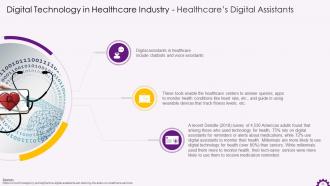
This slide explains the importance of digital assistants in healthcare. Digital assistants in healthcare can include voice assistants or chatbots. These tools enable the healthcare centers to answer queries, using apps to monitor health conditions like heart rate, etc., guide in using wearable devices that track fitness levels, etc.
Slide 35
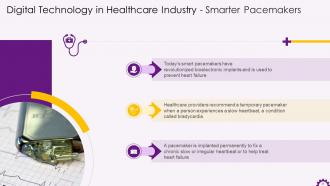
This slide explains the utilization of smart pacemakers in digital healthcare. It mentions that smart pacemaker is used to prevent heart failure. A pacemaker is implanted permanently to fix a chronic slow or irregular heartbeat or to help treat heart failure.
Slide 36
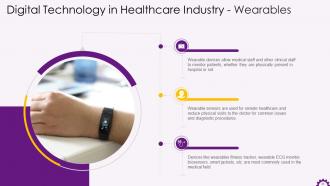
This slide explains the meaning and significance of wearables in digitalization of healthcare. Wearable devices allow the medical staff and other clinical staff to monitor patients closely whether they are physically present or not. Wearable sensors are used for remote healthcare and reduce physical doctor visits for common issues and diagnostic procedures.
Instructor’s Notes:
Impact of using Wearables in healthcare-
- With patients' physiology remotely measured in real-time, hospitals can improve their effectiveness, free up beds. . Doctors can focus on patients' vitals regardless of location, increasing their productivity
- Monitoring systems developed in wearables improves the quality of clinical assessment.
- Wearables medical devices offer critical and effective monitoring procedures. These can replace a wide range of existing medical monitoring systems and products
- Medical wearables ease the diagnostic process and are expected to witness a higher adoption at clinics, labs and diagnostic centers
Slide 37
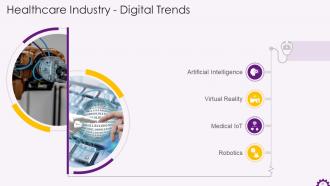
This slide mentions the top digital trends in healthcare. The trends are increasing Artificial Intelligence (AI) investments in healthcare, virtual reality transforming medical field, medical IoT developing rapidly, and use of robotics.
Slide 38
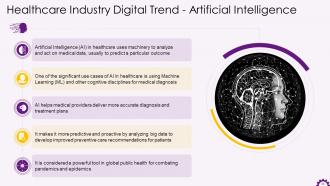
This slide mentions meaning and use of artificial intelligence in healthcare. It explains that Artificial Intelligence in healthcare uses machinery to analyze and act on medical data, usually to predict a particular outcome. It helps the medical providers deliver more accurate diagnosis and treatment plans and it is considered a powerful tool in global public health for combating pandemics and epidemics
Slide 39
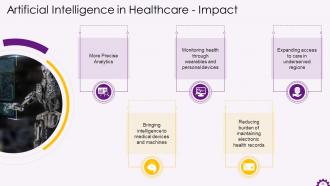
This slide illustrates various points of impact of artificial intelligence on healthcare. Artificial Intelligence in healthcare brings more precise analytics, brings intelligence to medical devices and machines, monitors health using wearables and personal devices, reduces burden of maintaining electronic health records, and expands access to care in remote areas.
Slide 40
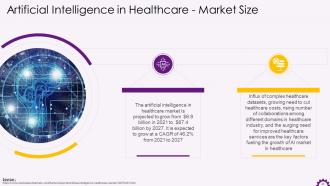
This slide mentions the statistics relating to growth potential of Artificial Intelligence (AI) in healthcare. It explains that factors like increasing healthcare costs, need for improved healthcare services, etc. encourage the growth of AI in healthcare.
Slide 41
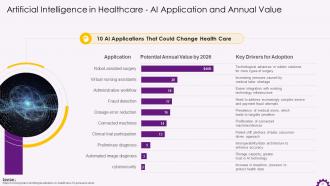
This slide mentions the statistics relating to application of artificial intelligence in healthcare and their potential annual values.
Slide 42
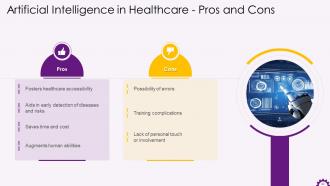
This slide mentions the advantages and disadvantages of implementing artificial intelligence in healthcare. Artificial Intelligence in healthcare fosters accessibility, saves time and cost, ensures early detection of diseases and risks, and augments human abilities. AI in healthcare is prone to errors, includes training complications, and lacks the personal touch.
Slide 43
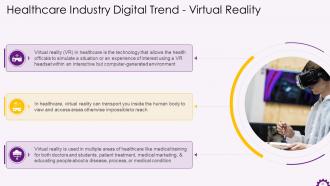
This slide mentions meaning and use of Virtual Reality in healthcare. It says that VR in healthcare is the technology that allows health officials to simulate a situation or an experience of interest using a VR headset within an interactive but computer-generated environment
Instructor’s Notes:
Significance:
- Teaching hands-on skills with VR technology in healthcare is an excellent learning resource and can be used to create scenarios for training healthcare professionals
- VR in healthcare creates a realistic world enabling the user to explore places inside human body
- VR makes medical education easy and comfortable
Slide 44
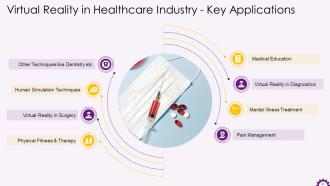
This slide illustrates the key application areas of virtual reality in healthcare. VR in healthcare is applicable in medical education, diagnostics, treatment of mental illnesses, pain management, physical fitness and therapy, surgery, human simulation techniques, and many other techniques like dentistry etc.
Slide 45
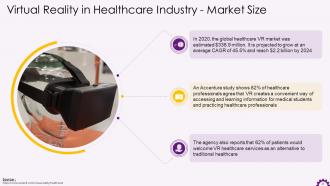
This slide mentions the statistics relating to global market size of virtual reality in healthcare.
Slide 46
This slide mentions the positives and negatives of Virtual Reality(VR) in healthcare. VR offers a detailed view of the human body, is helpful in multiple areas, and provides an engaging experience. VR is a high-cost affair in healthcare that does not offer any real experience and has sophisticated technological requirements.
Slide 47
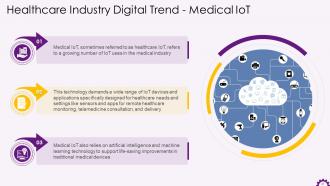
This slide mentions the concept of medical IoT. It explains that medical IoT, sometimes referred to as healthcare IoT, refers to a growing number of IoT uses in the medical industry. Medical IoT relies on artificial intelligence and machine learning technology to support life-saving improvements in traditional medical devices.
Slide 48
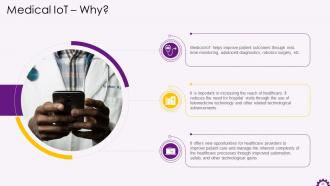
This slide mentions the reason of existence of medical IoT and how it is improving the healthcare sector. It is stated that it helps to improve patient outcomes through real-time patient monitoring, advanced diagnostics, robotics surgery, etc. It offers new opportunities for healthcare providers to improve patient care and manage the inherent complexity of the healthcare processes through improved automation, safety, and other technological gains
Slide 49
This slide explains the areas of applicability of medical IoT. Medical IoT assists in remote patient monitoring, glucose monitoring, heart-rate monitoring, hand-hygiene monitoring, depression and mood monitoring, Parkinson’s disease monitoring, etc.
Slide 50
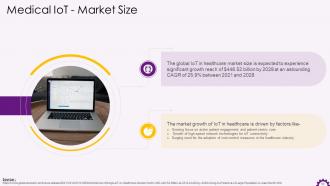
This slide depicts the market position of medical IoT and what factors are responsible for growth of this area.
Slide 51
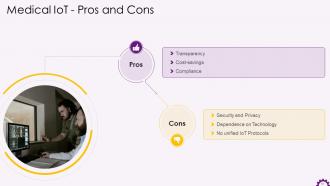
This slide mentions the advantages and disadvantages of medical IoT in healthcare. Medical IoT offers transparency of data, is cost-saving and compliant. Medical IoT is sometimes dependent on technology, lacks security, and provides no unified IoT protocols.
Slide 52
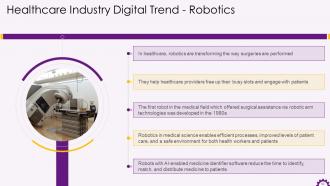
This slide mentions the significance of robotics in healthcare and how they are transforming the way medical science is performing today. It explains that robotics in medical science enables efficient processes, improved levels of patient care, and a safe environment for both health workers and patients. Robots with AI-enabled medicine identifier software reduce the time to identify, match, and distribute medicine to patients.
Slide 53
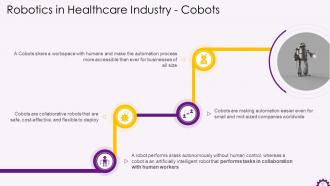
This slide mentions the meaning of Cobots as a type of robots in healthcare. It also explains how Robots and Cobots are differentiated in assisting healthcare officials.
Slide 54
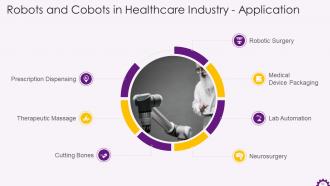
This slide mentions the areas of application of Robots and Cobots in healthcare. They assist in surgeries, packing, automation of processes, neurosurgery, prescription dispensing, and many more areas.
Slide 55
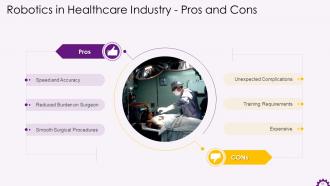
This slide mentions the positives and negatives of robotics technology in healthcare. Robotics offers fast processes, reduces the burden on surgeons, and offers smooth surgical procedures. Robotics in healthcare are expensive and have high training requirements and unexpected complications.
Slide 56
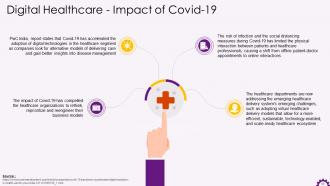
This slide depicts the impact of covid-19 on the adoption of digital healthcare. It states that covid-19 has accelerated the adoption of digital technologies in the healthcare segment as companies look for alternate models of delivering care and gain better insights into disease management. Hence, the Healthcare departments are now addressing the emerging healthcare delivery system's emerging challenges, such as adopting virtual healthcare delivery models that allow for a more efficient, sustainable, technology-enabled, and scale-ready healthcare ecosystem.
Slide 58
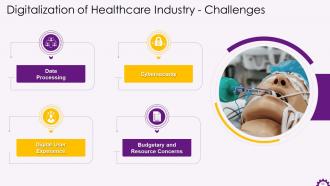
This slide illustrates the challenges in the digitalization of healthcare. Data processing, Cybersecurity, digital user experience, and budgetary concerns are the four significant challenges that impact digital healthcare success.
Slide 59
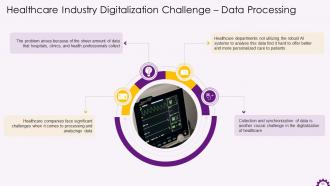
This slide explains data processing as one of the challenges in digitalization of healthcare. The problems arise because of the sheer amount of data hospitals, clinics, and health professionals collect.
Slide 60
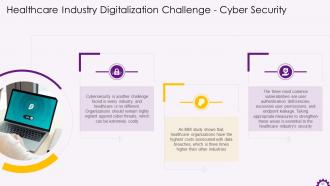
This slide mentions how cybersecurity issues affect the success of digital healthcare processes. It is said that healthcare organizations have the highest costs associated with data breaches, which is three times higher than other industries. The three most common vulnerabilities in data security are user authentication deficiencies, excessive user permissions, and endpoint leakage. Taking the appropriate measures to strengthen these areas is essential to the healthcare industry's security.
Slide 61
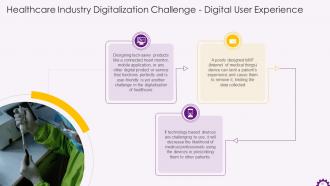
This slide explains digital user experience as a challenge in the digitalization of healthcare. It mentions that designing tech-savvy products like a connected heart monitor, mobile application, or any other digital product or service that functions perfectly and is user-friendly is yet another challenge in the digitalization of healthcare. Poorly designed IoMT devices can taint a patient’s experience and cause them to remove the device, limiting the data collected.
Slide 62
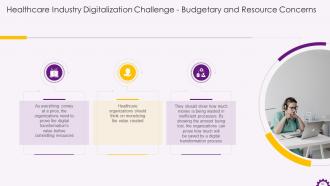
This slide says that considering and managing the budget while digitally remodeling the business is a significant challenge in healthcare. It says that while reimagining business, healthcare organizations should consider how to monetizr the value created.
Slide 63
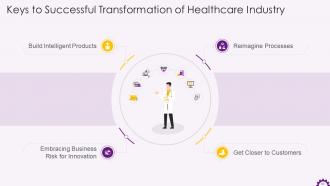
This slide mentions the four keys for transforming traditional healthcare to digital healthcare. The four keys are reimagining processes, getting closer to customers, embracing business risk for innovation, and building intelligent products.
Slide 65
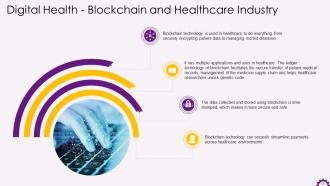
This slide mentions how blockchain technology is utilized to improve processes of healthcare sector. Blockchain has multiple applications and uses in healthcare. The ledger technology of blockchain facilitates the secure transfer of patient medical records, management of the medicine supply chain and helps healthcare researchers unlock genetic code
Slide 67
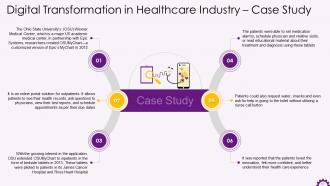
This slide mentions a case study in Ohio’s State University’s Wexner Medical Centre, which is a major US academic medical center. It mentions that it has an online portal solution for outpatients. It allows patients to see their health records, ask questions to physicians, view their test reports, and schedule appointments as per their due dates.
Slide 68
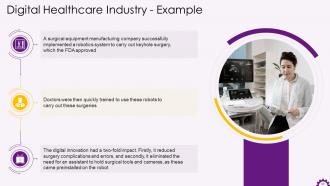
This slide mentions an example of digital transformation in healthcare and how it takes place.
Slide 69
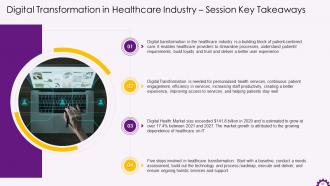
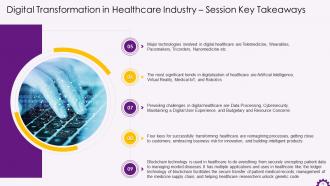
This slide mentions the key takeaways for the session digitalization of healthcare.
Slide 70
This slide illustrates the key takeaways for the section digital transformation in healthcare.
Slide 71
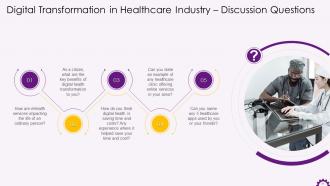
This slide mentions various questions for discussion and revision of the concepts in the topic digital transformation of healthcare.
Slide 83 to 98
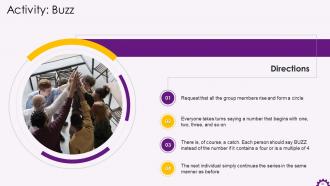
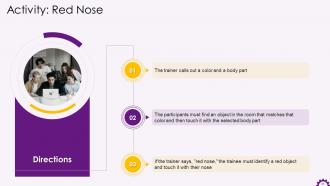
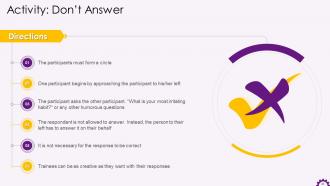
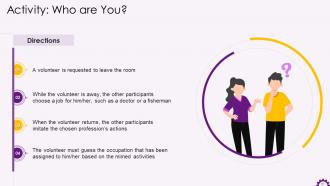
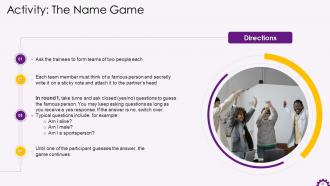
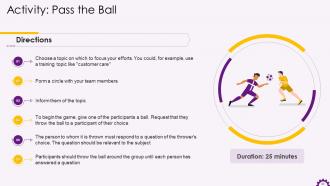
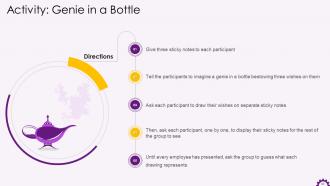
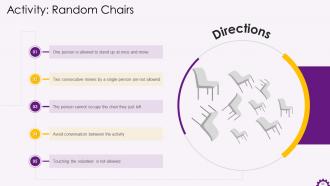
These slides contain energizer activities to engage the audience of the training session..
Digital Transformation in the Healthcare Industry Training ppt with all 103 slides:
Use our Digital Transformation in the Healthcare Industry Training ppt to effectively help you save your valuable time. They are readymade to fit into any presentation structure.


























FAQs for Digital Transformation in the Healthcare
Honestly, it's mostly about what patients expect now - they want to book appointments online and do telehealth like they order food. Cost pressure is huge too. Hospitals are scrambling to cut expenses while actually improving care quality, which is where tech comes in. Then you've got all the regulatory stuff pushing for better data sharing and outcome-based payments. COVID basically hit fast-forward on everything (my doctor went from zero tech to full telehealth overnight). If you're thinking about this space, go for anything that makes the patient experience smoother or cuts down paperwork - those are the easiest sells.
So telemedicine is pretty amazing because it totally eliminates the whole distance thing. Rural patients can finally see specialists without driving for hours - same goes for anyone who has trouble getting around. Honestly, the convenience alone is worth it since people actually follow through on preventive care when it's just clicking an app. You get way faster diagnosis too since there's no waiting weeks for appointments. Oh, and chronic conditions can be monitored way more consistently now. Just make sure whatever platform you use isn't a nightmare to navigate or you'll defeat the whole purpose.
So basically EHRs put everything in one spot digitally - no more digging through paper files or calling around for records. You can pull up patient histories, lab work, meds, all of it instantly. Way better than those old filing cabinets, trust me. Patients don't have to tell their whole story again every time they come in. Doctors can coordinate better between specialties too. Fewer mistakes happen when everyone's looking at the same info. The best part? You're not making decisions blind anymore - everything's right there when you need it.
Honestly, the biggest thing is that AI can spot stuff doctors miss - like tiny cancer signs in thousands of scans or when someone's about to crash based on their vitals. These systems learn from huge amounts of data, so they pick up on subtle patterns we'd never catch. Also they don't get brain-dead during night shifts like humans do! What's really cool is how they can look at everything at once - your bloodwork, scans, medical history - and connect dots that might take doctors way longer. I'd say start with just one department though, see how it goes before rolling it out everywhere.
Honestly, the biggest headache is securing patient data when it's bouncing between cloud storage, mobile apps, IoT devices, and random third-party systems. Each new connection point creates more ways hackers can get in - and trust me, they're targeting healthcare hard because medical records sell for crazy money on the dark web. HIPAA compliance gets messy fast when data's moving everywhere too. My advice? Don't try to bolt security on later. Start with zero-trust architecture from the beginning and do regular vulnerability checks. It's way easier than dealing with a breach afterwards.
Honestly, mix up your training methods since everyone learns differently. Get people actually clicking through the system instead of just watching demos - way more effective. Pair your tech people with the ones who struggle more, that peer thing works surprisingly well. Don't overwhelm them with everything at once though. Roll features out slowly and make those quick reference cards they can keep nearby. Oh, and definitely pick some "super users" who can help troubleshoot on the spot. Nobody wants to wait around for IT every time something goes wrong. Keep it hands-on and you'll be fine.
Honestly, patient portals are game-changers for getting people more involved in their care. No more waiting on hold to get test results or schedule stuff - you can do it all online whenever. Refilling prescriptions, checking visit notes, messaging your doctor directly... it's all there. People love having that kind of access and control over their health info. The transparency really makes a difference in how satisfied patients feel. Oh, and if you're setting one up, don't make the mistake of picking some confusing interface - I've seen too many that are just painful to navigate. Keep it simple and it'll actually get used.
Dude, mobile health apps are seriously crushing it for people with chronic conditions. Patients can track their symptoms and meds right from their phone, which is huge. Real-time data flows to doctors too, so they catch problems way earlier than waiting months between visits. Honestly, just the pill reminders alone make people way better at taking their medications. Seeing your progress mapped out over time? That's motivating as hell - like having a tiny health coach with you. Oh, and if you're picking one for work, definitely go for something that plays nice with your current records system. Makes life so much easier.
So blockchain basically creates this tamper-proof record system where patient data gets shared between hospitals without privacy issues. Smart contracts let patients decide who sees their stuff, which is pretty neat. The real game-changer though? It fixes that annoying interoperability mess - no more calling five different offices trying to get your records (seriously, why do some places still use fax machines in 2024?). Everything's encrypted and verified automatically. If you're thinking about a pilot project, I'd start with consent management. Shows quick wins and isn't too overwhelming to implement.
Oh man, this stuff is messy. Bias is huge - if your AI only learned from white dude patients, it'll screw over everyone else. Transparency's another nightmare because doctors can't explain why the AI picked some random treatment (patients hate that, obviously). Who gets sued when it goes wrong? The doctor? Hospital? Some tech bro in Silicon Valley? Nobody knows yet, which is... great. Anyway, you definitely need solid policies and don't let AI make final calls without a human double-checking. That's like, the bare minimum.
So basically these wearables let you track patients 24/7 instead of just seeing them every few months. Heart rate, blood pressure, glucose - all that stuff gets monitored in real time. Honestly it's pretty cool because you can catch problems early instead of waiting for someone to show up half-dead in the ER. Plus patients don't have to drive in constantly for basic checkups, which they definitely appreciate. Just make sure whatever devices you pick actually talk to your current system though - learned that one the hard way when we ended up with three different apps that didn't sync.
Honestly, most resistance just comes from people being scared of change. Talk to your staff first - explain how these digital tools will actually make their work easier, not create more headaches. Get them involved in picking the software too, since they're the ones who'll use it daily. Training is huge though - do hands-on practice with real situations they'll face. Find a few enthusiastic people on each team who can help the others learn (there's always that one person who picks up tech super fast). Roll things out slowly and make a big deal about small wins. Oh, and don't underestimate how much the "why" matters to people!
Dude, this stuff is getting crazy accurate. Doctors are ditching the whole "try this and see what happens" approach. Now they're crunching huge amounts of data - your genetics, medical history, even what your fitness tracker picks up - to figure out exactly what'll work for you. They can predict disease risks before you even feel sick, nail the perfect drug doses, spot problems early. Honestly feels a bit sci-fi sometimes. But yeah, if you're doing anything healthcare-related, predictive analytics is where it's at for personalizing treatment.
Honestly, digital transformation saved healthcare during COVID - no joke. Telemedicine went from basically nothing to everywhere overnight, like 5% to 80% usage. Remote monitoring kept so many people out of packed hospitals too. But here's what really mattered: facilities could actually share data quickly, track supplies in real-time, and monitor population health properly. Without electronic records and cloud systems, the whole pandemic response would've been chaos. My take? Don't wait until the next crisis hits to build this stuff up.
Yeah, regulations are such a pain - we're talking months or even years of compliance stuff before anything goes live. HIPAA alone is brutal, then you've got FDA approvals and whatever your state throws at you. Honestly feels like they designed this system to make you quit. But I get why the rules exist - patient safety and all that. My advice? Don't treat compliance like something you'll figure out later. Get your regulatory people involved from the start. Trust me, trying to retrofit compliance is way worse than just baking it in early.
-
“Easy to use. I always wanted to have a quick search for products and SlideTeam has helped me have it.”
-
You know what? I'm so glad I opted for this PPT design. It has been a total game-changer for me and my presentations. Thank you!