


Role Of Change Management In Digital Transformation Training Ppt




Try Before you Buy Download Free Sample Product
 Impress Your
 Audience
 100%
100% Editable
 Save Hours
 of Time


These slides showcase the role of change management in bringing digital transformation in an organization. These also contain a change management approach and the reasons that cause hindrances to change initiatives.
People who downloaded this PowerPoint presentation also viewed the following :
Content of this Powerpoint Presentation
Slide 1
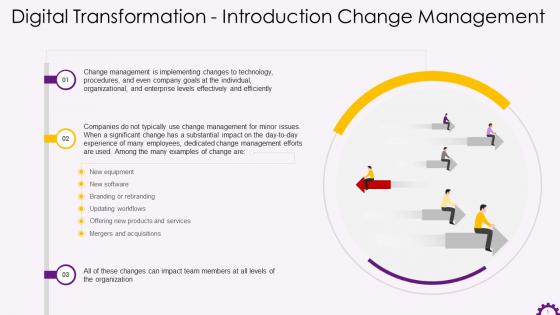
This slide depicts information about change management in the context of digital transformation. It emphasizes that change management is the effective and efficient implementation of changes to technology, procedures, and even company goals at the individual, organizational, and enterprise levels. It also provides examples of organizational changes.
Slide 2
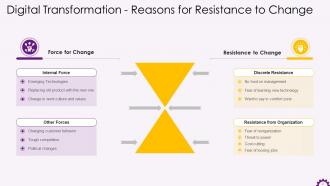
This slide illustrates the reasons for resistance to change when implementing change management. It also discusses the internal and external forces that contribute to organizational change.
Slide 3
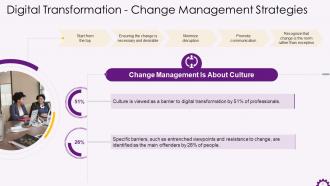
This slide showcases the change management strategies. The strategies include: start from the top, ensuring the change is necessary and desirable, minimizing disruption, promoting communication, recognizing that change is the norm rather than exception.
Instructor’s Notes: The strategies for change management are:
- Start from the top: Changes that affect the operation aspects of the business will impact the company's culture. As a result, such changes must begin at the top. Leadership's role during times of change is of great importance. For example, research on merger leadership discovered that when leaders took a more active role in change management, the merger process produced a more positive work environment
- Ensuring the change is necessary and desirable: If an organization lacks a solid strategy in place, introducing too much too soon can often be a massive problem down the road. Many digital transformation efforts fail or fall short of expectations. The main reason for this is that decision-makers are not sure of how to approach digital transformation and its impact on their business. Lack of a thorough audit can result in unnecessary solutions for an organization's needs, resulting in additional costs, additional training, and increased unrealistic expectations
- Minimize disruption: Employees transferred to a different position may become enraged, confused, or wonder what went wrong with the previous structure. In both cases, the result is lower morale, unsatisfactory performance, and a brain drain as your best performers flee. Disruption in the workplace can be reduced by:
- Preparing for some disruption and communicating as soon as possible
- Creating a culture that encourages change or transformation
- Giving employees the resources and training they need to adapt to changes
- Promote communication: Communication appears to be one of the underlying factors determining the success or failure of a transition or transformation during organizational change. Effective communication lets everyone on the same page and ensures that those who will bear the brunt of these changes are safe
- Recognize that change is the norm rather than exception: Technology, markets, consumer preferences, and even environmental conditions all rise and fall in the blink of an eye in today's world. Businesses must not only transform their operations to keep up with their customers, they must anticipate change and be prepared to deal with it when it occurs
Role Of Change Management In Digital Transformation Training Ppt with all 19 slides:
Use our Role Of Change Management In Digital Transformation Training Ppt to effectively help you save your valuable time. They are readymade to fit into any presentation structure.








FAQs for Role Of Change Management In Digital
Okay so the biggest thing is communication - you've gotta explain WHY you're changing stuff because people hate being left in the dark. Leadership buy-in is huge too. If your boss isn't sold on it, forget about everyone else getting on board. I swear half the time changes bomb just from crappy communication alone. Anyway, don't just announce things TO people - actually get them involved in figuring it out. Give them proper training, and honestly? Celebrate the small stuff early on. Builds momentum. Oh and listen to people's concerns first before you do anything else.
Culture basically makes or breaks any change you're trying to implement. Like, if your workplace is super rigid and hierarchical, good luck getting everyone on board with something flexible like agile methods. It's gonna be rough. But here's the thing - you can't just ignore culture and pray everything works out. I've watched so many companies fail because they skipped this step entirely. Figure out what parts of your current culture will actually help the change happen. Then work with those strengths instead of fighting against them. Sometimes you might need to shift the culture first before making other changes stick.
Honestly, most change efforts crash because people just don't get why it's happening. Leadership does this terrible job explaining the "why" - they just announce stuff and expect everyone to roll with it. Employees push back hard when they're left in the dark. Then you've got unrealistic timelines (classic mistake), zero training, and managers who preach change but keep doing things the old way. Oh, and budget constraints always seem to pop up halfway through. My advice? Get people bought in early. Communicate like crazy. Give them actual tools to succeed, not just a motivational email.
Honestly, communication makes or breaks these things. People hate being left in the dark - I've watched so many good ideas crash just because nobody explained what was happening. Be upfront about the why, the timeline, all of it. Use whatever works - meetings, emails, those awkward one-on-ones. But here's the thing: actually listen when people push back. Map out who needs to know what and tailor your message. Different groups care about different stuff. Oh, and don't just talk AT them - make it a conversation or you'll lose half your team before you even start.
Honestly, leadership makes or breaks everything when it comes to change. If they can't clearly explain the vision and why it matters, you're already screwed. People will just sit back and wait for it to blow over - I've watched this happen so many times. The leaders who actually succeed are the ones modeling what they preach and dealing with pushback directly. They celebrate the small stuff too, which sounds cheesy but actually works. Oh, and here's the big one: your leadership team has to be on the same page. Mixed messages will torpedo any change effort faster than you can blink.
Honestly, you've gotta look at both the numbers and the vibe. Check if you're hitting those original timelines and budget goals you set - that's the obvious stuff. But employee surveys and adoption rates matter just as much, maybe more. Are people actually sticking with the changes or just going through the motions? High turnover or pushback usually means something's off. I'd set up maybe 3-4 key things to track monthly so you can pivot fast. Oh, and watch for those productivity dips - they're sneaky but super telling about whether changes are really working.
Honestly, most pushback happens because people are scared - job security, more work dumped on them, or just not knowing what's coming. Talk to your biggest resistors one-on-one first. Figure out their specific concerns instead of brushing them off. Get them involved in planning so they don't feel like stuff is just happening *to* them, you know? Training helps too, obviously. I've watched so many changes crash because leaders thought people would just magically adapt. Find a few supporters who can help sway others. Oh, and don't forget to celebrate wins - even tiny ones matter.
Honestly, engaged employees will make or break your change project. When people trust leadership and feel connected, they're 70% more likely to actually support what you're doing instead of just pretending to go along. Plus they communicate better and catch issues early - which is huge. But here's the thing: disengaged teams are absolutely brutal. They'll resist everything, spread negativity, and basically tank your whole initiative. I've seen it happen so many times. Before rolling out major changes, you really need to check where your team's at engagement-wise. Fix any trust problems first or you're setting yourself up to fail.
Tech has honestly revolutionized change management - everything's way more data-driven now. You can track how people are adopting changes in real-time, which is pretty wild compared to just guessing like we used to. Analytics help predict pushback before it even starts happening. Plus you've got all these communication channels to reach people where they actually are. The tricky part? Technology moves so damn fast that your change processes have to be super flexible too. I'd start by figuring out what digital tools your team already knows well, then just build around those instead of forcing new platforms on everyone.
Oh man, don't make my mistake - I once rolled out a "simple" system upgrade that became total chaos because we didn't prep anyone beforehand. Figure out who's affected by your changes first, then actually talk to them about their concerns. Build communication and training right into your project plan as real deliverables, not something you'll "get to later." Get your executives to publicly back the changes too. Honestly, most people underestimate this stuff. Set aside 20% of your budget and timeline just for change management - trust me on this one.
So incremental change is basically baby steps - you're tweaking processes, making small updates gradually. Transformational is the complete opposite. We're talking major overhauls that flip your whole organization upside down. Most companies stick with incremental because, let's be real, it doesn't freak everyone out. But when the market's shifting fast? That's when you need the big transformational moves to actually make a difference. The main thing is scope - incremental works with what you've got, transformational throws it out and starts fresh. Just make sure you know which one you're dealing with before diving in, because the strategies are totally different.
Yeah, it totally depends on your industry. Tech companies can flip strategies overnight with agile stuff, but healthcare and finance? Good luck with all that compliance paperwork - seriously, the bureaucracy is wild. Manufacturing's different too since you're dealing with actual machines and workers (plus unions if they're around). Retail has this tricky balance where they can't mess up the customer experience while changing everything internally. Oh, and digital transformation in retail is basically chaos from what I've seen. I'd look up some real case studies in your specific field - way more helpful than generic advice.
Kotter's 8-Step Process works great for the big picture stuff - you know, creating urgency, building coalitions. Then pair it with ADKAR for the individual level (Awareness, Desire, Knowledge, Ability, Reinforcement). But honestly? Most frameworks do the job if you don't keep switching between them. Pick whatever fits your company's vibe and stick with it. I've seen too many teams jump around and get nowhere. Start by figuring out where you'll hit resistance first - that's usually the make-or-break moment anyway. It'll show you which tools to focus on right off the bat.
Honestly, the key is baking it into your actual daily stuff - update job descriptions, tie it to performance reviews, all that. Training's critical because people forget everything if you don't keep reinforcing it. I've watched so many "successful" changes completely collapse after like 6 months when leadership got distracted by something else (happens every time). Keep tracking how it's going and celebrate the wins. Jump on any backsliding right away. But here's the thing - your managers have to actually live this stuff consistently. That's what makes it stick for real.
Honestly, most change efforts crash because leadership talks a big game but doesn't actually commit. People get blindsided too - like nobody told them why this matters or what they're supposed to do differently. Organizations love trying to overhaul everything at once, which is just asking for chaos. Communication gets weird where executives think they explained it clearly but everyone's still lost. Oh, and you need champions throughout the company, not just at the top. Start small, communicate constantly (and I mean constantly), and make sure leaders actually model the behavior they want. Otherwise you're toast.
-
Excellent template with unique design.
-
Extremely professional slides with attractive designs. I especially appreciate how easily they can be modified and come in different colors, shapes, and sizes!