

Understanding Essential Fire Safety Equipment Training Ppt





Try Before you Buy Download Free Sample Product
 Impress Your
Audience
 100%
Editable
 Save Hours
of Time


This set of slides gives an overview of the essential fire safety equipment in the workplace. Fundamental fire safety equipment includes fire hydrants, sprinklers, dry risers, CO2 flooding system, drenchers, hose reels, and fire doors.
People who downloaded this PowerPoint presentation also viewed the following :
Content of this Powerpoint Presentation
Slide 1
This slide lists types of fire protection equipment that can be used at workplaces. These are fire hydrants, sprinklers, dry risers, CO2 flooding system, drenchers, hose reels, and fire doors.
Slide 2
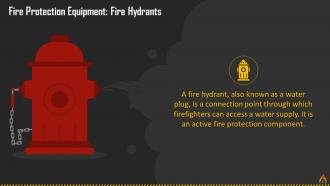
This slide tells us about fire hydrants that can be used at workplaces as fire protection equipment. A fire hydrant, also known as a water plug, is a connection point through which firefighters can access a water supply. It is an active fire protection component.
Slide 3
This slide talks about sprinklers that can be used at workplaces as fire protection equipment. A fire sprinkler or sprinkler head is an element of a fire sprinkler system that releases water whenever the effects of a fire are identified, such as exceeding a specified fixed temperature.
Slide 4
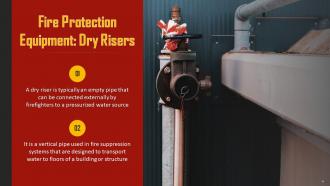
This slide tells us about dry risers that can be used at workplaces as fire protection equipment. A dry riser is typically an empty pipe that firefighters can connect externally to a pressurized water source.
Slide 5
This slide talks about CO2 Flooding System that can be used at workplaces as fire protection equipment. A CO2 Gas Flooding System spreads a layer of heavy gas that reduces the oxygen content in the atmosphere to a level where combustion is no longer feasible
Slide 6
This slide tells us about drenchers that can be used at workplaces as fire protection equipment. A drencher system consists of water heads that are used for fire protection. As opposed to sprinklers found internally, drenchers are typically installed on the exterior of a structure to protect against fire from a surrounding building.
Slide 7
This slide provinces information about hose reels that can be used at workplaces as fire protection equipment. A hose reel is used to suppress fires by carrying water or other fire retardants like foam at high pressure.
Slide 8
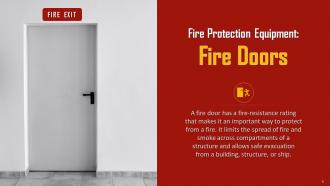
This slide tells us about fire doors that can be used at workplaces as fire protection equipment. A fire door has a fire-resistance rating that makes it an important way to protect from a fire.
Understanding Essential Fire Safety Equipment Training Ppt with all 24 slides:
Use our Understanding Essential Fire Safety Equipment Training Ppt to effectively help you save your valuable time. They are readymade to fit into any presentation structure.












FAQs for Understanding Essential Fire Safety
Fire extinguishers are the main thing - everyone should know those inside and out. Also get familiar with fire blankets, emergency alarms, and evacuation stuff like exit lights. People always mess up with fire doors by propping them open (seriously, why do they do that?). You can't actually operate the sprinkler systems yourself, but it's good to understand how they work. Really though, just figure out what's in your specific building and where it's all located. Maybe walk around your floor sometime this week and actually look for all this equipment.
At minimum you need yearly training - that's what most places require anyway. New hires should get it within 30 days, plus refreshers when you get new equipment. Honestly though, if your workplace is kinda risky I'd do quick sessions every six months. The whole point is people actually knowing where stuff is when things go sideways, not just checking a box. Oh and train everyone again if you change your setup. You're already thinking about it so might as well schedule something now before you forget.
Hey! So for fire training, definitely do hands-on practice with the actual extinguishers - videos are useless tbh. Cover the different fire types and which extinguisher works for what. People need to know where equipment's located, evacuation routes, and meeting spots. Oh and make sure someone knows how to work the alarm system properly. The communication protocols are huge too - like who calls 911, who does headcount, etc. Honestly you'll probably need refreshers every 6 months or so because people forget this stuff fast when they're not dealing with fires regularly (thankfully lol).
Run some surprise drills and time how fast people actually get out - you'll be shocked at the results sometimes. Quiz them a few weeks later on the basics to see what stuck. Honestly, most people just go through the motions during training, so make your practice scenarios feel real. Check if they're using equipment right, not just grabbing whatever's closest. Track any close calls or incidents - good training should make those way less common. The whole point is whether your team would actually know what to do if something went down, so don't make it boring.
You definitely need actual hands-on practice with this stuff. Reading about it won't cut it when there's an actual fire happening. I was surprised how different it felt the first time I actually used one - way more pressure than I expected! Your muscle memory only develops when you've physically done the PASS thing (Pull, Aim, Squeeze, Sweep) a few times. Most people get pretty nervous their first go at it too. Make sure your training isn't just someone talking at you about theory. Get your hands on the actual extinguisher and practice.
Honestly, the biggest thing people get wrong is thinking any fire extinguisher works on any fire - huge mistake. Using the wrong type can literally make it worse. Also, once you've used one even a little bit, you can't just put it back - needs to be serviced by a pro. Most sit around for years without anyone checking if they even work anymore (they probably don't). Your team should learn the PASS method instead of just spraying randomly and hoping for the best. Oh, and those pressure gauges? Check them monthly or you're basically carrying around expensive paperweights.
Look, you can't just throw everyone into the same boring training session - trust me, I've sat through way too many of those. Management needs the leadership stuff: coordinating with first responders, tracking who's out of the building, that kind of thing. Your regular employees? They need actual hands-on time with fire extinguishers and knowing their evacuation routes. Floor wardens have totally different jobs than executives do during emergencies. Here's what works: figure out what each person's role actually is during a fire, then build training around those specific scenarios. Way more effective than generic presentations.
OSHA's your starting point - they handle the basic workplace fire safety stuff. Different industries pile on extra rules though. Healthcare has NFPA 99, manufacturing deals with NFPA 10 for extinguishers, oil/gas companies get stuck with API standards. Construction? That's OSHA 1926. Honestly, the regulations can get pretty overwhelming when you're trying to figure out what applies to you. I'd just hit up your industry association first - they've usually done the legwork and can tell you exactly which rules matter for your specific setup. Way easier than digging through regulatory documents yourself.
VR fire training is actually pretty brilliant - you can mess up without burning anything down or making a huge mess. Honestly way less nerve-wracking than your first time with real equipment. The simulations will show you what happens if you grab the wrong extinguisher type or approach the fire all wrong. You get immediate feedback on your technique too. I'd definitely combine VR practice with some hands-on stuff though, since muscle memory from both really helps when things get real. Plus you can repeat scenarios until you've got it down cold.
Honestly, ditch the PowerPoint death march - nobody retains that stuff anyway. Get people actually using the fire extinguishers and walking those evacuation routes themselves. I'd do quick 20-30 minute sessions max because attention spans are shot these days. Throw in scenarios like "alarm's going off right now, what's your move?" Make it specific to your actual building and hazards too. The interactive approach works way better than just talking at people. Q&A keeps things lively, and when they're moving around instead of zoning out in chairs, they'll actually remember what you taught them.
Document the refusal first - that's your CYA move. Then sit down and figure out what's really going on. Maybe they're swamped with deadlines or genuinely freaked out by the whole thing. Be straight with them: this isn't optional, and there's real legal liability for everyone if something happens. People get surprisingly stubborn about fire drills - I never get it, but whatever. If they still won't budge after you explain it, loop in HR because now it's their problem. Just make sure everything's in writing so you're covered.
Start with the obvious stuff - where the pull stations are and how to actually use them. Different alarm sounds mean different things, so cover that too. Then dive into evacuation routes because triggering an alarm is useless if everyone just stands around confused. Make sure people know who can reset the system after false alarms (happens more than you'd think). Testing procedures are crucial - nobody wants to accidentally evacuate the whole building during routine maintenance. Most important thing? Hands-on practice. Get everyone pulling those stations during drills so they're not panicking and fumbling around when it actually matters.
Honestly, just build it into your training from day one - way less headache than trying to fix it later. Get your materials ready in different formats: audio files, large print, braille, plus digital stuff that plays nice with screen readers. When you're doing the hands-on drills, double-check that evacuation routes actually work for wheelchairs and think about visual cues for deaf employees. Oh, and here's the thing - don't guess what people need. Actually ask your HR team about specific accommodations, then run a practice session with someone who has disabilities first. Trust me, they'll catch issues you'd never think of. Short version: ask, don't assume.
Oh man, skipping fire safety training is such a costly mistake. You're looking at potential lawsuits, crazy insurance hikes, and OSHA fines that'll make your head spin. I've literally seen businesses get slammed with penalties that could've paid for training for like a decade. Insurance companies will jack up your rates too if you can't show proper training records. Honestly, spending 2-5K on annual programs beats paying hundreds of thousands after something goes wrong. Your premiums stay reasonable when you've got solid documentation. Worth doing an audit to see where your gaps are right now - probably more than you think.
Honestly, the best thing you can do is make those drills feel real. Block off some exits, turn off lights to simulate power outages, maybe even get one of those fake smoke machines if your company's budget allows it. Practice with actual fire extinguishers in your building - not some generic training room. Have people role-play who's calling 911, who helps anyone with mobility issues, all that stuff. Oh and make sure someone's doing headcounts at your actual meeting spots. The whole point is building that muscle memory so people don't freeze up when something actually happens. Way more effective than those boring classroom sessions.
-
I want to thank SlideTeam for the work that they do, especially their customer service.
-
“You have the structure in place that are easy to explore new opportunities.I will be recommending your services to other people.”