


Concept Of Fire Triangle Training Ppt




Try Before you Buy Download Free Sample Product
 Impress Your
 Audience
 100%
100% Editable
 Save Hours
 of Time


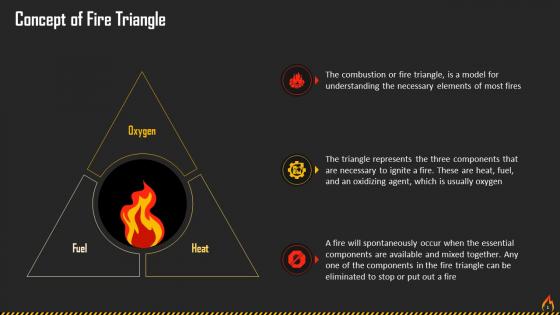
This slide covers the combustion triangle or fire triangle, a model for understanding the necessary elements of most fires. The triangle represents the three components that are necessary to ignite a fire. These are heat, fuel, and an oxidizing agent.
People who downloaded this PowerPoint presentation also viewed the following :
Concept Of Fire Triangle Training Ppt with all 17 slides:
Use our Concept Of Fire Triangle Training Ppt to effectively help you save your valuable time. They are readymade to fit into any presentation structure.










FAQs for Concept Of Fire
So basically fire needs three things - heat, fuel, and oxygen. It's like a three-legged stool, you know? Knock out any leg and the whole thing falls over. Heat kicks off the chemical reaction, fuel feeds it, oxygen keeps it going. That's why fire extinguishers aren't all the same - some cut off oxygen, others cool things down, some remove the fuel source. Pretty clever actually. If you're ever dealing with fire safety stuff, just focus on eliminating one of those three and you'll kill the fire. Way simpler than people make it sound.
So basically fire needs three things to survive - fuel, oxygen, and heat. Take away any one of them and boom, fire's out. You can smother it (cuts oxygen), remove what's feeding it like shutting off gas, or cool it down with water. Water's actually pretty smart because it does two things at once - cools AND makes steam that pushes oxygen away. Just figure out which one's easiest to tackle. Oh, and never dump water on grease fires in the kitchen - that'll just make things worse. Use a lid to smother those instead.
So basically fire needs oxygen to survive - like around 16% concentration minimum. Regular air has 21%, so there's usually plenty to work with. You can kill fires by cutting off that air supply though. Foam, sand, CO2 extinguishers - they all smother the flames. Water does this too actually, since the steam pushes oxygen away. Pretty wild how well it works! If you can't get rid of the heat or whatever's burning, just focus on starving it of air. That's honestly your best bet most of the time.
So basically the whole fire triangle thing is your game plan for putting fires out. Water cools stuff down, foam blocks oxygen from getting to the flames. You've got fire retardants that coat whatever's burning, or you can just remove fuel completely with firebreaks - though that's obviously way easier said than done sometimes. Different extinguisher types hit different parts of the triangle too. CO2 pushes out all the oxygen, dry chemical messes with the actual chemical reaction happening. Really just comes down to figuring out which element you can actually get rid of with whatever you've got on hand.
Okay so here's the thing - you don't actually need to eliminate ALL three elements of the fire triangle. Just disrupt one effectively and you're good. But people make some wild mistakes with this stuff. Like throwing water on a grease fire (spreads everywhere) or electrical fires (hello, electrocution risk). Also, just because you can't see fuel doesn't mean it's gone - vapors can still ignite later. Oh and different fires need different extinguishers, which seems obvious but apparently isn't? The key is figuring out which element is easiest to tackle in your specific situation.
So basically, temperature messes with that whole fire triangle thing - you know, heat, fuel, oxygen. When it's hotter outside, stuff ignites way easier because you're already closer to that magic ignition point. Cold weather? You'll need way more heat to get anything going. I swear lighting a fire in summer versus winter is like night and day! Your fuel and oxygen matter just as much, but temperature is what decides how much extra energy you need. Oh, and if you're doing any kind of safety planning, don't forget seasonal changes totally shift those ignition thresholds.
So with hazardous stuff, the fire triangle gets way more complicated. Those chemicals you're dealing with? They ignite at crazy low temperatures compared to regular materials. Static electricity alone can set things off - honestly, it's kind of terrifying how sensitive some solvents are. Heat sources become a huge problem since even warm equipment can trigger ignition. The oxygen part gets weird too because certain chemicals actually produce their own oxidizers. You've gotta map out every possible way these three elements could meet in your space. Multiple safety barriers are your best friend here.
So basically the fire triangle thing is about cutting off one of the three things fire needs - fuel, heat, or oxygen. You can't really mess with oxygen (we kinda need that lol), but you've got control over the other two. Store flammable stuff away from heat sources, keep your electrical system in decent shape, and don't let junk pile up in places like the attic. Smoke detectors are obviously crucial too. Be smart with candles and space heaters - those things cause way more fires than people think. Really it comes down to keeping fuel and heat separated since that's what you can actually manage daily.
Honestly, the fire triangle thing is super practical once you get it. Grease fires happen because people panic and dump water on them - terrible idea. Wildfires go crazy when it's dry and windy since there's tons of oxygen feeding the flames. Building codes actually use this concept too. Fire doors and sprinklers work by removing heat and cutting off oxygen. Even covering a campfire with dirt does the trick because you're basically suffocating it. Bottom line: knock out any one part of that triangle and you'll stop the fire. Just think fuel, heat, or oxygen - which one can I eliminate?
So different fuels behave totally differently in fires. Gasoline vaporizes crazy fast and lights at low temps - honestly terrifying stuff. Wood's gotta break down into gases first, which takes way more heat. Gas fuels are already vapor so they'll ignite instantly when they hit oxygen. The chemical makeup changes everything too - burn rate, heat output, all of it. That's why grease fires and paper fires need completely different approaches. Oh, and always check those safety data sheets when you're doing risk assessments. They'll tell you exactly what you're dealing with for each material.
So basically, firefighters attack different parts of the fire triangle - heat, fuel, or oxygen. Foam suppressants block oxygen by creating barriers. CO2 systems just push all the air out of the way. Water mist is actually pretty genius - way better at pulling heat than regular sprinklers and doesn't waste as much water. Chemical suppressants (like the new halon replacements) mess with the actual chemical reaction happening. Fire retardants coat stuff so it can't burn. Here's the thing though - water isn't always your best bet. Sometimes cutting off oxygen or fuel works way better depending on what's burning.
Honestly, just do the candle demo - it's foolproof. Light one up and show how covering it with a glass kills the flame (no oxygen), blowing it out removes heat, and dunking it in water cuts off fuel access. Kids go crazy for it every time. With adults, I'd tie it back to stuff they actually deal with - like why you never put water on a grease fire. Draw the triangle as you go and have them guess what'll happen next before each demo. Way better than just talking at people about fire science, you know? Gets them actually thinking instead of zoning out.
So basically you're working backwards from the burn scene, right? Look at the burn patterns first - they'll show you exactly where everything started. Then figure out what was burning (the fuel), check if airflow made things worse or better, and hunt down whatever heat source kicked it all off. Honestly, it's pretty much like being a detective but with more charred stuff. Once you can connect fuel + oxygen + heat at that exact spot, boom - there's your cause. The tricky part is usually pinning down the heat source since that's what actually started the whole mess.
So building codes are basically designed around the fire triangle - you know, fuel, oxygen, heat. They require fire-resistant materials to control the fuel side. Ventilation and HVAC systems manage oxygen flow, which is honestly pretty smart when you think about it. Electrical standards handle the heat sources. Modern buildings stack sprinkler systems on top of that to cool things down, plus some use displacement systems that actually remove oxygen. It's like a layered defense thing. When you're looking at plans, just check how each system tackles at least one part of that triangle.
Yeah so the fire triangle is kinda outdated tbh. It misses the chemical chain reaction part - that's why fire science moved to the "fire tetrahedron" with four sides instead of three. Makes way more sense when you're trying to figure out why certain extinguishers work. Like clean agents that mess with molecular bonds rather than just removing oxygen or heat. Triangle can't explain that stuff at all. Some instructors still use it because it's easier to teach, but honestly? If you're doing any real fire safety work, go with the tetrahedron model. Way better for understanding complex scenarios.
-
Great product with effective design. Helped a lot in our corporate presentations. Easy to edit and stunning visuals.
-
The slides are remarkable with creative designs and interesting information. I am pleased to see how functional and adaptive the design is. Would highly recommend this purchase!