

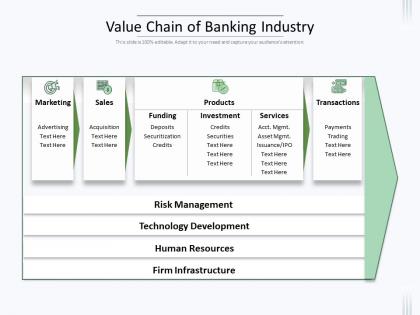
Value chain of banking industry




Try Before you Buy Download Free Sample Product
 Impress Your
 Audience
 100%
100% Editable
 Save Hours
 of Time


Say cheese with our Value Chain Of Banking Industry. Bring on the smiles from your listeners.
People who downloaded this PowerPoint presentation also viewed the following :
Value chain of banking industry with all 2 slides:
Our Value Chain Of Banking Industry have a cheery essence. Your listeners will become a bunch of smileys.

FAQs for Value chain
So banking basically breaks down into four main parts: getting customers (marketing, onboarding stuff), making the actual products (loans, deposits, investments), getting those products to people (branches, apps, partnerships), and then keeping customers happy afterward (support, collections, all that). It's kind of like a factory line but way messier since there's regulations everywhere. Oh and if one part screws up, the whole customer experience goes to hell. You should probably map out how your current projects fit into each area - gives you a better view of what's actually happening.
So CRM systems are game-changers for banks because they pull all your customer data into one place. You'll actually know who you're dealing with instead of just seeing account numbers. The cool part is you can predict what people need and sell them stuff that actually makes sense for them. Your support teams work way faster too since they're not scrambling for info - honestly, it's pretty obvious once you see it in action. Plus you catch opportunities that would normally slip through the cracks. I'd start by figuring out where your customer interactions are most scattered right now.
Banking tech is honestly a game changer - it automates so much stuff that used to take forever. Mobile apps let customers do their own transactions instead of calling in. AI catches fraud way better than humans ever could. Loan processing that used to take weeks? Now it's automated and happens in days. The data analytics side is pretty cool too - banks can actually predict staffing needs and manage risk in real time. Oh, and digital onboarding is huge now. If you're thinking about this for work, I'd start by looking at whatever repetitive tasks are eating up the most time.
Banks need to cut out all the friction that pisses customers off. Mobile check deposits, instant loan approvals, real-time notifications - basically digitize everything you can. The back-end processing has to be fast too because nobody cares if it's your fault or the system's when things are slow. Most banks are honestly terrible at this still. Map out where customers get stuck right now. Opening accounts should be simple. So should fixing problems. I'd probably start with whatever annoys people most - that's usually the low-hanging fruit that'll make the biggest difference.
Look, compliance and risk management are basically woven into everything banks do - customer onboarding, loans, payments, all of it. Yeah, it's kind of annoying but it stops banks from getting slammed with huge fines or completely failing. These processes help spot potential losses and keep you following all the rules (there are SO many). People think they slow things down, but honestly? They're what make the other business stuff actually work long-term. Plus customers trust you more when you're not constantly in trouble with regulators.
So basically banks take all that transaction data and figure out what it actually means for making better calls. Fraud detection happens in real-time now, which is honestly pretty impressive. Credit risk gets way more accurate too - they can spot who might default before it happens. Plus they personalize stuff based on how you actually spend money. I'd start with just one area where better data could help right away, then build from there. The crazy part is how they connect everything from customer service to risk management. Oh, and they can literally predict when someone's ready for a mortgage just from spending patterns.
Oh man, you're gonna hit some major roadblocks. Legacy systems are the worst - these banks are running on tech from like the 90s that absolutely refuses to play nice together. I've literally watched IT guys have breakdowns over this stuff. Data silos are another nightmare since every department hoards their info like it's classified. Don't even get me started on compliance - regulations change depending on where you are and what you're doing. People hate changing their workflows too. Honestly? Start small with pilot projects instead of going full nuclear on everything at once.
Look, fintech partnerships are basically shortcuts to avoid reinventing the wheel. Instead of spending years building your own payment system or lending tech, you just plug into theirs. Way faster and cheaper than doing it yourself. These fintech companies move super quick compared to old-school banks - honestly, they're built for speed. You can roll out new features in months instead of years. The trick is picking partners whose stuff actually works with what you already have, not ones that'll clash with your existing setup. Otherwise you're just creating headaches for yourself.
Banks are scrambling to keep up with digital changes - way faster than they expected. Sure, you see the obvious stuff like mobile apps replacing branch visits. But the real shake-up is happening behind the scenes. Loan approvals, risk checks, payments - all getting automated through AI and cloud tech. Those old step-by-step processes? Now they're happening in real-time instead. Honestly, I think most banks still don't get it though. Just slapping technology onto old systems won't cut it. You've gotta completely rethink how you operate or you'll get left behind.
Economic downturns mess with everything in banking, honestly. Loan defaults shoot up first, which crushes your risk management team. Customer acquisition? Forget about it - nobody wants new credit when they're worried about their job. Funding gets more expensive too since liquidity dries up. Your ops team ends up juggling way more problem accounts while revenue tanks from less lending. Regulators start breathing down your neck more than usual (because that's what you need during a crisis, right?). Best thing you can do is stress-test everything now so you're not completely blindsided when it hits.
Yeah, banks totally can! Pick one process - like loan approvals or onboarding - and map out every step. You'll see where stuff gets stuck (usually between departments). Loan processing is perfect for this - documents just sit around forever instead of flowing smoothly. Map the touchpoints, cut the redundant steps, automate whatever makes sense. It's basically treating customer flows like a factory line, which sounds weird but actually works. The wait times drop significantly once you get departments talking to each other properly. Start small though - don't try to fix everything at once.
Track your customer acquisition costs and how long it takes to resolve service issues first. Operational efficiency ratios matter for each part of your value chain too. Customer lifetime value is huge, and yeah, everyone still obsesses over Net Promoter Score even though it's kinda overrated honestly. Cost-per-transaction and processing error rates will show you where things break down. Cross-selling success rates are solid indicators too. Banking's so regulated you can't ignore compliance metrics either. The trick is connecting these numbers to specific activities instead of just collecting random data - that's how you figure out what's actually worth fixing.
Don't just wait until the end to ask customers what they think - build feedback collection right into onboarding, loan apps, your website, basically everywhere they interact with you. The real challenge isn't gathering the data though, it's actually doing something with it (I swear half the banks I know just let surveys pile up). Get cross-functional teams who can move fast on changes instead of letting feedback sit around for months. Use what you learn to fix your processes and retrain staff. Oh, and close the loop - tell customers you heard them and what you're changing because of it.
So basically, banks can hit sustainability in three ways. First, be picky about lending - fund green stuff and companies that actually care about ESG. Second, clean up your own operations (less paper, better energy use, smaller carbon footprint). Third, partner with suppliers who aren't sketchy. Oh, and you'll need to bake ESG into risk assessments anyway since regulators are pushing that hard now. The trick is making it core to how you operate, not some afterthought department. I'd start with an audit to see where you're bleeding the most impact-wise. That'll show you where to focus first instead of trying to fix everything at once.
When banks merge, everything gets flipped around. Back-office stuff gets consolidated first - that's the easy money. Branch closures happen next (RIP your favorite teller probably). The real nightmare is combining tech systems - I've seen those integrations drag on forever. Usually the bigger bank keeps their processes and just absorbs the other's customers and profitable products. Risk management becomes a total headache with all the different legacy systems. Customer service changes the most since they cut duplicate services. Watch what they focus on during integration though - shows you where they're actually headed long-term.
No Reviews