


Weekly Roadmap For MVP Scope Plan




Try Before you Buy Download Free Sample Product
 Impress Your
Audience
 100%
Editable
 Save Hours
of Time


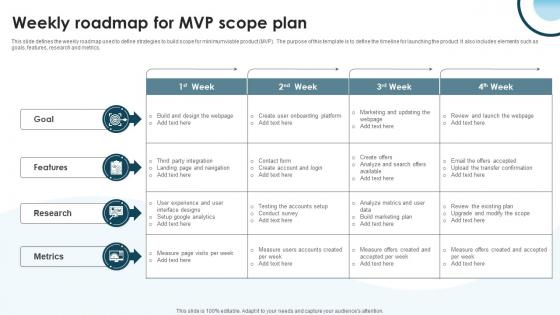
This slide defines the weekly roadmap used to define strategies to build scope for minimum viable product MVP. The purpose of this template is to define the timeline for launching the product. It also includes elements such as goals, features, research and metrics.
People who downloaded this PowerPoint presentation also viewed the following :
Weekly Roadmap For MVP Scope Plan with all 6 slides:
Use our Weekly Roadmap For MVP Scope Plan to effectively help you save your valuable time. They are readymade to fit into any presentation structure.






FAQs for Weekly Roadmap For
Okay so first figure out your core user problem and the absolute minimum features to solve it. I'd map out your assumptions first, then rank everything by risk and what you'll actually learn. Most teams (myself included) stuff way too much into their MVP - don't do this! Pick ONE main job users need done and stick to it. Success metrics and timeline milestones matter too, obviously. Prioritize by user impact first - like what HAS to work for people to get any value? Then look at technical stuff and dependencies. Your roadmap's basically just a hypothesis-testing plan anyway. Get to validated learning fast.
So MVP roadmaps are way more brutal than regular ones - you're cutting everything down to just the core stuff people actually need. Think of it like this: what's the tiniest version that still solves the main problem? Regular roadmaps have all the fancy features planned out for months, but MVP forces you to be super picky about what matters right now. Honestly, it's kind of liberating because you're not drowning in endless feature lists. Just write down everything you want to build, then slash like 80% of it. Sounds harsh but that's literally the point.
User feedback is your MVP's best friend - it shows you what's actually broken vs what you think might be. I'd collect it everywhere: interviews, support tickets, analytics, random user chats. Honestly? Too many teams build stuff nobody wants because they ignore this step. Sort feedback by how often it comes up and how big the impact would be. That becomes your feature priority list. Oh, and always tell users when you've fixed something they suggested - they love that shit and it keeps them engaged with giving you more feedback.
Honestly, just be brutal about what you actually need to test your main idea. Everything else is noise right now. Pick the bare minimum features that'll prove whether people want what you're building. I get it - you'll want to throw in extra stuff because it seems important. Don't. That's how launches get pushed back forever. Better to nail one thing perfectly than half-ass a bunch of features. You can use feature flags later to roll out more complexity without killing your timeline. Here's what works: pick your launch date first, then figure out what realistically fits. Working backwards forces you to make the tough calls instead of just adding more scope.
For your MVP, stick to maybe 5-7 metrics tops - any more and you'll drown in data. User engagement stuff is huge: daily/monthly actives, how often people use key features, retention rates. Then look for product-market fit signals through surveys and actual user conversations (honestly this is where the gold is). Don't chase vanity metrics that just make you feel good. Track your conversion funnels and any revenue/leads that matter for your specific model. Once you see which metrics actually change when you tweak things, then you can dig deeper into those.
Here's the thing - figure out what problem you're actually solving, then cut everything else. I always ask myself "what's the absolute bare minimum that proves people want this?" It's harsh but works. Your riskiest assumptions about users? Test those first with the simplest features possible. Talk to your actual target users constantly (I can't stress this enough). Half the stuff you think is "essential" probably isn't what they need at all. Map their path to success and only build what directly helps that journey. Yeah, it'll feel almost embarrassingly basic when you ship, but that's the point - you're learning, not building the perfect thing.
Build flexibility into your roadmap from day one. Don't get too detailed with specs upfront - keep features broad so you can adapt. Short sprints are your friend here. I've watched so many teams fall in love with their original idea and completely miss when they should've pivoted (honestly it's painful to see). Try timeboxed experiments rather than rigid deliverables. Your backlog needs constant review and reprioritization. Oh, and definitely build in buffer time for surprises. Trust me, users will want something totally different than what you expected.
Every 2-4 weeks, honestly. I used to think that was overkill but it's not - especially early on when you're getting tons of user feedback. After each sprint or big release, look at what the data's actually telling you. Maybe you need to pivot, maybe double down on what's working. Markets can flip overnight (remember 2020?). So yeah, make those review sessions with your team a regular thing. Don't wait until everything's on fire to check if you're still heading in the right direction. Trust me on this one.
Dude, you need an MVP roadmap. It gets everyone aligned on what you're actually building instead of having random stakeholders throwing in their two cents every five minutes. Shows your priorities and timelines super clearly. Your team finally understands how their daily work connects to the big picture - which honestly saves so much headache later. The visual aspect is clutch for managing expectations too. Plus it stops feature creep dead in its tracks (trust me on this one). Just map out your core features and show it at your next meeting. You'll see the confusion vanish instantly.
Honestly, the two biggest traps are overthinking your feature list and trying to please everyone from day one. Don't add "just one more tiny thing" - that's literally how MVPs turn into monsters. Skipping user research is another killer mistake. I've watched teams build for months only to discover nobody wanted what they made because they guessed instead of asking real people. Ship narrow and simple first. Yeah, it feels weird launching something that feels "incomplete," but better that than spending forever on complexity that breaks. Validate your assumptions fast and don't let perfectionism kill your momentum.
Honestly, competitive analysis is like having insider info when building your MVP. Check out what your competitors are crushing and where they're totally missing the mark - those gaps are pure gold for your product. I'd dig into their main features, see what users are complaining about, and look at pricing to get the baseline expectations. Then you can decide what to match, what to skip, and where you might actually beat them. The whole point is using that intel to rank your feature list. Focus on stuff that'll make you stand out instead of just copying everyone else. It's basically a shortcut to smarter prioritization, which honestly saves you tons of time later.
Miro and Figma are solid picks if you want something visual - love how easy it is to drag stuff around and get the whole team involved. ProductPlan's really good for prioritization but costs more than I'd like honestly. You might already have Notion lying around? It's actually pretty decent for roadmaps, way more flexible than people give it credit for. Trello works fine too if you're keeping things basic with just cards and lists. My advice though - whatever tool your team will actually open and use beats the "perfect" solution sitting untouched.
So MVP roadmaps are pretty much perfect for agile dev - they stop you from trying to build the entire universe in one go. You'll ship small pieces, test your ideas, and actually listen to what users tell you (which is usually not what you expected, honestly). Think of it like GPS that reroutes when there's a jam. Your team can focus on what really matters instead of getting distracted by shiny features. Start with the core problem you're solving. Then figure out the bare minimum features to fix it. Everything else? That's future you's problem.
Hit them with your problem statement and who you're solving it for first. Then break down your MVP features - be super clear about priorities here. Timeline comes next with milestones that won't make you look crazy later. Success metrics are crucial too, obviously. Honestly, stakeholders eat up competitive analysis slides, so toss one in there. Here's the thing though - be really explicit about what you're NOT building. Scope creep will destroy you otherwise. Mockups help a ton if you've got them. Wrap up with what you actually need from them - budget, people, or just a green light to keep going.
Work backwards from where you want to be in 2-3 years. What's the tiniest version that still proves your concept? That's your MVP. Here's the thing - your MVP should feel like the baby version of your big vision, not some random side project. I've seen so many teams build MVPs that are basically just waiting to pivot into something totally different. Pick features that connect directly to your end goal, even if they're super stripped down. Write down how each MVP piece fits into the bigger picture so everyone gets it. Otherwise you'll end up with stakeholders going "wait, how does this login screen relate to our AI-powered whatever?" Keep that thread visible.
-
Based on my personal experience, I would recommend other people to subscribe to SlideTeam. No one can be disappointed here!
-
The presentations are very helpful. I am always able to get appropriate templates for the different topics related to my profession.