


What is cultural bias edu ppt




Try Before you Buy Download Free Sample Product
 Impress Your
 Audience
 100%
100% Editable
 Save Hours
 of Time


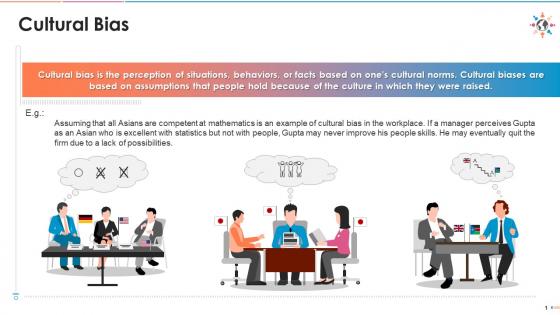
This slide covers the definition of cultural biases with some examples. It also depicts that cultural biases in the hiring process may lead to less racial or cultural diversity in the workplace.
People who downloaded this PowerPoint presentation also viewed the following :
What is cultural bias edu ppt with all 16 slides:
Use our What Is Cultural Bias Edu Ppt to effectively help you save your valuable time. They are readymade to fit into any presentation structure.








FAQs for What is cultural
Cultural bias types include ethnocentrism, sampling bias, language barriers, response style variations, and researcher assumptions about universal behaviors. These biases significantly impact data interpretation across global markets, with many multinational organizations finding that diverse research teams, culturally adapted methodologies, and localized data collection ultimately deliver more accurate insights and competitive advantage in international expansion.
Cultural bias affects marketing campaigns by influencing messaging relevance, visual representation, channel selection, and audience engagement strategies. When marketers overlook cultural nuances, campaigns often fail to resonate with diverse audiences, resulting in reduced conversion rates and brand disconnect, while culturally-informed approaches enhance customer connection and market penetration across different demographic segments.
Educators can recognize cultural bias by auditing materials for diverse representation, examining underlying assumptions, reviewing language for inclusivity, and seeking feedback from diverse communities. Through incorporating multicultural perspectives, using varied examples from different backgrounds, and regularly updating content, teachers enhance learning experiences while fostering inclusivity, with many institutions finding that diverse materials significantly improve student engagement and outcomes.
Cultural biases manifest in workplaces through unequal promotion opportunities, communication misunderstandings, exclusion from informal networks, stereotyping based on accents or customs, and varying leadership style preferences. These biases significantly impact employee relations by creating tension, reducing collaboration, limiting diverse perspectives, and ultimately decreasing productivity, with many organizations finding that addressing cultural bias enhances team cohesion and competitive advantage.
Cultural bias significantly influences media representation through stereotypical character roles, limited narrative perspectives, underrepresentation in leadership positions, and skewed storytelling frameworks that favor dominant cultural viewpoints. This presents both challenges and opportunities for entertainment organizations, with many studios and networks increasingly finding that diverse, authentic representation enhances audience engagement, expands market reach, and delivers stronger financial performance across global demographics.
Researchers can minimize cultural bias by employing diverse, multicultural research teams, using culturally validated instruments, implementing cross-cultural validation techniques, and incorporating local community input throughout the study design. These methodologies enhance validity by ensuring perspectives from different cultural contexts are represented, ultimately delivering more accurate, globally applicable findings that better serve diverse populations and improve research credibility.
Organizations can create inclusive environments by implementing diverse hiring practices, providing cultural competency training, establishing bias-aware policies, fostering cross-cultural collaboration, and creating feedback mechanisms for continuous improvement. These strategic approaches streamline workplace dynamics by enhancing communication, reducing misunderstandings, and leveraging diverse perspectives, with many companies finding that inclusive cultures ultimately deliver higher employee engagement, innovation, and competitive advantage.
Cultural bias significantly shapes consumer behavior by influencing purchasing decisions, brand preferences, communication styles, and product expectations across different regions. In Asian markets, collective decision-making often drives family-oriented purchases, while Western consumers typically prioritize individual choice, with many retailers finding that localized marketing strategies, culturally-adapted product offerings, and region-specific customer experiences ultimately deliver higher engagement and competitive advantage.
Cultural bias is particularly prevalent in psychological assessment tools, diagnostic criteria, therapeutic approaches, research methodologies, and cognitive testing, often reflecting Western-centric perspectives. Addressing this requires developing culturally adapted interventions, diversifying research populations, training psychologists in cultural competency, and incorporating indigenous healing practices, with many mental health institutions finding that culturally responsive approaches significantly enhance treatment effectiveness and client engagement.
Cross-cultural communication training reduces misunderstandings by teaching awareness of cultural differences, nonverbal communication patterns, and varying business practices across regions. Through structured workshops and real-world scenarios, organizations enhance employee sensitivity, improve client interactions, and streamline international partnerships, with many global companies finding that comprehensive training ultimately delivers stronger relationships and competitive advantage in diverse markets.
Artists and designers can challenge cultural biases through inclusive research methodologies, diverse collaboration partnerships, authentic representation practices, accessibility-focused design principles, and community-centered feedback processes. These approaches enable creative professionals to move beyond traditional perspectives, with many studios and agencies finding that culturally inclusive work resonates more broadly, ultimately delivering enhanced audience engagement and competitive market advantage.
Cultural bias significantly impacts global health initiatives by creating barriers to healthcare access, reducing treatment adherence, and limiting community engagement in resource-limited settings. When programs ignore local beliefs, social structures, and cultural practices, they often face resistance from communities, leading to reduced vaccination rates, maternal health service utilization, and chronic disease management, with many organizations finding that culturally responsive approaches ultimately deliver better health outcomes and sustainable community partnerships.
Technology contributes to cultural bias through biased training data, algorithm design reflecting developer perspectives, and automated systems amplifying existing prejudices. However, it also reduces bias by enabling diverse data collection, implementing bias detection algorithms, and facilitating cross-cultural collaboration platforms, with many organizations finding that strategic AI governance ultimately delivers more equitable outcomes and enhanced global competitiveness.
Cultural bias significantly influences public policy by shaping how policymakers interpret data, prioritize community needs, and design implementation strategies, often inadvertently favoring dominant cultural perspectives while overlooking minority viewpoints. This creates policies that may inadequately serve diverse populations, with many governments increasingly recognizing that inclusive stakeholder engagement and cultural competency training ultimately deliver more effective, equitable outcomes across communities.
Unaddressed cultural bias in education systems creates persistent achievement gaps, reduced educational outcomes for marginalized students, teacher-student disconnection, and systemic inequities that perpetuate across generations. These consequences ultimately limit institutional effectiveness, reduce diverse talent development, and undermine educational quality, with many progressive institutions finding that addressing bias through inclusive curricula and cultural competency training delivers improved student engagement and broader academic success.
-
Easily Understandable slides.
-
Use of different colors is good. It's simple and attractive.
-
Great designs, Easily Editable.
-
Very unique, user-friendly presentation interface.
-
I discovered this website through a google search, the services matched my needs perfectly and the pricing was very reasonable. I was thrilled with the product and the customer service. I will definitely use their slides again for my presentations and recommend them to other colleagues.