


Hofstedes cultural dimensions theory edu ppt




Try Before you Buy Download Free Sample Product
 Impress Your
 Audience
 100%
100% Editable
 Save Hours
 of Time


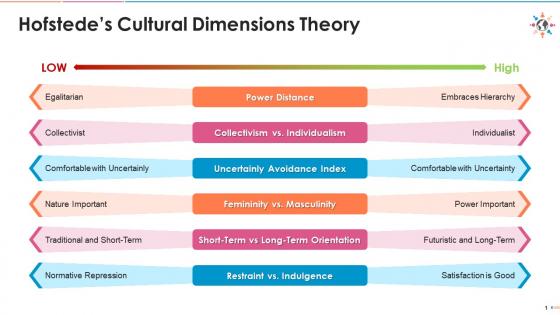
This slide covers the details on Hofstedes cultural dimensions theory. It includes what is Hofstedes cultural dimensions theory and six cultural dimensions.
People who downloaded this PowerPoint presentation also viewed the following :
Hofstedes cultural dimensions theory edu ppt with all 16 slides:
Use our Hofstedes Cultural Dimensions Theory Edu Ppt to effectively help you save your valuable time. They are readymade to fit into any presentation structure.










FAQs for Hofstedes cultural dimensions
Hofstede's Cultural Dimensions Theory includes Power Distance, Individualism vs. Collectivism, Masculinity vs. Femininity, Uncertainty Avoidance, Long-term vs. Short-term Orientation, and Indulgence vs. Restraint. These dimensions enable organizations to streamline cross-cultural management, enhance global team collaboration, and optimize international business strategies, with many multinational companies finding significantly improved operational efficiency.
Individualism versus collectivism fundamentally shapes workplace communication, decision-making processes, team collaboration, and leadership expectations across different cultural contexts. In individualistic cultures like the United States and Germany, employees prioritize personal achievement and direct communication, while collectivistic cultures such as Japan and China emphasize group harmony, consensus-building, and collaborative success, ultimately requiring managers to adapt their leadership styles and organizational structures accordingly.
High power distance cultures favor hierarchical, directive leadership styles where leaders make unilateral decisions and subordinates expect clear authority structures, as seen in countries like Malaysia and Mexico. Conversely, low power distance societies encourage participative, collaborative leadership approaches where managers actively seek input and create flatter organizational structures, with countries like Denmark and New Zealand demonstrating more egalitarian workplace dynamics that enhance employee engagement and innovation.
Uncertainty avoidance significantly influences decision-making in multinational organizations by affecting risk tolerance, information requirements, and consensus-building approaches across different cultural contexts. Organizations with high uncertainty avoidance cultures typically demand extensive documentation, detailed planning, and formal approval processes, while low uncertainty avoidance cultures embrace faster, more flexible decision-making, with many global companies finding that adapting their decision frameworks to local cultural preferences ultimately delivers better employee engagement and operational efficiency.
High-context communication involves implicit messaging through non-verbal cues, relationships, and shared understanding, commonly found in collectivist cultures like Japan and Arab nations, while low-context communication relies on explicit, direct verbal exchange typical in individualist societies like Germany and Scandinavian countries. These communication styles significantly impact international business negotiations, team collaboration, and customer relationship management, with many multinational organizations finding that adapting communication approaches to cultural contexts enhances operational efficiency and competitive advantage.
Masculinity versus femininity in Hofstede's model significantly influences corporate gender dynamics, with masculine cultures emphasizing competition, achievement, and traditional role distinctions, while feminine cultures prioritize collaboration, work-life balance, and egalitarian approaches. Through these cultural orientations, organizations in masculine societies like Japan or Germany often maintain hierarchical structures and performance-driven environments, whereas companies in feminine cultures like Sweden or Denmark increasingly adopt flexible policies, shared leadership models, and inclusive practices, ultimately delivering more diverse workplace cultures and enhanced employee satisfaction across different cultural contexts.
Understanding long-term versus short-term orientation enables businesses to align strategic planning with cultural expectations regarding investment horizons, stakeholder relationships, and growth timelines. Companies operating in long-term oriented markets like Germany or Japan emphasize sustainable growth, gradual market penetration, and relationship building, while short-term focused cultures prioritize immediate results and quarterly performance, ultimately delivering more culturally resonant strategic approaches.
Hofstede's theory reveals that successful cross-cultural negotiations require adapting strategies to match cultural dimensions like power distance, uncertainty avoidance, and individualism versus collectivism preferences. Negotiators from high-context cultures often prioritize relationship-building and consensus, while low-context cultures focus on direct communication and efficiency, with many international organizations finding that understanding these differences streamlines deal-making and enhances partnership outcomes.
Cultural dimensions significantly impact team collaboration through differing approaches to hierarchy, decision-making, risk tolerance, and communication styles across diverse workgroups. Teams with varying power distance orientations may struggle with authority structures, while individualistic versus collectivistic members approach problem-solving differently, ultimately requiring strategic cultural awareness and adaptive management practices to enhance collaborative effectiveness.
Hofstede's dimensions enable marketers to tailor strategies by understanding cultural preferences for authority, individualism versus collectivism, risk tolerance, and communication styles across different markets. Companies like McDonald's and Coca-Cola leverage these insights to customize messaging, product positioning, and advertising approaches, ultimately delivering more resonant campaigns and stronger market penetration internationally.
Indulgence versus restraint significantly influences consumer behavior through spending patterns, lifestyle choices, and purchase motivations, with indulgent cultures prioritizing immediate gratification, leisure activities, and premium experiences. These cultural orientations manifest differently across sectors, as consumers in restraint-focused societies emphasize practicality and savings, while indulgent markets drive demand for entertainment, dining, and luxury goods, ultimately shaping marketing strategies and product positioning.
Cultural dimensions significantly influence motivation strategies through varying approaches to hierarchy, individualism versus collectivism, uncertainty avoidance, and long-term orientation preferences across different workforce segments. Organizations increasingly adapt their retention programs by offering flexible recognition systems, tailored career development paths, and culturally-sensitive benefits packages, with many multinational companies finding that localized motivation strategies enhance employee engagement and reduce turnover rates.
Critics argue that Hofstede's Cultural Dimensions Theory oversimplifies complex cultures, relies on outdated IBM data from the 1970s, and assumes national boundaries define cultural uniformity. While these limitations present challenges, contemporary researchers increasingly use Hofstede's framework as a foundational starting point, combining it with modern methodologies to deliver more nuanced cultural insights for global organizations.
Educators can apply Hofstede's dimensions by adapting teaching methods to match cultural preferences, incorporating diverse case studies and examples, adjusting assessment styles, and modifying communication approaches to reflect power distance and individualism-collectivism values. This strategic combination enhances learning outcomes across multicultural classrooms, with many international schools and universities finding that culturally responsive curricula significantly improve student engagement and academic success.
Companies can measure cultural dimensions through employee surveys using validated instruments like the Values Survey Module, focus groups exploring workplace behaviors, observational assessments of decision-making patterns, and cultural audits examining policies and practices. These methods enable organizations to identify cultural gaps, enhance cross-cultural communication, and align management strategies with employee values, ultimately delivering improved collaboration and organizational effectiveness in increasingly diverse business environments.
-
Easily Editable.
-
Much better than the original! Thanks for the quick turnaround.
-
Great product with effective design. Helped a lot in our corporate presentations. Easy to edit and stunning visuals.