


What is supervised machine learning ppt powerpoint presentation outline




Try Before you Buy Download Free Sample Product
 Impress Your
 Audience
 100%
100% Editable
 Save Hours
 of Time


Our What Is Supervised Machine Learning Ppt Powerpoint Presentation Outline are explicit and effective. They combine clarity and concise expression.
People who downloaded this PowerPoint presentation also viewed the following :
Content of this Powerpoint Presentation
Description:
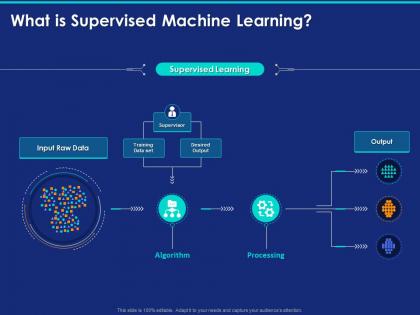
The image provides an informative overview of Supervised Machine Learning using a visually engaging flow diagram. At the top, "What is Supervised Machine Learning?" introduces the topic and sets the stage for further explanation. The slide then breaks down the concept into five main components: Input Raw Data, Supervisor, Algorithm, Processing, and Output.
1. "Input Raw Data" indicates the starting point where raw data is fed into the system. This is typically a collection of data points that need to be analyzed.
2. The "Supervisor" includes a small icon representing a person overlooking the process, signifying the role of human oversight. In supervised learning, the training data set and the desired output are provided by a supervisor, or an expert, who knows the correct answers the algorithm should produce.
3. The "Algorithm" section visualizes the machine learning algorithm that will be trained on the data. It acts as the recipe for the machine to learn from the input data.
4. "Processing" represents the stage where the algorithm processes the input and learns from the training data set in order to make predictions or decisions.
5. The final "Output" section visualizes the result of the learning process, which includes the predictions or classifications produced by the machine learning model.
Use Cases:
This slide is adaptable for a variety of industries and presentations where educating the audience about machine learning is relevant:
1. Technology:
Use: Explaining machine learning concepts to developers or product teams
Presenter: Machine Learning Expert
Audience: Software Developers and Technical Product Managers
2. Finance:
Use: Illustrating how machine learning can improve fraud detection systems
Presenter: Data Science Lead
Audience: Financial Analysts and Risk Managers
3. Healthcare:
Use: Demonstrating how machine learning assists in diagnostic processes
Presenter: Healthcare Informaticist
Audience: Medical Professionals and Hospital Administrators
4. Retail:
Use: Showcasing personalized customer experiences through machine learning
Presenter: Marketing Director
Audience: Marketing Teams and Retail Executives
5. Automotive:
Use: Educating on machine learning's role in autonomous vehicle development
Presenter: AI Research Scientist
Audience: Automotive Engineers and Tech R&D Teams
6. Education:
Use: Discussing the role of machine learning in educational data analytics
Presenter: EdTech Consultant
Audience: Educators and Academic Administrators
7. Manufacturing:
Use: Presenting predictive maintenance capabilities powered by machine learning
Presenter: Operations Analys
Audience: Plant Managers and Manufacturing Engineers
What is supervised machine learning ppt powerpoint presentation outline with all 2 slides:
Give your audience a fulfilling experience. They will find our What Is Supervised Machine Learning Ppt Powerpoint Presentation Outline elevating.
FAQs for What is supervised machine learning ppt
So basically, supervised learning needs labeled data - you show it examples with the right answers so it learns to predict stuff. Unsupervised is different. No labels at all. It just digs through data looking for patterns you didn't even know existed. Honestly, supervised is way more straightforward if you have a specific thing you want to predict, like will this email be spam or not. But unsupervised can surprise you - it might cluster your customers in ways that actually make sense for marketing. Really depends what you're trying to do.
Quality beats quantity every time with labeled data. First thing - nail down what your labels actually mean and write it out clearly for your team. Can't tell you how many times I've seen "positive" mean totally different things to different people lol. Get multiple people labeling the same samples and check if they agree with each other. Your data needs to match what the model will see in the real world, so don't forget edge cases and weird examples. Oh, and always spot-check some labels yourself before you start training. You'll catch so many mistakes that way.
Accuracy, precision, recall, and F1-score are your go-to metrics for classification stuff. Regression? MAE and RMSE work great. Here's the thing though - accuracy can totally fool you with unbalanced data (trust me on this one). Precision shows how many positive predictions were actually correct. Recall tells you what percentage of real positives you managed to catch. F1-score basically splits the difference between them. For regression tasks, MAE gives you the average error size while RMSE hits you harder for big mistakes. Just pick whatever matches what you're actually trying to solve, you know?
So feature engineering is where you actually turn messy raw data into stuff your model can work with. You're creating and tweaking features to highlight the patterns that matter - like scaling numbers, encoding categories, pulling apart dates. Honestly, crappy features will tank your model no matter how sophisticated your algorithm is. The more you get your domain, the smarter you can be about crafting features. I always start basic with simple transformations first. Then you can get creative based on what actually makes sense for your problem. It's kinda like being a translator between business logic and math.
Oh man, overfitting is so annoying - basically your model just memorizes the training data instead of actually learning anything useful. Like cramming vocab words but then bombing when the test asks you to use them in sentences, you know? You'll spot it when your training accuracy looks amazing but validation accuracy is trash. Try L1/L2 regularization or dropout layers to fix it. Getting more data helps too, though that's not always realistic. Cross-validation catches it early. Honestly, I always start with something super simple first, then make it more complex bit by bit until I hit that sweet spot.
Nah, definitely not - each field is way too different. Healthcare data is usually messy and has crazy regulations, while finance needs those super fast real-time predictions. The success metrics don't even compare. You can't just take a fraud detection model and slap it onto medical diagnosis, you know? Features are different, error tolerances are different, everything's different. Honestly, I learned this the hard way on a project last year. Domain-specific feature engineering is huge. You'll need to customize your whole approach for whatever field you're tackling.
So you've got linear regression for stuff like predicting prices, logistic regression when it's yes/no decisions (like spam detection). Decision trees are great if you need to actually explain what's happening to people. Random forests are just multiple decision trees working together - honestly they're probably what I'd start with since they're pretty forgiving with messy data. SVMs work well for text stuff, neural networks crush it with images. Oh and decision trees barely need any setup which is nice. I'd just throw a couple algorithms at your data and see what sticks - that's what most of us do anyway.
Dude, hyperparameter tuning is honestly where the magic happens - way more than people realize. Your learning rates, regularization settings, all that stuff? It's like the difference between a car that barely runs and one that purrs. I've literally watched models go from trash to 20% better accuracy just from tweaking parameters right. Grid search is your friend here, or random search if you're feeling lazy (which, let's be real, we all are sometimes). Oh and don't forget to test on separate data or you'll fool yourself into thinking you're a genius when you're just overfitting. Trust me on this one.
Honestly, class weights are where I'd start - most sklearn models have that parameter and it's dead simple to use. If that doesn't cut it, SMOTE is pretty solid for generating synthetic minority samples. Random Forest usually handles imbalanced data better than other algorithms, so maybe try that too? You could also undersample your majority class but I'm always worried about throwing away data. Oh, and boosting methods work well here - though I forget why exactly. Start with the class weights thing first since it takes like 2 seconds to implement.
Honestly, there's no magic number - it totally depends on what you're building. Simple stuff like linear regression? Maybe 10x more samples than features as a starting point. Deep learning though? That's gonna need way more data, like thousands or even millions of examples. I'd just start with whatever you've got and plot some learning curves. If your accuracy keeps climbing as you add data, keep going. Once it flattens out, you're probably good. Oh, and watch your validation scores - that's where you'll really see if more data is helping or if you're just wasting time collecting it.
Bias in your data is the big one - it'll just amplify existing discrimination if you're not careful. Your models need to be explainable too, especially when they're making decisions about people's lives. Privacy's obviously critical since you're dealing with personal info. False positives can seriously screw someone over depending on what you're building (imagine getting flagged for fraud when you're not). Regular audits across different groups are a must. Keep humans involved for anything high-stakes - algorithms aren't perfect. Oh, and set up bias monitoring right from the start, not as an afterthought.
So grab a pre-trained model and fine-tune it on your labeled data instead of starting from zero. Most layers stay frozen - you're just retraining the final classification bits with your specific dataset. Way faster than building from scratch, plus you get better results (especially with smaller datasets). The model already knows basic features from training on huge datasets like ImageNet, so you're basically adapting that knowledge. Works really well for image stuff, NLP tasks, whatever. TensorFlow Hub and Hugging Face have tons of models to start with - honestly just pick one and mess around with different fine-tuning setups until something clicks.
Oh man, cross-validation is a lifesaver - basically you split your data into chunks and rotate what you train on vs test on. Way better than just doing one train/test split. Think of it like asking multiple people for their opinion instead of just one person, you know? It catches models that just memorized stuff but can't actually handle new data (which honestly happens more than you'd think). The metrics you get are way more trustworthy too. Don't skip this step before putting your model into production or you'll probably regret it later.
Oh man, real-time streams are a total game changer for ML. Your model gets outdated crazy fast, so you can't just train once and call it a day. Data distribution keeps shifting - what worked last week might be garbage now. I've been burned by this before lol. You need online learning or scheduled retraining to keep up. Set up drift detection on your main features first, that's clutch for catching problems early. Also monitor when performance starts tanking so you can trigger retraining automatically. It's messy but honestly pretty cool once you get it working.
There's actually a bunch of ways to do this. Predictive stuff works great - forecasting sales, spotting customer churn, figuring out your best leads. Anomaly detection is solid too for catching weird data patterns. Power BI and Tableau already have ML built in, which is nice since you don't need to become some hardcore data scientist overnight. I'd probably just start with sales forecasting on whatever data you already have. It's pretty straightforward and you'll see results fast. Oh, and automated data classification helps if you're drowning in unorganized data.
No Reviews