

Workflow Of IT Governance Process Ppt Powerpoint Presentation Outline Format Ideas




Try Before you Buy Download Free Sample Product
 Impress Your
 Audience
 100%
100% Editable
 Save Hours
 of Time


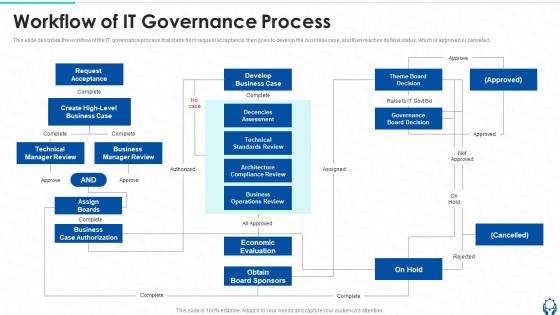
This slide describes the workflow of the IT governance process that starts from request acceptance, then goes to develop the business case, and then reaches its final status, which is approved or canceled.
People who downloaded this PowerPoint presentation also viewed the following :
Workflow Of IT Governance Process Ppt Powerpoint Presentation Outline Format Ideas with all 6 slides:
Use our Workflow Of IT Governance Process Ppt Powerpoint Presentation Outline Format Ideas to effectively help you save your valuable time. They are readymade to fit into any presentation structure.





FAQs for Workflow Of IT Governance Process Ppt Powerpoint Presentation
So you need four main things to get IT governance working. First - figure out who actually makes decisions (this is where most places totally screw up, btw). Then set up solid processes for approving IT investments and picking vendors. Third thing is risk management so you catch problems early. Performance metrics are key too, but track business value not just tech stuff. Oh, and definitely start by mapping who's currently making IT decisions in your org - you'll probably be surprised how messy it is! Don't let too many people have their fingers in every decision or nothing gets done.
Your IT team can't keep operating in a bubble - board committees need regular tech updates on security threats, compliance issues, and major investments. I'd suggest starting with monthly reports to your audit or risk committee. Corporate governance principles should guide IT decisions too, so mirror those same accountability standards. Quick tangent - I've seen companies mess this up by treating IT like some mysterious black box. Set up clear paths for escalating tech risks through normal business channels. Short quarterly reviews alongside board meetings work well. The goal is making IT governance feel like a natural extension of how you already run the company, not some separate thing.
COBIT's your best bet here - it's what most places use and gives you maturity levels 0-5 to work with. ITIL covers some governance stuff too but it's really more about service management. There's also ISO/IEC 38500 which is built specifically for IT governance, though honestly it stays pretty high-level. I'd go with COBIT since it's comprehensive and you can find tons of resources online. Start with a baseline assessment against whatever framework you pick. The gaps will jump out at you pretty quickly, and then you'll know where to focus first.
So IT governance basically gives you a solid framework for staying compliant - you'll have clear processes, proper documentation, and everyone knows their role when audits happen. Which is great because auditors have this uncanny ability to show up right when you're swamped with other stuff! Your governance structure becomes like a compliance blueprint that standardizes how you handle data protection and security across the board. Otherwise you're just scrambling to fix whatever pops up next. I'd start by comparing what you currently have against your main regulatory requirements - that'll show you where the gaps are.
Look, stakeholder engagement is literally what makes or breaks your IT governance. Map out who matters for each decision first - trust me on this one. You'll need their input to prioritize projects and figure out where to spend your budget. Otherwise you're just building stuff nobody wants (been there). Regular check-ins keep everyone happy and bought in. It's like herding cats honestly, but at least these cats help you avoid those cringe moments where leadership asks "why did we build this again?" Get their requirements upfront and validate decisions as you go.
Track your hard numbers first - uptime, security incidents, project timelines, budget stuff. But the cultural side is where you'll really see if it's working. Are people actually following your processes or just doing sneaky workarounds? Survey folks about decision-making speed. See how fast you can adapt to new compliance stuff (ugh, there's always something). The goal is making governance feel helpful instead of like a roadblock. I'd set up quarterly check-ins to see what's actually moving the needle and ditch what isn't.
So many choices, honestly! ServiceNow and BMC Remedy are solid for the big stuff - change requests, compliance tracking, automated approvals. Jira Service Management too. If you're dealing with crazy regulatory requirements, check out Archer or MetricStream. Power Platform works fine for smaller teams (Microsoft's actually gotten pretty decent with this stuff). Here's what I'd do though - map out your processes first. Don't just pick the flashiest tool and try to force your workflows into it. That never ends well. Atlassian's another decent option if you're not going enterprise-level.
Don't treat risk assessment like some separate checklist thing - weave it into how you already make IT decisions. Map out your main risks first: security breaches, system crashes, compliance headaches. Then figure out who owns what controls. I've watched too many teams create these assessments that basically become expensive paperweights. Use them when you're doing budgets, approving projects, picking vendors. Set up quarterly reviews with your stakeholders and actually let those findings drive where you spend money and focus energy. Otherwise you're just going through the motions.
Oh man, it's mostly that IT and business teams literally speak different languages. Your tech people obsess over system uptime while executives only care about sales numbers. Then you've got these ancient approval processes that take forever - meanwhile priorities shift every other week. Nobody really owns the final call either, so stuff just sits there. Honestly the cruise ship thing is so real lol. What works? Get both sides in a room regularly and make them explain their stuff in normal human terms. Start there and see what happens.
Honestly, just bake feedback into your system right from day one. Every quarter, actually check what's working instead of those useless reports everyone ignores. Give your team easy ways to call out broken processes - bureaucracy kills good ideas fast. Track the basics: how quick decisions happen, compliance numbers, whether people are happy. Small tweaks beat massive overhauls every time. Pick one thing that's obviously screwed up and fix it this month. I learned this the hard way - waiting just makes everything worse.
Start by mapping out each step with clear owners and decision points - seriously saves so much headache down the road. Simple flowcharts work great, or even bullet lists if that's more your team's style. Document the "why" behind approval gates, not just the "what" - people's memories are terrible with context. Put everything somewhere stakeholders can actually find it (not some random buried SharePoint nightmare). Oh, and set up quarterly reviews to keep docs current. Workflows change constantly and your documentation needs to keep up or it becomes useless pretty fast.
Your company culture totally shapes how IT governance plays out day-to-day. Collaborative places usually get better buy-in across departments, but if you're super hierarchical, the transparency piece can be rough. Risk appetite matters too - some cultures are cool with testing new stuff in controlled ways, others lock everything down (honestly, that second approach kills innovation fast). Oh, and decision-making style is huge. Figure out how choices actually happen at your company first. Then build your governance around that reality instead of fighting it. Don't force a framework that goes against the grain.
Honestly, you'll need both tech chops and business sense - gotta understand how IT actually supports company goals. Leadership is massive since you're dealing with teams that basically speak different languages. Get some risk management training under your belt, plus learn frameworks like COBIT or ITIL. Communication skills are way more critical than people realize - you're constantly playing translator between executives and developers. CGEIT certification is probably your best starting point. The tricky part? You can't be too technical or too business-focused. It's all about finding that sweet spot in the middle.
Build flexibility into your governance from day one - don't tie rules to specific tech. My last company got totally blindsided when AI tools exploded overnight. Instead, set up regular "emerging tech" reviews where you test new stuff against your existing risk and security standards. Make it principle-based rather than technology-specific, you know? Start by figuring out what experimental tech your team's already playing with and run it through your current approval process. That way when the next big thing hits, you're not scrambling to create rules from scratch.
Stop treating data governance like it's this separate thing - just weave it into what you're already doing. Add data stewards to your IT steering committee. Build data quality checks into your regular performance reviews. When you're doing change management, throw in data impact assessments too. Your ITIL processes? They need data classification stuff baked in. Most companies mess this up by keeping everything in silos when it should all work together. Make data part of every IT decision instead of running parallel tracks. Oh, and definitely integrate your data policies into risk management - that one's huge.
-
Unique and attractive product design.
-
The website is jam-packed with fantastic and creative templates for a variety of business concepts. They are easy to use and customize.