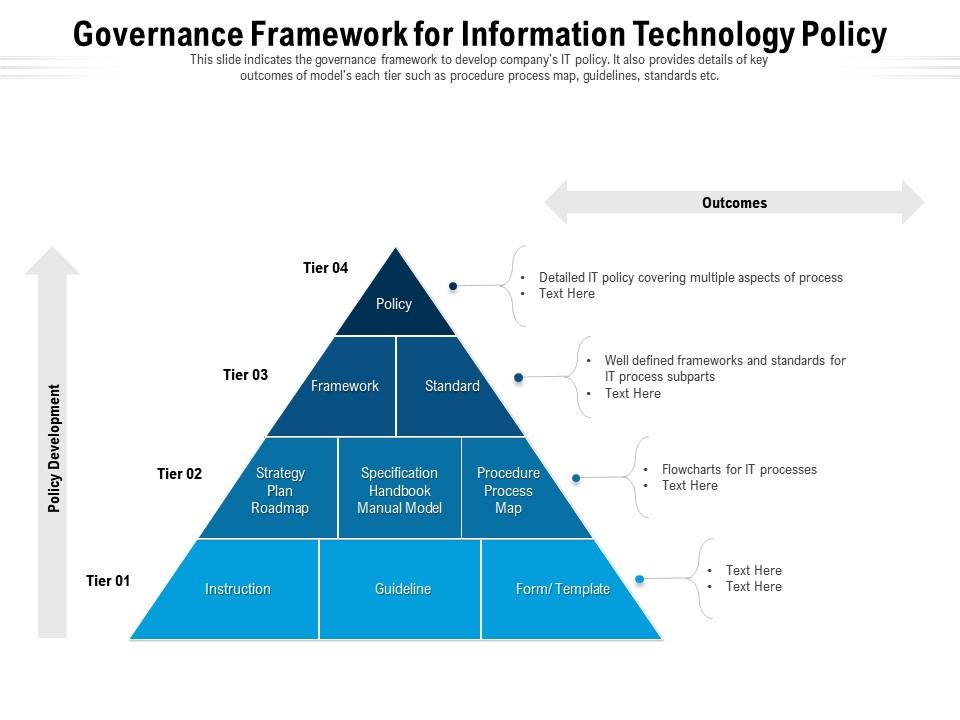
Governance framework for information technology policy
Try Before you Buy Download Free Sample Product
Audience
Editable
of Time
Our Governance Framework For Information Technology Policy are topically designed to provide an attractive backdrop to any subject. Use them to look like a presentation pro.
People who downloaded this PowerPoint presentation also viewed the following :
Governance framework for information technology policy with all 2 slides:
Use our Governance Framework For Information Technology Policy to effectively help you save your valuable time. They are readymade to fit into any presentation structure.
FAQs for Governance framework for
So you've got five key pieces to figure out. First, make sure your IT stuff actually matches what the business wants - seriously, this gets screwed up more than you'd think. Then focus on getting real value from your tech spending and managing all the security/compliance headaches. Don't forget about budgets and staffing - that's always a nightmare. Performance tracking comes last but matters most since it shows if anything's working. Honestly, I'd just audit where you stand on each area first, then tackle whatever's most broken.
Look, good IT governance basically makes sure your tech stuff actually supports what the business is trying to do. Risk management gets way better. Resource allocation becomes less of a mess. Decision-making speeds up too - which honestly is huge because nobody has time to wait around for approvals on everything. Compliance stops being such a nightmare (seriously, this alone makes it worth it). Your team can innovate better since there's clear accountability and you're not just throwing money at random tech. The trick is finding that sweet spot where you have enough oversight but don't bog everything down.
Look, compliance stuff like SOX, GDPR, HIPAA - that's honestly what forces most companies to actually care about IT governance. Nobody wants to deal with massive fines or failed audits, trust me. So you build frameworks and controls around your data, access, systems - all that critical stuff. IT governance basically becomes your roadmap for documenting processes and managing risks properly. I'd start by figuring out which compliance rules actually apply to you, then see where your current IT processes might be falling short. It's way easier than trying to fix everything at once.
Honestly, you need both the hard numbers and the fuzzy stuff. Track things like project delivery rates, budget variance, system uptime - that's your bread and butter. But don't ignore stakeholder satisfaction surveys and whether your IT decisions actually make sense for the business. I'd probably start with just 3-4 metrics that really matter to your company instead of going overboard. Oh, and those governance maturity assessments are pretty useful for seeing if you're actually getting better over time. The decision-making flow thing is huge too - if that's clunky, everything else falls apart.
Ugh, the worst part is always getting people to actually care about new processes - they just see more work. Executive buy-in is crucial though, like you NEED someone at the top who's genuinely invested, not just ticking boxes. Resource constraints kill everything too since governance feels like busywork instead of real work. Plus everyone thinks someone else is handling the governance stuff, so nothing gets done. Oh and balancing control with staying agile? Good luck with that mess. Honestly, start tiny with some quick wins first. Build momentum before tackling the big stuff.
So basically IT governance is how you spot and manage all the tech risks that could mess with your business goals. Data breaches, systems crashing, compliance issues - you know the drill. What it does is create this framework where every IT decision gets looked at through a risk perspective. Proper oversight and accountability become part of the process. Honestly, I've seen too many companies learn this the hard way - being proactive here saves you massive headaches down the road. Just make sure your IT risk stuff connects properly to your overall enterprise risk management. You don't want gaps where things slip through.
Depends what you're trying to govern, but there's a bunch of good options. ServiceNow, MetricStream, and RSA Archer are pretty solid for risk management stuff. Jira Service Management works great for IT services. Then you've got specialized tools like Apptio for financial management or Flexera for software assets - honestly the whole vendor space moves crazy fast though. Risk registers and dashboards are basically must-haves. My advice? Map out your actual processes first instead of just buying some shiny platform and hoping it fits. Trust me, I've seen that go wrong too many times.
Look, good IT governance actually speeds things up when done right. Set clear decision-making processes so teams don't need approval for every little thing. Define your innovation budgets and risk levels upfront too. Yeah, it sounds super boring but honestly it keeps projects from dying in approval hell. Teams get better at portfolio management - they know when to axe failing stuff and invest more in what's working. My advice? Start by setting innovation criteria and approval thresholds. That way teams know exactly what they can chase on their own without asking permission constantly.
Yeah, frameworks totally shift depending on your industry. Healthcare orgs are obsessed with HIPAA and patient data stuff. Financial companies? They're all about SOX compliance and risk controls. Manufacturing focuses more on operational tech security - which honestly makes sense when you think about it. Government agencies have their own weird standards like FISMA that don't really apply elsewhere. The basic ideas stay consistent though: risk management, compliance, strategic alignment. But you've got to tailor everything to match whatever regulations your sector throws at you. It's kind of a pain but necessary.
Get the right mix of people involved - business folks, IT, security, compliance, plus some executives. Monthly status meetings are soul-crushing though, so skip those. Interactive workshops work way better where people can actually debate priorities and trade-offs. Speak their language instead of tech jargon - show them business impact. I've seen too many initiatives die because stakeholders felt ignored. Close the loop by demonstrating how their feedback influenced real decisions. Honestly, that last part is what separates successful governance from the bureaucratic nightmare most places end up with.
So IT governance is basically your security blueprint - way better than just scrambling when attacks happen. You get clear policies, someone actually owns the decisions, and there's ongoing monitoring instead of hoping for the best. Plus it helps you spend smart on security tools that matter for your business goals, not just whatever's trendy. The culture shift is huge too - suddenly everyone knows what they're supposed to do to protect company data. Oh, and start by figuring out who's responsible for what security decisions in your company. That part's honestly harder than it sounds.
You'll want to track operational stuff first - project delivery rates, budget variance, security incidents, system uptime. The usual suspects. But honestly, don't sleep on the business side either. Stakeholder satisfaction scores, compliance results, how well IT projects actually support business goals. Time-to-market is huge too since that's what executives really care about. I'd probably start with just 3-4 metrics that make sense for your company instead of going overboard. Way easier to build on that later than trying to track everything at once and burning out your team.
Dude, cultural alignment makes or breaks IT governance - I can't stress this enough. People won't follow processes if they don't get why they exist or if it feels like pointless red tape. I've literally watched companies blow millions on governance projects because they totally ignored the culture side. Your team has to see it as helpful, not just more bureaucracy to deal with. Quick wins help a ton here. Figure out what cultural roadblocks you're facing first, then tackle them with good communication and training. Without real buy-in, you'll just get people going through the motions.
IT governance sets up the rules for managing your org's tech resources - data management being a huge part of that. Governance handles the "what" and "who" stuff: policies, data ownership, compliance, who gets blamed when everything breaks (and trust me, it will). Data management? That's your "how" - the actual processes and tools doing the work day-to-day. Honestly, trying to manage data without solid governance first is like driving blindfolded. You'll just end up making a mess. Start by figuring out who actually owns what data in your company - that's usually messier than you'd think.
Build in feedback loops - quarterly reviews, track metrics, get input from stakeholders. Monitor stuff like project delivery times and budget variance to catch issues early. The key thing? Don't stick with broken processes just because that's how you've always done things (I swear, some companies are their own worst enemy). Create space for your team to suggest improvements without getting shut down. Quick assessments every few months help you pivot when something isn't working. Trust me, tracking compliance scores and delivery metrics will save you headaches down the road.
-
Great quality slides in rapid time.
-
Illustrative design with editable content. Exceptional value for money. Highly pleased with the product.
-
Innovative and Colorful designs.
-
Great designs, Easily Editable.