


Information technology governance flow chart




Try Before you Buy Download Free Sample Product
 Impress Your
 Audience
 100%
100% Editable
 Save Hours
 of Time


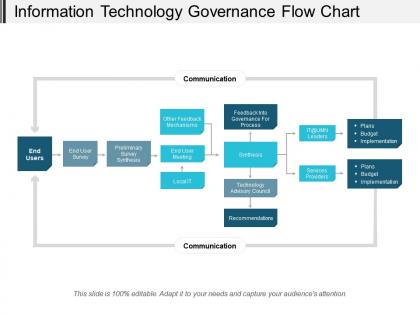
Have a look at our race information technology governance flow chart presentation design. The PPT template has been designed using a flow chart process visual with text boxes to understand the concept of IT governance and management in today's time. Governance works hand in hand with IT portfolio management to align IT investments with agency objectives, enabling federal managers to improve responsiveness to challenges and manage current and future IT investments. Our information technology governance process PPT visual provides federal managers with the framework to manage all IT initiatives and demands, through a single point where they are prioritized and fulfilled. People engaged in the digital and IT work can get the best value out of this presentation diagram as it perfectly enables control in planning and organizing IT initiatives. IT governance is an activity that requires continuous improvement. So, download this information governance flow chart PowerPoint graphic now and then share the message in the most appropriate manner. Entrust your thoughts to the care of our Information Technology Governance Flow Chart. They will prove worthy caretakers.
People who downloaded this PowerPoint presentation also viewed the following :
Information technology governance flow chart with all 5 slides:
Feel assured of beating back any challenge with our Information Technology Governance Flow Chart. You will experience infinite confidence.



FAQs for Information technology
Look, most companies totally blow this by treating IT like just another expense instead of actually strategic. You want five main things: align with business goals, deliver real value, manage risks, optimize resources, and measure performance. Start with a governance committee that has both IT and business people - they'll handle the big tech decisions and spending. Clear accountability is huge, plus you need regular communication with stakeholders. Honestly, the measuring outcomes part trips people up the most. Set up policies for major investments upfront so you're not scrambling later when someone wants to buy the latest shiny thing.
Connect every IT project to a real business goal first - seriously, if you can't explain why it matters to revenue or operations, dump it. Set up monthly check-ins with both sides so you're not building shiny toys nobody wants (learned this the hard way at my last job). Make people justify the business case before approving any big tech spend. Track metrics that actually show business impact, not just whether servers are running. Review everything quarterly and don't be afraid to kill projects that aren't delivering.
Look, risk management is honestly the foundation of solid IT governance - helps you spot problems before they blow up in your face. Every major IT decision should have risk assessment baked in, whether you're picking vendors, upgrading systems, or updating security policies. It's way more proactive than just having insurance (though that analogy isn't terrible). You're always trying to balance pushing innovation forward while protecting your company's data and reputation. Start by figuring out your biggest IT vulnerabilities first. Then make sure someone actually owns each risk and there's a real plan to deal with it. Trust me, future you will thank present you.
Honestly, start with the obvious stuff - project delivery rates, budget overruns, security incidents, uptime stats. Those give you real numbers to track. But don't sleep on the softer side either. Survey people about how fast decisions get made, if communication actually makes sense, whether IT projects match what the business needs. I'm a big fan of doing regular maturity assessments too - shows you the bigger picture. Oh, and definitely set baselines first before you start measuring everything. Focus on trends, not individual months that look weird. Pick like 3-5 metrics that actually matter to your company and stick with those.
Honestly, the biggest pain is just getting people to care. Executive buy-in is everything - without it you're basically shouting into the void. Then there's the whole "not my job" thing when roles aren't clear, which drives me crazy. Budget's always tight too since governance needs actual people and decent tools. Different departments love staying in their bubbles instead of working together. Oh, and everyone hates new processes until they see results. Start small though - get some quick wins first so people actually want to participate, then expand from there.
Think of IT governance as your safety net for compliance stuff like GDPR or HIPAA. You'll want solid policies and controls in place - trust me, I've watched companies panic during audits because they had zero framework. Really not fun to witness. Governance helps you set up proper data handling, figure out who's responsible for what, and keep those audit trails that regulators actually want to see. My advice? Map out where your current setup falls short against whatever regs hit your industry. That'll show you the biggest gaps to tackle first.
Start by figuring out who actually matters - business leaders, IT people, end users, compliance team. Set up steering committees and regular check-ins so nobody's left wondering what's going on. Listen to what they're saying (not just pretending to listen in boring meetings). Each group needs real input on stuff that affects them. Honestly, the trick is having some structure but not making it so rigid that people hate participating. Focus on your biggest influencers first and let that momentum carry you forward. Build from there and you'll be golden.
Dude, cloud and AI are totally reshaping how IT governance works. Traditional risk frameworks? They're basically useless now because these technologies create security holes nobody saw coming. Honestly, the compliance stuff alone will make your head spin. Your approval processes need a complete overhaul too - teams can't wait weeks for permission to deploy something when competitors are moving at lightspeed. I learned this the hard way at my last job. Build policies that bend without breaking, ya know? You want control but not so much that innovation dies waiting for paperwork.
COBIT's your best bet to start - covers everything from strategy down to day-to-day ops. Most places also use ITIL for service management (you're probably already doing half of it without knowing). ISO 27001 is the go-to for security governance if that's a big focus. TOGAF pops up too for enterprise architecture stuff, though honestly it can be overkill sometimes. I'd dive into COBIT first to get the big picture, then add the others as you figure out what gaps you actually have. Don't try to do everything at once - that way lies madness.
Okay so you've gotta build feedback loops right into your governance framework. Schedule quarterly reviews where you actually look at what's working and what sucks. Track metrics like decision speed, compliance rates, business alignment - that stuff matters. Most companies just set it once and never touch it again (huge mistake btw). Set up regular input sessions with stakeholders so problems come up fast instead of festering. Oh and make sure IT and business people can actually talk to each other easily. Treat the whole thing like it's alive and evolving, not some dusty policy doc. Book your first quarterly review for next month.
IT governance is like having guardrails for your projects - stops you from building the wrong thing or doing it badly. I've watched too many projects crash and burn without proper oversight, honestly it's painful to see. You get clear decision-making frameworks and standardized processes that keep everything tied to business goals. Risk management becomes way easier too. Resource allocation doesn't turn into a free-for-all, plus you'll actually meet compliance stuff. Oh, and definitely set this up BEFORE starting any big project. Trust me on that one - fixing governance issues mid-project is a nightmare you don't want.
Think of performance metrics as your report card for IT stuff. Track system uptime, how long projects take, budget overruns, user happiness - the usual suspects. Honestly, executives get really cranky when you can't show them numbers. These help you catch issues before they blow up and actually prove IT isn't just burning money. You'll spot trends, make smarter calls about resources, and have real data when someone questions your decisions. Don't go overboard though - pick maybe 4-5 metrics that matter to your business goals and stick with tracking those consistently.
So basically governance is your "what and why" - it sets the big picture strategy, risk tolerance, all that executive stuff. ITSM is the "how" - the actual processes that make things happen day-to-day. Without both working together, you're screwed either way. Amazing strategy with trash execution? Failure. Perfect processes with no direction? You'll just be really efficient at doing the wrong things (seen that disaster before). Your governance folks should check ITSM metrics regularly to see if you're actually hitting those strategic goals. They really can't exist without each other.
Honestly, you've gotta nail down who owns what first - like actually assign specific people to decisions, not just "the IT team." When stuff breaks (and it will), someone needs to be on the hook. I'd set up regular check-ins where people report on their stuff, but here's the thing - you can't let accountability slide even once or everyone notices. Create metrics they can't BS their way out of. Celebrate when people own their screwups and fix them, that builds good culture. Oh, and map out who currently owns each major process - you might be surprised how messy it is.
Honestly, the biggest shifts I'm seeing are AI integration and zero-trust security becoming standard. ESG stuff is huge now too - IT teams actually have to track carbon footprints like uptime metrics, which feels weird but makes sense. Continuous compliance is replacing those awful yearly audits (thank god). Cloud-first everything means governance has to be way more agile and real-time. The whole approach is changing - instead of governance being this separate thing that hovers over you, it's getting baked into daily ops. My advice? Start with one piece like AI ethics or cloud security. Don't try to overhaul everything at once.
No Reviews