


Zero Shot And Few Shot Prompting Method Prompt Engineering For Effective Interaction With Ai




Try Before you Buy Download Free Sample Product
 Impress Your
 Audience
 100%
100% Editable
 Save Hours
 of Time


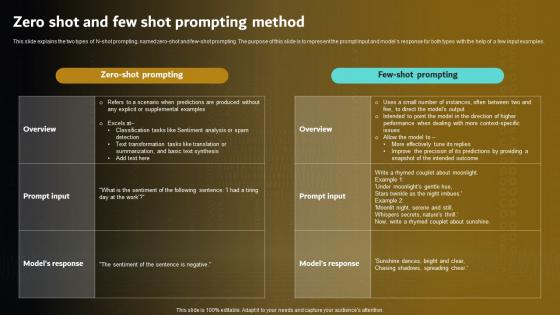
This slide explains the two types of N-shot prompting, named zero-shot and few-shot prompting. The purpose of this slide is to represent the prompt input and models response for both types with the help of a few input examples.
People who downloaded this PowerPoint presentation also viewed the following :
Zero Shot And Few Shot Prompting Method Prompt Engineering For Effective Interaction With Ai with all 6 slides:
Use our Zero Shot And Few Shot Prompting Method Prompt Engineering For Effective Interaction With Ai to effectively help you save your valuable time. They are readymade to fit into any presentation structure.





FAQs for Zero Shot And Few Shot Prompting Method Prompt Engineering For Effective
Effective prompt engineering principles include clarity and specificity, context provision, structured formatting, iterative refinement, and strategic constraint setting. These approaches enhance AI model performance by minimizing ambiguity, providing relevant background information, and establishing clear parameters, with many organizations finding that well-engineered prompts significantly improve output quality, reduce processing time, and deliver more consistent results across business applications.
Prompt engineering improves AI accuracy by providing specific context, clear instructions, structured formatting guidelines, and relevant examples that guide model responses. Through iterative refinement and strategic prompt design, organizations streamline content generation processes, minimize revision cycles, and enhance output quality, with many marketing teams and content creators finding that well-crafted prompts deliver consistently reliable, brand-aligned results.
Context serves as the foundation for prompt effectiveness, providing background information, setting parameters, defining scope, establishing tone, and clarifying desired outcomes for AI systems. Through strategic context inclusion, organizations across industries like healthcare, finance, and customer service achieve more accurate responses, reduced ambiguity, and enhanced task-specific performance, ultimately delivering improved efficiency and more reliable AI-driven solutions.
**INPUT**: How can specific language choices in prompts influence AI responses? **OUTPUT**: Specific language choices significantly shape AI responses through precise terminology, contextual framing, tone indicators, and explicit instruction formats that guide model interpretation and output style. Strategic prompt construction enables organizations across sectors like customer service, content creation, and data analysis to achieve more accurate, consistent, and purposeful AI-generated results, ultimately enhancing operational efficiency and decision-making processes. [Word count: 57 words]
**INPUT**: What techniques can be used to test and refine prompts for better output? **OUTPUT**: Prompt testing techniques include A/B comparison, iterative refinement, output scoring, variable isolation, and batch testing across different scenarios. These methods enhance performance by identifying optimal phrasing, structure, and context parameters, with many organizations finding that systematic testing reduces ambiguity, improves consistency, and ultimately delivers more reliable AI outputs for business applications. [Word count: 54 words]
Prompt length significantly impacts AI response quality by providing context, specificity, and constraints that guide output precision, relevance, and depth. While longer prompts generally deliver more targeted results through detailed instructions and examples, they must balance comprehensiveness with clarity, with many organizations finding that structured, moderate-length prompts optimize both accuracy and processing efficiency across customer service, content creation, and analytical applications.
Common prompt engineering pitfalls include being overly vague, failing to provide sufficient context, neglecting to specify output format, and using ambiguous language that confuses AI models. These issues lead to inconsistent results, requiring multiple iterations and reducing efficiency, while organizations implementing clear, structured prompting frameworks find significantly improved accuracy, faster task completion, and enhanced operational productivity across their AI-driven processes.
**INPUT**: Can you provide examples of prompts that yield diverse or creative responses? **OUTPUT**: Creative prompts include open-ended scenarios, role-playing exercises, analogical thinking challenges, constraint-based problems, and perspective-shifting questions that encourage unconventional approaches. These techniques streamline brainstorming by removing traditional boundaries, introducing fresh viewpoints, and combining disparate concepts, with many organizations finding that strategic prompt design ultimately delivers innovative solutions and enhanced creative problem-solving capabilities. [Word count: 58 words]
Understanding user intent fundamentally transforms prompt design by enabling engineers to craft specific instructions, select appropriate tone and context, and anticipate desired output formats. This approach ensures prompts align with underlying goals rather than surface requests, with applications in customer service chatbots, content generation tools, and automated support systems ultimately delivering more accurate, relevant, and actionable AI responses.
Popular prompt engineering frameworks include OpenAI's prompt design guidelines, LangChain for chaining prompts, Microsoft's Semantic Kernel, and AutoPrompt for automated optimization. These tools streamline prompt development by enabling systematic testing, version control, and performance tracking, with many organizations finding that structured frameworks reduce development time while delivering more consistent, reliable AI outputs across various business applications.
In healthcare, prompt engineering optimizes AI for medical diagnosis assistance, patient data analysis, and treatment recommendations, while in finance, it enhances fraud detection algorithms, automated trading systems, and risk assessment models. These strategic applications streamline operational efficiency by reducing manual processes, accelerating decision-making, and improving accuracy, with many institutions finding that well-engineered prompts deliver faster services and competitive advantage.
Iterative testing enhances prompt performance by systematically refining language clarity, adjusting specificity levels, optimizing response formats, and fine-tuning context parameters through continuous feedback loops. Through A/B testing and performance analytics, organizations streamline their AI interactions, reduce ambiguous outputs, and ultimately deliver more accurate responses, with many enterprises finding that structured iteration cycles significantly improve operational efficiency and user satisfaction rates.
Ethical prompt engineering considerations include avoiding bias reinforcement, ensuring data privacy protection, maintaining transparency about AI limitations, preventing harmful content generation, and respecting intellectual property rights. These principles help organizations build responsible AI systems that deliver accurate results while protecting user trust, with many companies finding that ethical frameworks ultimately enhance their competitive advantage and regulatory compliance.
Multilingual prompt engineering requires strategic adaptation of prompts across languages, cultural contexts, and linguistic structures, while maintaining consistent AI model performance and accuracy. Organizations leverage native speaker expertise, cultural localization, cross-language testing protocols, and performance benchmarking to ensure prompts deliver reliable results across diverse markets, ultimately enabling global scalability and enhanced user experiences in international operations.
Zero-shot prompting provides no examples and relies on the model's pre-trained knowledge, one-shot includes a single example to guide responses, and few-shot offers multiple examples for pattern recognition. These techniques enable increasingly precise AI outputs, with financial services and healthcare organizations finding that few-shot approaches deliver more accurate, context-aware results for specialized tasks.
-
Their designing team is so expert in making tailored templates. They craft the exact thing I have in my mind…..really happy.
-
The designs are very attractive and easy to edit. Looking forward to downloading more of your PowerPoint Presentations.