


0614 cellular respiration medical images for powerpoint




Try Before you Buy Download Free Sample Product
 Impress Your
 Audience
 100%
100% Editable
 Save Hours
 of Time


Groups become cohesive with our 0614 Cellular Respiration Medical Images For PowerPoint. They begin to collaborate better.
People who downloaded this PowerPoint presentation also viewed the following :
Content of this Powerpoint Presentation
Description:
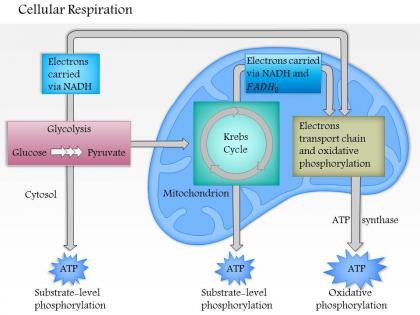
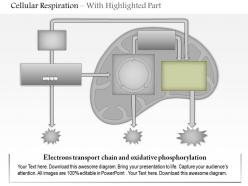
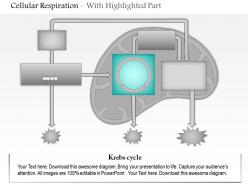
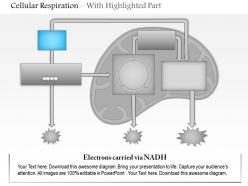
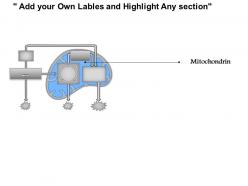
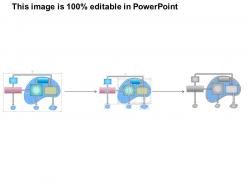
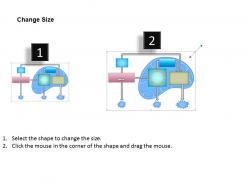
The image is a schematic diagram of cellular respiration, a fundamental biochemical process in cells. It outlines the multi-step transformation of glucose to energy in the form of adenosine triphosphate (ATP), which is vital for various cellular activities.
1. Glycolysis: The first stage, occurring in the cytosol, where glucose is broken down into pyruvate, yielding a small amount of ATP through substrate-level phosphorylation.
2. Krebs Cycle: Taking place within the mitochondrion, this cycle processes pyruvate further, producing electron carriers NADH and FADH2 while generating ATP through another round of substrate-level phosphorylation.
3. Electron Transport Chain and Oxidative Phosphorylation: The final stage, located in the mitochondrial inner membrane. Electrons from NADH and FADH2 are transferred through a series of proteins, leading to the creation of a proton gradient that drives the synthesis of a large amount of ATP by ATP synthase.
The diagram effectively communicates the stages of cellular respiration, the flow of electrons, and the sites of ATP production, making it a useful tool for education in biology, biochemistry, and related fields.
Use Cases:
Educational diagrams like this one are crucial in various fields for explaining complex biological processes such as cellular respiration.
1. Biotechnology:
Use: Detailing cellular processes for product development
Presenter: Research scientists
Audience: Development teams, stakeholders
2. Academic Publishing:
Use: Illustrating textbooks and educational materials
Presenter: Authors, illustrators
Audience: Students, educators
3. Pharmaceuticals:
Use: Drug research and development presentations
Presenter: Biochemists, pharmacologists
Audience: R&D teams, investors
4. Healthcare Education:
Use: Training medical professionals about cellular metabolism
Presenter: Medical educators
Audience: Medical students, residents
5. Scientific Equipment Manufacturing:
Use: Explaining equipment usage in cellular analysis
Presenter: Product trainers
Audience: Sales representatives, end-users
6. Nutraceuticals:
Use: Formulation of health supplements based on metabolism
Presenter: Product developers
Audience: Marketing teams, regulatory agencies
7. Fitness and Wellness Coaching:
Use: Educating on metabolism for health and fitness
Presenter: Health coaches
Audience: Clients, athletes
0614 cellular respiration medical images for powerpoint with all 11 slides:
Get customized assistance from our 0614 Cellular Respiration Medical Images For PowerPoint. Decide on the display of every detail.


FAQs for 0614 cellular respiration medical
So cellular respiration has three stages - glycolysis, Krebs cycle, and electron transport chain. Glycolysis breaks down glucose in your cytoplasm (no oxygen needed) and spits out 2 ATP. Then the Krebs cycle happens in the mitochondria's matrix, making CO2 and electron carriers. Honestly the Krebs cycle always trips people up. The electron transport chain is where the magic happens though - it's on the inner mitochondrial membrane and cranks out like 32-34 ATP molecules using those carriers. Just remember where each one occurs and what goes in vs what comes out. You'll be fine!
So basically, your cells break down glucose into two pyruvate molecules through glycolysis - all happens in the cytoplasm, no oxygen needed yet. You only get 2 ATP from it, which honestly isn't much. But here's the thing: those pyruvate molecules are gold because they go straight to your mitochondria where the real energy production happens. It's like the warm-up before the main workout. Oh, and since it doesn't rely on mitochondria, literally every cell can do glycolysis. Pretty neat how your body has this backup system, right?
So mitochondria are like tiny power plants inside your cells. They run this whole process called aerobic respiration that's way more efficient than the basic stuff. In the matrix part, you've got the citric acid cycle churning through acetyl-CoA and making some ATP. But here's where it gets cool - the inner membrane has this electron transport chain that creates a proton gradient, which powers ATP synthase. It's actually pretty wild how it works. Without these guys, you'd only squeeze out 2 ATP from glucose instead of 30-38. That's a huge difference for your cells.
Ok so the electron transport chain is basically your cell's main power generator. Electrons move through these protein complexes and pump protons out of the mitochondrial matrix. Creates this gradient that's honestly pretty cool when you think about it. Those protons flow back through ATP synthase - it spins like a tiny motor and cranks out ATP from ADP. You end up with like 32-34 ATP per glucose molecule. Without this whole system you'd only get 2 measly ATP from glycolysis, which obviously wouldn't keep you alive very long.
Hey! So NADH and FADH2 are like your cell's delivery drivers. They pick up high-energy electrons during glycolysis and the citric acid cycle, then haul them over to the electron transport chain. That's where ATP actually gets made. NADH's the better deal - it cranks out about 3 ATP molecules when it drops off its cargo. FADH2 only makes around 2, which is kinda disappointing honestly. But here's the thing - without these guys shuttling energy around, glucose would just sit there being useless. They're basically what turns food into actual power your cells can use.
So basically, aerobic respiration is like way more efficient - you get around 36-38 ATP from one glucose molecule when there's oxygen involved. Compare that to anaerobic which only gives you 2 ATP from the same glucose. Huge difference! Without oxygen, your cells can't finish the electron transport chain thing, so they miss out on most energy production. That's actually why you get wiped out during intense workouts - your muscles flip to anaerobic mode when oxygen gets low, but honestly it's just not sustainable for long periods.
So it depends on the fermentation type you're looking at. Lactic acid fermentation makes lactate - same stuff that builds up when you're dying during a workout lol. Alcoholic fermentation produces ethanol and CO2. Both regenerate NAD+ from NADH, which is honestly the real point here. Your cells need that NAD+ to keep glycolysis going when there's no oxygen around. There are other types that make different acids too, but those two are what you'll see most. I'd focus on remembering which organisms do what if this is for a test!
So basically, temperature and pH mess with your enzymes, which control cellular respiration. Around 37°C and pH 7.4 is the sweet spot for human cells. Crank up the heat past 40°C? Your enzymes literally fall apart. pH gets wonky and those enzymes can't hold their shape anymore - kinda like a bent key that won't work in a lock. This screws up glycolysis and the whole citric acid cycle. Honestly, the range where everything works is super narrow, which is why your body fights so hard to maintain homeostasis. Focus on that enzyme structure stuff - it'll make sense once you get it.
So basically, organisms get super creative with how they breathe based on where they live. Deep-sea creatures use sulfate instead of oxygen - which is honestly pretty wild when you think about it. Animals at high altitudes just pump out more red blood cells and pack in extra mitochondria to catch whatever oxygen they can. Some bacteria are total opportunists and flip between aerobic and anaerobic depending on what's available. Desert plants do this CAM thing to save water. The pattern's pretty clear though - check out where something lives and you'll probably figure out how it's tweaked its cellular processes.
So basically they're like mirror images of each other. Photosynthesis grabs sunlight and CO2 to make glucose, spits out oxygen. Then respiration does the reverse - takes that glucose plus oxygen and breaks it down for ATP energy the plant actually uses. It's like the plant is literally eating what it just made, which is kinda wild when you think about it. The whole thing's this perfect loop too. Oxygen from photosynthesis feeds the respiration side, CO2 from respiration goes back to photosynthesis. Pretty neat system honestly.
So basically, when your mitochondria can't convert glucose and oxygen into ATP properly, that's when you get insulin resistance and diabetes. It's like your cellular engine is broken - can't burn fuel right, so everything gets screwed up. Your cells struggle to use energy, which contributes to obesity too. But here's what's cool: exercise actually fixes this stuff. Proper nutrition and intermittent fasting directly improve how your mitochondria work. I mean, most metabolic diseases really come back to this cellular respiration dysfunction at the core. Pretty wild how it all connects, right?
So basically your cells have these smart enzymes - phosphofructokinase and isocitrate dehydrogenase - that work like switches. High ATP? They shut down. Low energy? They kick into gear. It's wild how automatic it all is, honestly. The whole system runs on negative feedback loops that respond to ADP and AMP levels. That's why your metabolism can ramp up during a workout without you thinking about it. Pretty cool that we don't have to manually control our energy production, right? Would be exhausting lol.
So there's a few ways to tackle this. Respirometers are probably your best bet - they track oxygen consumption over time and they're pretty straightforward to set up. CO2 measurement works too, though plants can be annoying since they're photosynthesizing at the same time. If you need super precise data, oxygen electrodes or gas chromatography will do the trick, but honestly that might be overkill depending on what you're doing. Calorimetry measures heat directly which is cool. I'd just start simple with a respirometer setup - cheap and reliable.
So basically when you work out, your muscle cells go crazy trying to make more energy. They're burning through glucose and oxygen super fast - way faster than when you're just sitting around. That's why you start breathing hard and your heart races, your body's trying to get more oxygen to your muscles. And when you're really pushing it? Your muscles can't get enough oxygen so they switch to that anaerobic thing, which is what makes them burn with lactic acid. Pretty wild how your breathing always matches how hard you're going, right?
So basically, cellular respiration is way more efficient than fermentation - like 32 ATP molecules per glucose instead of just 2. That's huge when you're trying to stay alive. All that extra energy lets organisms get bigger and do crazy energy-intensive stuff like flying or being an active predator. Plus it solved the whole "oxygen is toxic" problem by turning it into fuel instead. I always thought that was pretty clever. Anyway, this efficiency boost is what allowed complex life to evolve and take over new environments. Without it, we'd all still be tiny simple organisms.
-
Qualitative and comprehensive slides.
-
Great product with highly impressive and engaging designs.