


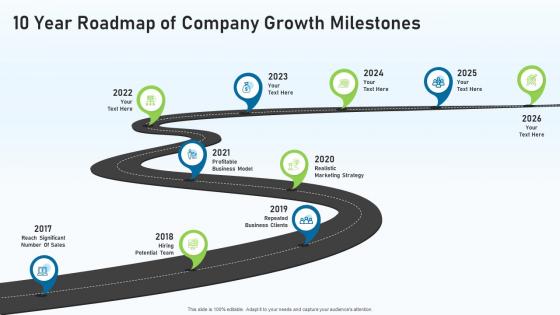
10 year roadmap of company growth milestones




Try Before you Buy Download Free Sample Product
 Impress Your
 Audience
 100%
100% Editable
 Save Hours
 of Time


Our 10 Year Roadmap Of Company Growth Milestones are topically designed to provide an attractive backdrop to any subject. Use them to look like a presentation pro.
People who downloaded this PowerPoint presentation also viewed the following :
10 year roadmap of company growth milestones with all 9 slides:
Use our 10 Year Roadmap Of Company Growth Milestones to effectively help you save your valuable time. They are readymade to fit into any presentation structure.








FAQs for 10 year roadmap of
Track the basics first - revenue growth, customer acquisition cost, and lifetime value. Monthly recurring revenue too if you're doing subscriptions. Churn rate's huge. Don't forget conversion rates at each stage. Honestly? Most teams I know get obsessed with metrics that sound cool but are totally useless. Pick maybe 5-7 that actually matter for your goals. I'd set up a dashboard you can glance at weekly - there's no point collecting data if you're not gonna look at it regularly. Keep it simple or you'll just overwhelm yourself with numbers.
Think of market trends like having a crystal ball for your business decisions. Watch what customers are doing differently, keep tabs on new tech popping up, and see what your competitors are up to. Nobody wants to end up like Blockbuster, you know? All this stuff tells you when to jump into new markets or pump the brakes on certain projects. Honestly, the companies that monitor this regularly are the ones making moves before everyone else catches on. Set up some kind of system so you're not scrambling to react when change hits.
Honestly, customer feedback is like having a GPS for growth - tells you exactly what's working and what isn't. I've watched way too many companies build random features nobody asked for, then wonder why they're bleeding money. Your users will literally tell you which segments matter, what messaging hits different, and where your product sucks so bad it's costing you deals. Quick surveys work great, but also just pick up the phone sometimes? Support tickets are goldmines too. The trick isn't collecting feedback though - it's actually doing something with it instead of letting it sit in some spreadsheet forever.
Honestly, digital marketing is a game-changer because you can reach tons more people without blowing your budget like traditional ads do. Target exactly who you want through social media, email, content - whatever. The data you get back is instant, so you'll know what's working and what sucks. Small companies can punch way above their weight online if they're smart about it. Oh, and you can test stuff super fast then scale the good stuff. My advice? Pick 2-3 places where your customers actually are, post valuable content regularly, and obsess over your metrics. That's where you'll see what to invest more in.
Look, scaling definitely gives you bang for your buck - more customers without crazy cost increases. Your processes get smoother too. But real talk? It's way messier than anyone tells you. Quality control becomes a nightmare when you're growing fast. Your team vibe can totally fall apart if you're not careful. Cash flow gets weird during rapid expansion - like, really weird. Oh, and random bottlenecks will pop up everywhere. Honestly though, don't try scaling everything at once. Pick one thing at a time and throw money at good systems early.
Honestly, just rank your features by impact vs effort first. Quick wins that actually boost retention or revenue - that's what matters. Your existing customers are literally telling you what they want, so listen to them instead of chasing whatever shiny new thing everyone's talking about. I've seen so many teams get distracted by trendy features that go nowhere. Run small tests before you commit to anything big. Here's the thing though - growth usually comes from doubling down on what's already working for you, not constantly jumping to new ideas.
Dude, roadblocks are rough but you gotta stay flexible. First thing - check if you're actually tracking stuff that matters or just feel-good numbers that don't mean anything. Maybe try switching up how you find customers? Like if ads aren't working, pivot to partnerships or content instead. Honestly, sometimes you need to completely change who you're targeting - I've watched companies do a total 180 on their ideal customer and suddenly everything clicks. The real trick is questioning your assumptions every month or so. Don't get stuck hoping things'll magically improve when the data's telling a different story.
Focus on what actually makes you money, not what screams loudest. Figure out your top 3 revenue drivers first - could be product dev, hiring salespeople, whatever moves the needle for you. Put like 70% of your resources there. The boring operational stuff still needs 30% though (bills don't pay themselves, unfortunately). I'd track this monthly and don't be afraid to shift things around. Honestly, the hardest part is saying no to cool opportunities that aren't your main thing. Maybe create some simple scoring system when people ask for resources? Keeps you from getting distracted by shiny objects.
Dude, culture literally makes or breaks everything. I've watched companies with perfect strategies completely bomb because their teams just weren't feeling it. Your people need to actually believe in where you're going, not just nod along in meetings. Look for gaps first - does your current vibe even support the risks and changes your growth plan needs? If not, fix that before you do anything else. Honestly, I'd rather have an okay strategy with a killer culture than the reverse. The best roadmap is useless if nobody's excited to follow it.
Honestly, competitive analysis is like getting a peek at everyone else's homework. You'll see what's working for them and what isn't - plus all the obvious gaps they're missing. I always look at what features are becoming must-haves versus nice-to-haves. Their growth tactics tell you a lot too. The trick isn't just copying though (that's boring). Map what they're doing against what you can actually pull off. Focus on the moves that'll set you apart instead of following the crowd. It's basically your shortcut to not making the same dumb mistakes.
Google Analytics is your best bet for website stuff, then grab a CRM like HubSpot or Salesforce for sales tracking. If you're doing subscriptions, ChartMogul or ProfitWell are solid - otherwise just use whatever accounting software you've got. Here's the thing though: I've watched so many teams obsess over these crazy complex dashboards when honestly? A basic spreadsheet would've worked way better. Pick like 5-7 metrics that actually move the needle for your business and stick with those. Start simple, then add more tools later when you really need them. Don't make it harder than it has to be.
Honestly, be picky about partnerships - saying yes to everyone is a mistake I've seen way too many times. Figure out what you're actually missing first, whether that's skills or market access or whatever. Then find partners who fill those gaps instead of just doing more of what you already rock at. Look for companies with similar values and energy levels because nothing kills a partnership faster than one side being way more invested. Oh, and definitely start with something small to test it out. Set clear goals upfront so you're not guessing what success looks like later. Trust me, that "good vibes" feeling isn't enough to make partnerships work long-term.
Honestly, it's all over the place depending on your situation. Market conditions play a huge role, plus whether your team can actually execute at the speed you need. I've watched some companies crush crazy aggressive deadlines while others with similar budgets just... don't. Economy shifts or competitors doing something unexpected will mess you up too. My advice? Build in buffer time from the start and track the small wins along the way, not just the big finish line. Way easier to pivot early when you see things going sideways than panic when you're already behind.
Look, innovation doesn't have to be this huge scary thing. Start small - maybe tweak how you deliver what you're already doing, or spot some annoying process that's slowing everyone down. New products are great, but honestly? Sometimes the biggest wins come from making existing stuff work better. 3M does this cool thing where employees get 15% of their time for random projects they're passionate about. Tons of their breakthrough products came from that. Find your pain points first, then test tiny experiments before going all-in. You'd be surprised how small changes can open up completely new revenue streams.
Honestly, you've gotta bake flexibility right into your growth plan from day one. Ditch the annual planning thing - quarterly cycles are way better for pivoting when stuff hits the fan. I learned this during the last downturn and it sucked lol. Watch your leading indicators instead of just the backwards-looking stuff so you can catch changes early. Always keep some budget aside for random opportunities or when you need to completely switch directions. Oh, and don't get emotionally attached to your first strategy - that's probably the biggest mistake I see people make. Regular market check-ins are clutch too.
-
Excellent work done on template design and graphics.
-
Good research work and creative work done on every template.
-
Wonderful templates design to use in business meetings.
-
Unique research projects to present in meeting.