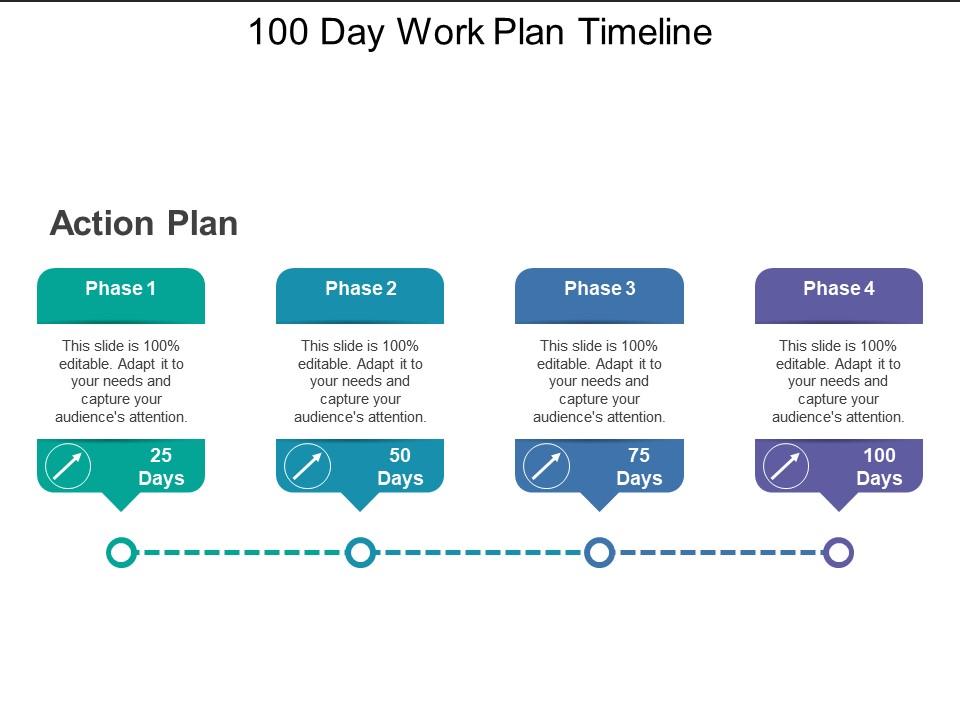
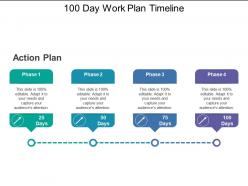
100 day work plan timeline

Slide 1 of 5
Favourites Favourites

Try Before you Buy Download Free Sample Product

Audience Impress Your
Audience
Editable 100%
Editable
Time Save Hours
of Time
The Biggest Sale is ending soon in
0
0
:
0
0
:
0
0
SlideTeam presents before you the new 100 Day Work Plan Timeline PowerPoint Slides to increase the efficiency of your presentation. These slides can be fully altered according to your needs. You can change the orientation, style, color of the text. A number of icons can be added to the slides. You can resize any shape or edit the colors. These slides are fully compatible with Google Slides. This document can be downloaded in both JPEG and PDF format.

FAQs for 100 day

Honestly, break it into three chunks - learning, relationships, and quick wins. First 30 days? Just listen and soak everything up. Figure out how things actually work, what the culture's like, all that stuff. Then spend days 31-70 building real connections with your team and stakeholders. Most people totally blow this part by trying to fix everything immediately (huge mistake). Last 30 days are for finding some easy wins that show you're adding value. Oh, and definitely set specific goals for each phase - plus regular check-ins with your boss so you don't go off track.

Honestly, pick 2-3 big things you can actually move the needle on in 100 days. Don't try to tackle everything at once - that's where most people mess up. Break each one down into weekly chunks that actually connect to your bigger goals. Like, if you're trying to improve customer retention, maybe week 1 is analyzing current data, week 2 is interviewing churned customers, etc. The whole point is having real wins you can point to after those 100 days. Otherwise you'll just spin your wheels and have nothing concrete to show for it.

For your 100-day plan, track three main things: completion rates, quality stuff, and what people actually think. First - did you finish what you said you would? Sounds dumb but most people don't even check this. Quality metrics depend on your goals - could be customer scores, fewer mistakes, whatever makes sense. Then ask your boss and teammates how they felt about your work's impact. I'd stick to maybe 5-7 metrics total because honestly, more than that and you'll just get overwhelmed trying to track everything. The feedback part is probably most important since that's what actually matters for your next review.

Honestly, just bake feedback into your plan from the start. I'd do weekly or bi-weekly check-ins with the important people - learned this one the hard way when I totally misread what my team wanted lol. Coffee chats work great, or those quick pulse surveys if you're feeling fancy. Write down what people tell you and actually show them you're changing things based on their input. That's the part most people mess up - they ask but don't follow through. Oh, and keep a simple log of themes you're hearing. Makes it way easier to spot patterns.

Honestly, leadership makes or breaks these things. You've gotta be the one pushing momentum and holding people accountable - no way around it. Set clear expectations upfront, then spend your time clearing obstacles so your team can actually get stuff done. When everything goes sideways (and it will around week 8-9), you're the one keeping everyone focused. The leaders who actually succeed? They jump in and work with their teams instead of just barking orders from their office. Check in weekly with key people and celebrate the small wins. Trust me, people lose steam fast if they don't see progress being acknowledged.

Yeah, totally adaptable! You just swap out what you're focusing on. Tech folks might track sprint cycles and product launches. Healthcare workers care more about patient outcomes and staying compliant with regulations. Manufacturing is all about production numbers and safety stuff - honestly that industry moves at its own pace anyway. The 100 days stays the same, but figure out what quick wins actually look like in your field first. Some sectors just naturally move faster than others, so don't worry if yours feels slower. I'd start by writing down your industry's top 3 must-haves, then build backward from there.

Honestly, the worst thing you can do is try cramming everything into those 100 days. Pick maybe 3-5 concrete things you actually want to accomplish - not some vague "improve team performance" nonsense that means nothing. I made that exact mistake on my last project and it was a disaster. Before you even start, make sure the key people are actually on board with what you're doing. Otherwise you'll spend half your time just convincing people instead of getting stuff done. Map out what winning looks like first, then figure out how to get there. Way less stressful that way.

Honestly, visual stuff is a game changer for 100-day plans. Nobody wants to read through endless bullet points - timelines and progress bars actually get people excited about what you're doing. I've literally watched plans go from being completely ignored to suddenly having everyone's attention just because someone made them look decent. PowerPoint templates work fine, or you could try Miro if you want something fancier. The visual approach makes it super easy to spot dependencies and update everyone during meetings. Plus you can highlight the big wins way better than just listing everything out.

I'd split it into three chunks - first 30 days for learning the ropes and grabbing some quick wins, then 31-70 for the big projects and getting to know everyone. Last stretch is about actually delivering results and setting yourself up for what's next. My old boss called it "learn, do, deliver" which honestly stuck with me. Set weekly check-ins so you're not flying blind - trust me on this one. The trick is being realistic about what you can pull off without selling yourself short on making real impact. Map out your big milestones first, then work backwards to build your timeline.

Honestly, those 100-day plans work because they force your team to actually talk to each other regularly. Everyone's goals connect, so people can't just disappear into their own little bubbles. The timeline is short enough that nobody can really slack off - you're checking in every few weeks anyway. What's cool is how competitive teams get about hitting those 30-60-90 day marks. It's like... weirdly motivating? I'd set up weekly meetings right away and make sure everyone sees how their work connects to the bigger picture. The constant sync-ups mean problems get caught early instead of turning into disasters later.

Figure out your 3-5 biggest goals first, then work backwards from there. I always sort stuff into "must-do," "should-do," and "nice-to-do" - super simple but honestly works great. Your first month should be quick wins and getting to know people. Month two is when you dive into the bigger strategic stuff. Use the last 30 days to wrap things up and prep for what's next. Oh, and block time each week to reassess everything because your priorities will definitely change as you figure out the role. Trust me on that one.

Here's what I've learned from watching too many good initiatives die: you need systems that run without you babysitting them. Set up regular check-ins with your team, write down the processes (seriously, document everything), and find people who actually care about keeping this going. The 100 days is just the start - think of it more like laying groundwork than hitting a finish line. Create ways to measure progress that don't disappear when you're busy. Oh, and definitely plan a review around day 120. That's when you'll see what's actually stuck and what's already sliding back to the old mess.

Oh dude, this is SO important and people constantly screw it up. Some cultures want you building relationships first before jumping into work stuff. Others expect you to hit the ground running immediately. Your timeline needs to account for how decisions get made too - is it top-down or does everyone need to weigh in? Communication styles vary wildly. Direct feedback vs. beating around the bush, you know? Don't forget their holiday schedules when planning milestones. Honestly, just find someone who knows the culture and bounce your plan off them first. Trust me on this one.

Honestly just use whatever your team's already on - Asana, Monday, or even a basic shared Google sheet works fine. I'd set up those automated reports showing completion rates and deadlines because the visual stuff actually keeps you motivated (who knew charts could be exciting lol). Weekly updates are key so you catch problems early. Most platforms can ping you on Slack or email when things get behind schedule. Don't overthink it with some fancy new tool - I've seen too many people waste time learning complex software instead of just tracking their progress.

Honestly, risk management is just your safety net for the whole plan. What could totally screw up your key stuff? Resource issues, people pushing back, tech problems - you know the drill. I learned this lesson the hard way, but you need backup plans for your backup plans. Don't treat contingencies like an afterthought. Build buffer time right into your timeline, especially for the risky stuff. Alternative approaches should already be mapped out. Oh, and definitely start with your top 3-5 risks - any more than that and you'll overthink it. Quick pivot strategies for each one, then you're golden.

Ratings and Reviews

0% of 100
Review Form
Write a review
Most Relevant Reviews

No Reviews