


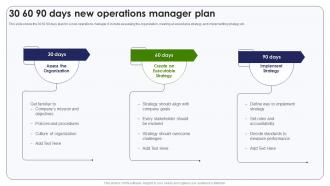
30 60 90 Days New Operations Manager Plan





Try Before you Buy Download Free Sample Product
 Impress Your
 Audience
 100%
100% Editable
 Save Hours
 of Time


This slide shows the 30 60 90 days plan for a new operations manager. It include assessing the organization, creating an executable strategy and implementing strategy etc
People who downloaded this PowerPoint presentation also viewed the following :
30 60 90 Days New Operations Manager Plan with all 6 slides:
Use our 30 60 90 Days New Operations Manager Plan to effectively help you save your valuable time. They are readymade to fit into any presentation structure.





FAQs for 30 60 90 Days New
You need process optimization, quality control, supply chain management, and capacity planning - the usual suspects. Inventory management too. But honestly? Most people totally mess up the metrics part, which is where you actually see if anything's working. Map out what you're doing now first. Then hunt down your biggest bottlenecks because that's where you'll get the most bang for your buck. Keep everything aligned with what customers actually want and your business goals. Oh, and stay flexible - things change fast and you don't want to be stuck with some rigid system that breaks the first time something goes sideways.
So lean manufacturing is all about cutting waste - stuff like extra inventory sitting around, people waiting for materials, unnecessary steps. The goal? Focus only on what actually adds value for customers. Think of it like decluttering but for factories, honestly. Just-in-time production helps a ton, plus kaizen (continuous improvement) and smoother workflows. Costs go down while quality and speed go up - pretty sweet deal. I'd start by mapping out your current processes first. Trust me, you'll find waste hiding in places you never expected. Sometimes it's obvious once you actually look.
Look, tech can totally transform your supply chain game. IoT sensors give you real-time tracking, which is pretty sweet. AI helps with routing and inventory - honestly way better than doing it manually. You'll want ERP systems to pull all your data together in one spot. Predictive analytics are clutch for demand forecasting too. Oh, and cloud platforms make working with suppliers way smoother. Here's the thing though - don't go crazy trying to fix everything at once. Start with whatever's driving you nuts right now and build from there. Trust me on this one.
So quality control is like your safety net - catches stuff before it hits customers. You're monitoring production constantly to hit standards, which saves you from expensive recalls and keeps customers happy. Honestly, it seems super boring until something breaks and then everyone's freaking out! Good QC also helps spot where you can improve processes and cut waste. I'd start by looking at your current checkpoints first - usually that's where problems sneak through. It's one of those unglamorous things that actually matters way more than people think.
Honestly, data analytics is a game-changer for making smarter operational calls instead of just winging it. You can dig into demand patterns, spot supply chain issues, track inventory - stuff that's impossible to catch manually with all the crazy amounts of data we're dealing with now. It helps you optimize schedules, predict when equipment might fail, find ways to cut costs. My advice? Don't go overboard initially. Pick something specific like how fast inventory moves or delivery performance. Get comfortable reading those insights first, then branch out. Way less overwhelming that way and you'll actually stick with it.
Look, you gotta find that balance between having stock and not drowning in cash tied up everywhere. ABC analysis is your friend here - sort everything by value and obsess over those high-dollar A items. Set up automatic reorder points using your lead times and demand data. Trust me on this one: your gut feeling is usually wrong compared to what the numbers tell you. Safety stock works great for mission-critical stuff, just be smart about which items actually need it. Oh, and check your metrics every week - trends shift faster than you think and you'll want to catch them early.
Your forecasting method totally changes how you run things - pick wrong and your whole supply chain gets screwed. Moving averages are solid for steady demand, makes inventory planning way easier. Seasonal stuff though? You need expert opinions and market research instead. I learned this the hard way at my last job, honestly. Match your method to your demand pattern - seasonal businesses can't use the same tools as companies with consistent sales. Look at how much your demand bounces around historically, then decide from there.
JIT's biggest pain points? Supplier reliability and unpredictable demand, honestly. Your suppliers need to be absolutely bulletproof - any hiccup from their end can crash your whole operation since there's zero buffer stock. Weather delays, transport strikes, whatever - you're toast. Customer demand spikes? Good luck scrambling to catch up. I'd say start small though, maybe just with your most dependable suppliers first. Once you've worked out the inevitable bugs (and there will be bugs), then expand it. Oh, and invest in really solid supplier relationships upfront - you'll thank yourself later.
Honestly, just pick three things: cut waste, use resources smarter, and make stuff recyclable. Map out where you're bleeding energy or materials first - that's usually where the money's hiding anyway. I know "circular economy" sounds like corporate BS, but it genuinely works. Renewable energy's obvious. Lean manufacturing helps tons. Design products people can actually reuse instead of toss. Your suppliers matter too - bug them about going greener. Don't try everything at once though. Start small with one pilot program and track the savings. You'd be surprised how often this stuff pays for itself.
Dude, you absolutely need other departments talking to your ops team. Like, how's production supposed to know what to make if sales isn't sharing customer demands? Finance controls the budget for inventory, procurement handles suppliers - it all connects. I learned this the hard way at my last job when we kept making stuff nobody wanted because marketing never told us about campaign changes. Set up weekly check-ins between teams and pick metrics everyone actually gives a damn about. Trust me, breaking down those silos will save you from so many fires later.
So basically, services are way trickier because you can't touch them or store them up like products. Manufacturing deals with inventory and fixing stuff on assembly lines, but with services? Everything happens in real-time while the customer's right there watching. That's honestly the hardest part - they're literally part of your process, which makes standardization super difficult. You gotta focus on training your front-line people really well since they ARE your quality control. Oh, and design everything around your busiest times because you can't just make extra "units" ahead of time.
Start with the basics: efficiency, quality rates, delivery times, and cost per unit. Those four will tell you most of what you need to know. Don't overcomplicate it right away - I've seen too many people get lost in fancy dashboards they never check. You want something for speed, accuracy, and costs. Customer satisfaction too if you deal with clients directly. Honestly? Pick maybe 3-5 that actually connect to what your business cares about and check them weekly. Way better than having 20+ metrics sitting there looking pretty but telling you nothing useful.
Honestly, don't rely on just one supplier - that's disaster waiting to happen. I'd spread things across different vendors in various regions, you know? Always have backups lined up too. Get some visibility tools so you can actually see what's going down in your supply chain before it hits you. Yeah, keeping extra inventory costs money, but for critical stuff it's worth it. Oh and map out where you're most vulnerable first - tackle those weak spots before worrying about everything else. It's all about redundancy without going broke.
Honestly, three things will make the biggest difference for your customers. Streamline your processes so people aren't waiting forever - nothing kills satisfaction like standing around. Quality control at every step is crucial too, catch problems before customers do. Your frontline team matters way more than most people realize, so train them well. Here's the thing though - consistency is what really wins people over. Map out how customers move through your business right now and find the worst pain points. That's probably where you should start, even if it seems obvious.
Managing global ops is honestly a headache sometimes. Supply chains get crazy complex when you're sourcing from multiple countries - different regulations, quality standards that don't match up, currency swings messing with your budgets. COVID really showed how fragile these networks can be. Time zones make coordination rough too. You've got to build in flexibility though, can't just chase the cheapest option anymore. Having good supplier relationships worldwide helps, but you're still gonna face disruptions. Cultural differences add another layer of complexity to deal with.
-
Exclusive and extensive collection of templates. Really helped me create a professional presentation in just no time.
-
Wonderful ideas and visuals. I'm really pleased with the templates, which are unique and up to date.