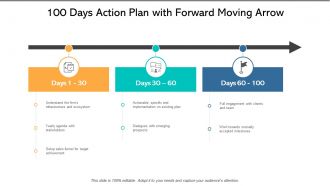
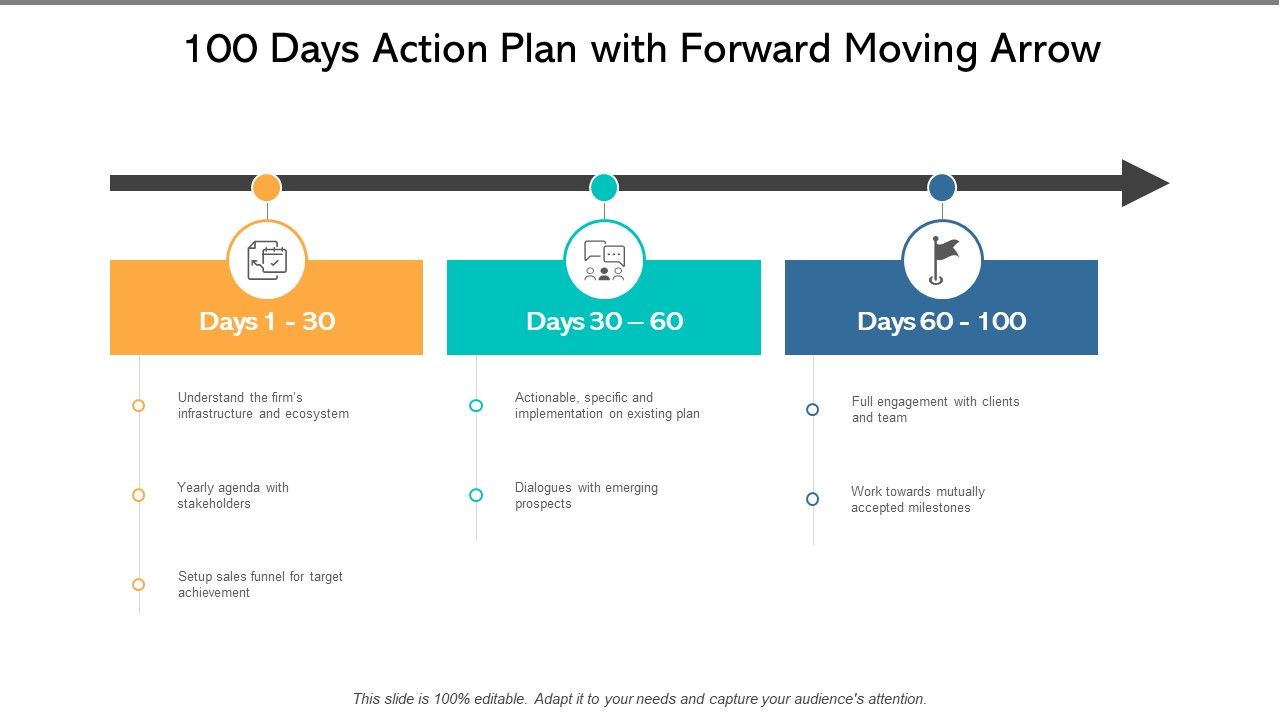
100 days action plan with forward moving arrow
Try Before you Buy Download Free Sample Product
Audience
Editable
of Time
Keep ambitions alive with our 100 Days Action Plan With Forward Moving Arrow. Give your audience something to cherish with your ideas.
People who downloaded this PowerPoint presentation also viewed the following :
100 days action plan with forward moving arrow with all 5 slides:
Our 100 Days Action Plan With Forward Moving Arrow bring out the bare facts. They help filter out the available data.
FAQs for 100 days action plan with
Start with super specific goals - none of that vague "increase sales" nonsense. Break everything into bite-sized tasks with actual deadlines and put someone's name on each one. You'll want to measure progress somehow or you're just flying blind. Build in check-ins too, otherwise people disappear into the void. Oh, and always plan for when things go wrong because they will. I learned that the hard way on my last project! Keep it all visible so everyone stays accountable.
Figure out what's both urgent AND actually matters - that's your starting point. The Eisenhower Matrix thing really works for sorting everything into those urgent/important boxes. I used to just tackle whatever felt loudest and honestly? Total disaster. Hit the stuff that moves your main goals forward first. Quick wins are great for momentum after that. Don't forget some tasks block others - like you can't do B until A's done. Time-block your priorities when you're sharpest (mornings for me), and group similar tasks together. Oh, and review weekly because priorities always shift anyway.
Okay so SMART criteria are like your BS detector for goals. You know how people write stuff like "improve customer service" and call it a day? That's garbage. SMART forces you to be Specific, Measurable, Achievable, Relevant, and Time-bound instead. Honestly changed how I plan everything. Your action items become actual concrete steps with real deadlines. Way easier to track if you're making progress or just spinning your wheels. I literally run every goal through this filter now - saves me from those pie-in-the-sky plans that go nowhere.
Honestly, visuals are a game-changer for action plans. People can actually follow along when you show them flowcharts and timelines instead of just talking at them. Gantt charts are clutch for mapping out when stuff needs to happen. I learned this the hard way after boring people to death with bullet point slides - nobody retains that info anyway. Throw in some simple icons to break things up. Graphs make progress super obvious at a glance too. Trust me, you'll get way better buy-in when people can actually visualize what you're asking them to do.
Figure out who's actually going to be impacted by your plan first. Then talk to them early - don't wait until you need their approval or whatever. I learned this the hard way when people got pissed about being left out. Mix it up with workshops, quick surveys, maybe grab coffee one-on-one. Make them feel like they're helping build the thing, not just getting handed some finished product. Oh, and definitely do regular check-ins. People love knowing their input actually matters and isn't just going into some black hole. Be upfront about how you're using their feedback too.
Ugh, the worst thing you can do is be super vague with tasks. Like don't just write "fix marketing" - say "post 3 times on Instagram by Thursday" or whatever. Specific stuff that you can actually check off. Also? Don't go crazy week one trying to do everything at once. I always do this and it's exhausting. Pick maybe 5-6 real priorities instead of making some insane 50-step plan that nobody will follow. Oh and definitely say WHO'S doing what. Otherwise everyone assumes someone else is handling it. Build in extra time too because something always goes sideways. Check in weekly or tasks just disappear into the void.
Honestly? Start with something basic like Trello or Asana - don't overthink it. Break everything into actual tasks with real deadlines and assign them to people. The progress bars are weirdly addictive when stuff actually gets crossed off. Set up notifications so things don't just disappear into the void (speaking from experience here). If you're dealing with tons of data, connect it to spreadsheets that update automatically. But seriously, pick ONE tool first. Get everyone using it before you go crazy with fancy features. I've seen too many teams get overwhelmed trying to use everything at once.
Okay so first thing - figure out what's actually still doable vs what needs to change completely. I always build in extra time now because let's be real, we're all terrible at estimating how long stuff takes. Break big tasks into smaller pieces so you can shift gears fast when things go sideways. Oh and set up regular check-ins instead of just waiting until deadlines to see if you're screwed. Tell your team about changes right away - nobody likes surprises. Write down what went wrong too, future you will thank you for it.
Honestly? I'd say monthly at minimum, but I'm constantly tweaking mine every week. Things move way too fast now to ignore it longer than that. Weekly makes sense if you've got crazy deadlines or tons of people involved. Monthly or quarterly works for bigger picture stuff though. Just don't be like my old coworker who made this elaborate plan then never looked at it again - total waste. Set up a phone reminder or you'll forget. Oh, and if something big changes mid-project, update it right away instead of waiting.
Honestly, stick to 3-5 metrics tops or you'll go crazy trying to track everything. Focus on outcome stuff (did you hit your goals?), process tracking (staying on time/budget), and early warning signals. At least one should be hard numbers - revenue, completion rates, whatever. Maybe throw in something about stakeholder happiness too since that always bites you later if ignored. The key is picking things you can actually control and update regularly. I learned this the hard way after drowning in spreadsheets once. Weekly check-ins work best for course corrections.
Honestly, you really need your team's input on this stuff. They'll catch things you totally missed - like unrealistic deadlines or steps that just won't work in practice. Different people bring different expertise, you know? Plus they're the ones actually doing the work, so if they don't buy into the plan from the start, good luck getting them motivated later. I'd just set up a quick meeting (doesn't have to be fancy) and ask them straight up: what's missing here? What seems impossible? Trust me, way better to find problems now than when you're already behind schedule.
Honestly, you gotta hit people with different formats since everyone learns differently. Mix it up - throw together an infographic, write out the details, and definitely do a Q&A session where people can actually talk. I'm obsessed with doing quick video walkthroughs too because some folks just get it better that way. Don't forget about language stuff and time zones though. Oh, and make sure each format covers the main points on its own - you never know what people will actually look at. Ask for feedback early so you know if it's working.
Oh man, cultural stuff can totally mess with your team dynamics if you're not ready for it. Some cultures are all about detailed hierarchical plans, others want flexibility and everyone's input - it's wild how different approaches can be. Communication styles vary too - like high-context cultures rely on reading between the lines instead of spelling everything out. Timeline expectations? Completely different depending on where people are from. Honestly, I'd research cultural norms ahead of time and maybe get someone to act as a cultural bridge. Also build in extra time for alignment talks because trust me, you'll need it.
Think of risk assessment as your sanity check before diving into any big plan. What could blow up in your face? List out the main things that might go sideways - money running out, timeline getting crushed, outside stuff you can't control. Honestly, I learned this the hard way after a few projects went completely off the rails. Rate your top 5 risks by how bad they'd be and how likely they are to actually happen. That way you're not just crossing your fingers and hoping for the best. Build some backup plans for the worst ones.
Honestly, action plans are total game-changers for teams. You know those moments where everyone's staring at each other like "wait, who was supposed to do this?" Yeah, they basically disappear. Map out who's doing what upfront and suddenly people can actually help each other instead of accidentally duplicating work. The visibility thing is huge too - when someone hits a roadblock, teammates can spot it and jump in. I learned this the hard way on a project that went completely sideways last year. Try getting your whole team together to hash out tasks and ownership from the start. Trust me, it's worth the extra hour.
No Reviews