


1 year plan template sample of ppt




Try Before you Buy Download Free Sample Product
 Impress Your
 Audience
 100%
100% Editable
 Save Hours
 of Time


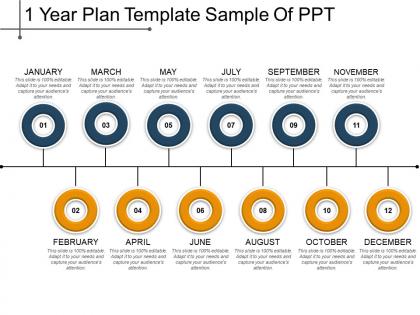
Make awesome PowerPoint presentations with our 1 Year Plan Template. Plan your yearly activities well in advance and guide your audience about the same with the 1-year plan template. The main purpose of using this is to display all the relevant information in a summarized form in just one slide. Where you have to tell a story that has many events across time, this year timeline template can be best used at such places. It can also be used for planning and outlining the sequence of activities and sharing them with others. Quickly convey your important information using our timeline chart slide. A series of data can be best presented using this slide. It is a 12 stage process that allows you to plan your monthly activities for a year. This is ready to use template with which you can deliver your PPT presentations effortlessly. You just need to insert your data in place of the sample text and your presentation will be ready in no time. Share your company’s goal with our 12 stage timeline slide. Stages of any event that need to be completed over a year in a chronological manner can be easily illustrated using such a slide. Click the download button now and avail the benefits.
People who downloaded this PowerPoint presentation also viewed the following :
1 year plan template sample of ppt with all 5 slides:
Create faithful customers with our 1 Year Plan Template Sample Of Ppt. Their belief in you will endure.
FAQs for 1 year plan template
Honestly, start with 3-5 big goals max - any more and you'll just overwhelm yourself. Break those down into quarterly chunks, then monthly action steps. The trick is getting specific with your metrics because "get healthier" means literally nothing when you're trying to track progress. Oh, and definitely plan for when things go sideways - add a section for obstacles and your backup plans. I'd review it monthly since things change fast. Build in buffer time too because something always comes up. You want it detailed enough to actually guide decisions but not so rigid that you can't pivot when life throws curveballs.
Honestly, those yearly templates are game-changers for tracking stuff. They chop up your massive goals into bite-sized pieces you can actually measure each month or quarter. Just compare where you're at versus where the plan says you should be - boom, instant reality check. I used to think I was crushing it until I started doing this regularly (turns out I wasn't lol). The monthly updates are clutch though. You'll catch yourself falling behind way earlier instead of hitting December like "wait, what happened to this whole year?" It's basically your personal GPS for goals.
Look, presentation templates are honestly a game-changer for yearly planning. Way better than burying everything in some doc that'll collect digital dust. Breaking things down visually - your goals, timelines, all that stuff - just clicks better for everyone involved. It forces you to actually think through how everything connects too, which is clutch. I always catch unrealistic deadlines when I see them laid out like that. Oh and grab one with monthly breakdowns if you can - makes tracking progress throughout the year so much easier. Trust me on this one.
People get way more invested when they can actually tweak their plan to fit them. Like, if I can adjust timelines or add my own milestones, I'm gonna stick with it. Think about it - would you rather wear some random person's clothes or something tailored for you? Same deal here. Users can make it work for their industry or goals instead of being stuck with whatever generic setup you gave them. Oh, and don't go crazy with options at first - maybe 3 or 4 customizable things max. Too many choices just paralyzes people.
Look, your timeline is basically what stops your whole plan from turning into a fantasy. Break those big yearly goals into quarterly chunks, then monthly check-ins - way less scary that way. Work backwards from December (sounds weird but trust me, it works). You'll actually see how much time each piece needs instead of just hoping it'll magically happen. Honestly, this is where most people mess up - they skip the timeline part. Monthly checkpoints let you catch problems early instead of panicking in November when nothing's done.
Honestly, having that yearly overview is a game-changer for spotting problems early. You'll catch stuff like your best developer being needed on two projects simultaneously - super helpful for getting ahead of scheduling nightmares. Plus it shows seasonal trends, so you can avoid launching anything during that dead week between Christmas and New Year's (learned that one the hard way). Map out your biggest constraints first - like which team members are always in demand - then work everything else around those bottlenecks. Makes you think more strategically about timing instead of just winging it month by month.
Honestly, SMART goals saved my butt after I kept setting super vague objectives that never happened. So instead of "boost sales," try "grow monthly sales 15% by Q4." Way clearer, right? Break big goals into quarterly chunks - makes tracking actually doable. I always write mine like I'm explaining to someone totally clueless about my job. Quick test: could a coworker handle this without texting you a million questions? Also, stick to 3-5 major ones max. Any more and you'll be all over the place. Review monthly and tweak as needed.
Honestly, the best templates work because they focus on the basics that every business needs - goals, deadlines, resources, and how you'll measure success. The structure is what matters, not the specific content. Like, your marketing team might track leads while operations watches efficiency numbers, but they'd both use the same quarterly setup. You can literally take one template and swap out the objectives and metrics for whatever industry you're in. Tech, healthcare, retail - doesn't matter. Start with something solid, then just tweak the categories to match how your sector talks and what actually moves the needle for you.
Biggest mistake? Treating it like some rigid checklist. Don't cram 15 goals in there - I've seen people do this and they're toast by March. Also skip the "fill it out once and forget it" approach. Life changes, so your plan should too. Actually customize those sections instead of writing generic fluff (you know what I mean). Monthly check-ins are clutch - set them up right away. Oh, and honestly? Most templates work better as starting points than gospel. Your situation is probably different than whoever made the thing anyway.
Build in regular feedback checkpoints - monthly check-ins, quarterly reviews, that kind of thing. I always throw in a simple "what's working/what's not" section because plans that never change usually just... die. Leave space for your own thoughts plus input from your boss or teammates. Oh, and make sure each feedback section ties back to your original goals so you can pivot when you need to. The trick is making it feel routine instead of that panicked scramble you do right before your annual review. Trust me on that one.
Honestly, tech makes these planning templates so much better than just writing stuff down. You can set up automatic reminders for deadlines and track progress without thinking about it. Plus your whole team can jump in and edit from anywhere - no more "sorry, the file's on my other computer" nonsense. I'd start with something basic like Google Sheets or Notion first. Don't go crazy with expensive project software yet. The cool thing is you can sync everything with your calendar so it actually blocks time for important stuff. Some platforms even show you progress charts and graphs, which is pretty satisfying when you're crushing your goals.
For your one-year plan, stick to three main parts: objectives, milestones, and what resources you'll need. Big picture goals first, then break it down by quarters with actual numbers. Don't get bogged down in monthly stuff - honestly, leadership doesn't have time for that level of detail. Charts and visual timelines are your friend here, way better than paragraphs of text. Put dependencies and risks right up front where people will actually see them. Each section should end with clear next steps and who's responsible. You want everyone leaving that room knowing exactly what winning looks like and when they'll see results.
Honestly, the one-year template is clutch for this stuff. Write down your big goals first, then work backwards - what needs to happen each quarter to get there? Monthly action steps come next. Most people totally skip connecting their daily tasks to the bigger picture, which is why they spin their wheels forever. I do monthly check-ins to see where I'm at and tweak things. Oh, and make sure every small goal actually feeds into something bigger. Otherwise you're just busy without any real direction, you know?
Track both results stuff (revenue, new customers, market share) and how you're actually getting there - like project completion rates and staying on budget. Leading indicators are clutch too, think pipeline health or how happy your team is. Those predict what's coming next. Pick 5-7 metrics that actually move the needle for YOUR goals. Don't get sucked into vanity numbers that just look impressive. Each one needs a starting point, target, and how often you'll check it. Monthly reviews work well - gives you time to fix things before they spiral. Trust me, less is more here.
Dude, seriously - make that plan look clean or people won't even bother reading it. I've watched amazing strategies get totally ignored because they looked like a mess. Break everything into clear sections with decent spacing. Use headers and bullet points so people can actually scan through it. Maybe throw in a chart or two? Dense walls of text are the kiss of death, trust me. Oh and pick fonts that don't make people squint - seems obvious but you'd be surprised. Your ideas are good, don't let bad formatting kill them before anyone gets to the actual content.
-
Content of slide is easy to understand and edit.
-
Unique and attractive product design.