4s fishbone timeline diagram

4s fishbone timeline diagram
Slide 1 of 2
Favourites Favourites

Try Before you Buy Download Free Sample Product

Audience Impress Your
Audience
Editable 100%
Editable
Time Save Hours
of Time
The Biggest Sale is ending soon in
0
0
:
0
0
:
0
0
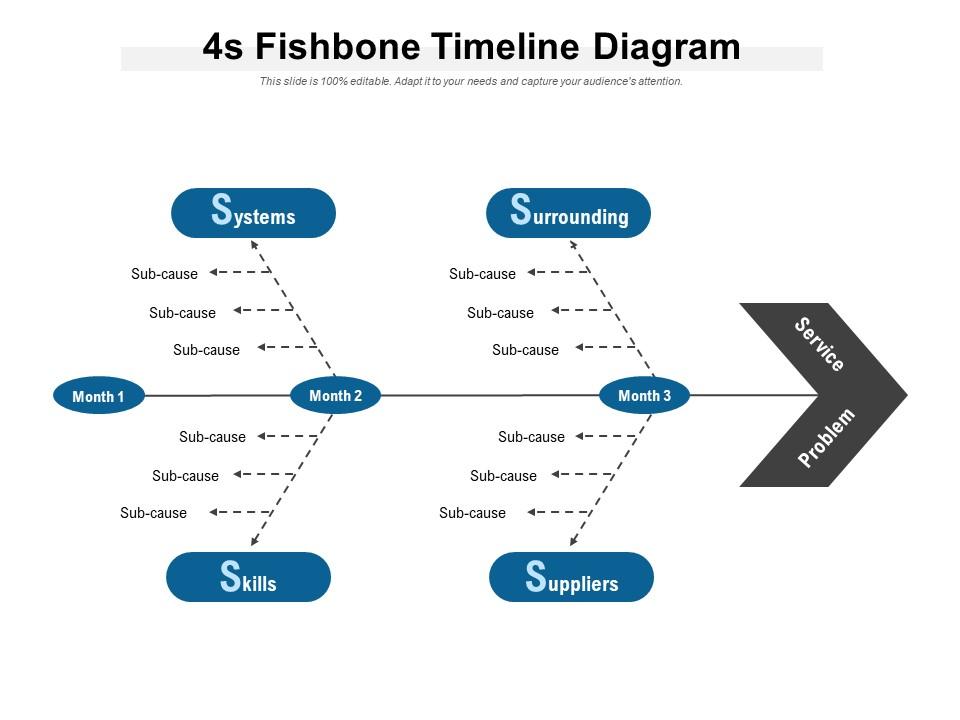
Presenting this set of slides with name 4s Fishbone Timeline Diagram. This is a four stage process. The stages in this process are Fishbone Timeline, Production Process, Management. This is a completely editable PowerPoint presentation and is available for immediate download. Download now and impress your audience.

People who downloaded this PowerPoint presentation also viewed the following :

FAQs for 4s

The key components of the 4S Fishbone diagram include Skills, Systems, Supplies, and Surroundings as the four primary cause categories branching from the central problem statement. This structured approach enables organizations to systematically analyze root causes across human capabilities, operational processes, resource availability, and environmental factors, with many manufacturing and service industries finding that this comprehensive framework streamlines problem-solving while ensuring no critical contributing factors are overlooked.

The 4S Fishbone diagram incorporates four structured categories—Skills, Systems, Supplies, and Surroundings—while traditional fishbone diagrams use broader, often customizable categories like people, process, and environment. This standardized approach streamlines root cause analysis by providing consistent frameworks across organizations, enabling teams to systematically evaluate operational factors, ultimately delivering more targeted solutions and faster problem resolution.

The 4S Fishbone diagram proves most effective in complex problem-solving scenarios involving systematic root cause analysis, quality control investigations, process improvement initiatives, and cross-functional team collaborations. Manufacturing companies use it for defect analysis, healthcare organizations for patient safety reviews, and service industries for customer complaint resolution, ultimately delivering structured problem identification and comprehensive solution development across diverse operational challenges.

The 4S Fishbone diagram integrates seamlessly with quality improvement tools like Six Sigma DMAIC methodology, Pareto analysis, statistical process control, and root cause corrective action frameworks. This strategic combination enhances problem-solving capabilities by providing comprehensive cause identification, data-driven prioritization, and systematic resolution tracking, with many manufacturing and healthcare organizations finding that integrated approaches deliver faster issue resolution and sustained operational improvements.

Combining a timeline with the 4S Fishbone diagram enhances root cause analysis by tracking when issues emerged across Surroundings, Suppliers, Systems, and Skills categories, enabling teams to identify patterns and correlations over time. This temporal perspective helps organizations in manufacturing, healthcare, and service industries pinpoint trigger events, assess intervention effectiveness, and prevent recurring problems, ultimately delivering more strategic problem-solving capabilities.

Teams can effectively populate 4S Fishbone diagrams through structured brainstorming sessions using techniques like silent brainstorming, round-robin discussions, and cross-functional input across Surroundings, Suppliers, Systems, and Skills categories. These collaborative approaches streamline root cause identification by encouraging diverse perspectives, minimizing groupthink, and systematically exploring each category, ultimately delivering comprehensive problem analysis and faster resolution timelines.

Manufacturing, healthcare, automotive, aerospace, and financial services commonly benefit from employing the 4S Fishbone diagram for systematic problem analysis. These industries leverage this structured approach to identify root causes across Skills, Systems, Supplies, and Surroundings categories, ultimately streamlining quality control processes, reducing operational inefficiencies, and enhancing regulatory compliance outcomes.

The 4S Fishbone diagram improves collaborative problem-solving by structuring team discussions around Surroundings, Suppliers, Systems, and Skills, ensuring all members contribute diverse perspectives systematically. This visual framework enables teams to identify root causes more comprehensively, reduces individual bias through collective analysis, and creates shared understanding across departments, ultimately delivering faster resolution times and stronger team alignment.

Teams implementing 4S Fishbone diagrams often face challenges including resistance to systematic change, difficulty categorizing problems across the four dimensions, inadequate data collection, and insufficient cross-functional collaboration during analysis sessions. While these obstacles can initially slow implementation, organizations in manufacturing, healthcare, and service industries find that structured training, dedicated facilitation, and gradual integration ultimately streamline problem-solving processes and enhance operational efficiency.

Visual aids enhance the 4S Fishbone timeline diagram's effectiveness by improving pattern recognition, accelerating root cause identification, and enabling clearer stakeholder communication across complex problem-solving scenarios. Through color-coded categories, interactive elements, and data visualization overlays, teams in manufacturing, healthcare, and project management can streamline analysis processes, reduce diagnostic time, and ultimately deliver more targeted solutions while facilitating cross-functional collaboration.

**INPUT**: What software or tools are recommended for creating a 4S Fishbone timeline diagram? **OUTPUT**: Recommended tools include Microsoft Visio, Lucidchart, SmartDraw, PowerPoint, and specialized templates from SlideTeam for creating comprehensive 4S Fishbone timeline diagrams. These platforms streamline diagram creation through drag-and-drop functionality, pre-built templates, and collaborative features, with many organizations finding that template-based solutions significantly reduce development time while enhancing visual clarity.

Results from a 4S Fishbone diagram can be quantified by establishing baseline metrics for each identified root cause, implementing key performance indicators (KPIs), and creating measurement frameworks that track improvement percentages. Organizations use dashboard systems, regular audit cycles, and statistical process control methods to monitor progress, with many manufacturing and healthcare institutions finding that systematic tracking delivers measurable operational improvements and sustained competitive advantage.

Stakeholders play a crucial role in 4S Fishbone timeline diagram development by providing diverse perspectives, domain expertise, and validation of cause-effect relationships across different organizational levels. Through collaborative workshops and structured input sessions, stakeholders from operations, quality, management, and frontline teams contribute essential insights that ensure comprehensive problem analysis, while their collective knowledge enhances diagram accuracy and ultimately delivers more effective root cause identification and sustainable solutions.

Real-world applications of the 4S Fishbone diagram include manufacturing defect analysis, healthcare patient safety investigations, software development bug tracking, supply chain disruption analysis, and customer service complaint resolution. These structured approaches enable organizations across automotive, pharmaceutical, technology, and retail sectors to systematically identify root causes while streamlining problem-solving processes, ultimately delivering faster resolutions and enhanced operational efficiency.

The timeline aspect transforms the Fishbone diagram into a dynamic planning tool by mapping cause-and-effect relationships across specific time periods, enabling teams to identify when issues emerged, track problem evolution, and sequence corrective actions strategically. This temporal dimension helps organizations in manufacturing, healthcare, and project management prioritize interventions based on chronological patterns, ultimately delivering more targeted solutions and preventing recurring issues.

Ratings and Reviews

0% of 100
Write a review
Most Relevant Reviews

No Reviews