


5 key factors of scalability of business model




Try Before you Buy Download Free Sample Product
 Impress Your
 Audience
 100%
100% Editable
 Save Hours
 of Time


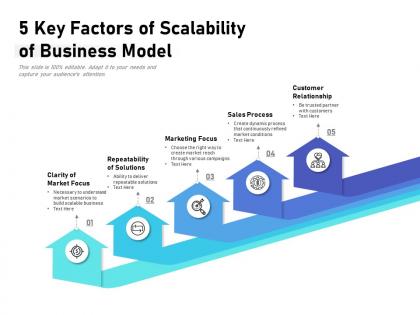
SlideTeam presents this content ready 5 key factors of scalability of business model PowerPoint template. You can gain a competitive edge using these five elements of scalability in a business PPT slide. Besides, highlight the ways to maximize your marketing efforts with the aid of this professionally designed five elements of success and growth presentation diagram. Employ this well-crafted scalability business model to present ways of marketing your company to garner the right type of clients and grow a successful business. This PPT slide is filled with well-researched information on everything from marketing your company to scaling it, so you can reach more people. Talk about concepts of clarity of market focus and sales process using this PowerPoint graphic. All the content in this PowerPoint diagram is statistically backed up by extensive research and data analysis. This framework of business scalability PowerPoint graphics will be sure to knock your audience's socks off! Download the presentation layout now and get started on your way to higher profits.
People who downloaded this PowerPoint presentation also viewed the following :
5 key factors of scalability of business model with all 2 slides:
SlideTeam presents this content ready 5 key factors of scalability of business model PowerPoint template. You can gain a competitive edge using these five elements of scalability in a business PPT slide. Besides, highlight the ways to maximize your marketing efforts with the aid of this professionally designed five elements of success and growth presentation diagram. Employ this well-crafted scalability business model to present ways of marketing your company to garner the right type of clients and grow a successful business. This PPT slide is filled with well-researched information on everything from marketing your company to scaling it, so you can reach more people. Talk about concepts of clarity of market focus and sales process using this PowerPoint graphic. All the content in this PowerPoint diagram is statistically backed up by extensive research and data analysis. This framework of business scalability PowerPoint graphics will be sure to knock your audience's socks off! Download the presentation layout now and get started on your way to higher profits.

FAQs for 5 key factors of scalability
Honestly, it all comes down to three big things: your system setup, how you've designed your database, and managing resources well. Can your app handle more users by adding servers, or are you stuck just upgrading what you have? Your database will absolutely crush you if you don't plan ahead - trust me on that one. Caching makes a huge difference too. Load balancing helps spread things out. Oh, and whether you went with microservices or kept it simple with a monolithic setup matters a lot. I'd start by monitoring what's actually slowing you down right now, then figure out which approach fits your situation best.
Get some monitoring tools first - New Relic or DataDog work great for tracking response times and memory usage. Then do load testing by slowly cranking up traffic until things start breaking. Database queries are usually the biggest troublemakers, though API endpoints can be sketchy too. I always check logs for patterns when stuff slows down. Oh, and don't forget third-party integrations - they love to randomly crap out. The main thing is finding these issues before your users do, because discovering bottlenecks during a traffic spike is basically nightmare fuel.
Dude, cloud computing is like having a magic button for your business needs. Traffic explodes on Black Friday? Scale up instantly. Dead quiet in January? Scale back down. You only pay for what you're actually using instead of buying a bunch of servers that'll sit there collecting dust half the time. The whole thing beats the hell out of trying to predict what you'll need six months from now - I mean, who's good at that? You also get automatic backups and your stuff works from anywhere. My advice? Don't overthink it. Pick something small like file storage and just try it out.
So basically with microservices, you can scale just the parts that need it instead of your whole app. Like if everyone's hitting your login service hard but payments are chill, just add more auth servers. Leave everything else alone. Each service can run different tech too - whatever works best for that specific thing. Plus you can push updates to one piece without breaking the rest, which honestly saves so much headache. The trick is figuring out what actually needs more juice and scaling smart instead of just throwing resources at everything.
So vertical scaling is just beefing up your current server - more RAM, better CPU, that stuff. Way easier to pull off. Horizontal means spinning up more servers to split the work. Here's the thing though - you can only make one machine so powerful before you hit a wall. With horizontal, you can basically add servers forever, but now your app needs to play nice across multiple boxes which gets messy fast. I'd say start vertical when you're small. Once you need serious growth or can't have your site go down, that's when horizontal makes sense. Pain in the ass to set up initially but worth it.
Database choice can make or break your app's growth, honestly. PostgreSQL is solid for complex stuff and stays consistent, but scaling horizontally? Pain in the ass. MongoDB and Cassandra spread across servers way easier - you just lose some consistency guarantees. I've watched so many teams screw themselves over by picking wrong early on. Figure out if you'll hit read limits, write bottlenecks, or storage issues first. That'll point you toward what actually fits. Match the database strengths to how you expect things to grow.
Auto-scaling is your best friend here - set it up so new servers kick in automatically when traffic spikes. Load balancers help spread everything out evenly too. Monitor response times religiously because that's where you'll spot trouble first. CDNs are clutch for static stuff. Honestly, most people skip this part, but run load tests way before you need them - like, monthly if you can swing it. Keep some backup capacity ready to go. The worst feeling is scrambling during an actual traffic surge when you could've caught issues earlier. Oh, and cache aggressively wherever possible.
Yeah, programming languages definitely affect scalability. Go, Rust, and Java handle concurrency and memory way better than Python or Ruby - they're just designed differently. Python's amazing for fast development, but that GIL will mess you up once you hit real scale. Honestly though? Your architecture matters more than the language most of the time. I've seen scalable systems built in "slow" languages with smart caching and good infrastructure design. Oh, and profile your bottlenecks first before you go rewriting everything in Go or whatever.
Start with stateless design - no server-side sessions so you can spin up instances easily. HTTP status codes matter, and add pagination now even if your data's tiny. You'll thank yourself later. Cache everything you can, especially read-heavy stuff. Design endpoints around resources, not actions - way cleaner to think about. Rate limiting saves you from getting hammered by bots or whatever. Version early too. Oh and definitely track response times and errors from the start. That way you'll actually know when things are breaking instead of just guessing.
Load testing is basically ramping up traffic until stuff starts breaking. Start with normal usage, then crank it higher until response times go to hell or you get errors. Honestly, it's a lifesaver for avoiding those middle-of-the-night disaster calls. You want to hit different weak spots - database connections, memory, CPU, whatever. I usually grab baseline metrics first, then bump up the load bit by bit. Shows you exactly where things fall apart. Way better to find out during testing than when actual users are screaming at you.
Dude, honestly the worst thing is scaling before you actually know what works. Burning cash on everything at once instead of just focusing on the stuff that moves the needle - I've watched so many startups do this. Team culture gets messy too when you're hiring fast without decent onboarding. Suddenly it's chaos and nobody knows their role. Oh and don't overthink your tech stack early on. Simple works fine when you're small. Pick one metric that actually matters for your business right now. Then scale whatever improves that number. Everything else can wait.
Dude, containers are a total game changer for scaling. You can launch identical app instances in seconds instead of waiting around for VMs to boot up. They're super lightweight since they share the host OS, and honestly? Way more efficient with resources. Your app runs exactly the same whether it's on your MacBook or spread across a bunch of cloud servers - that portability is clutch. Tools like Kubernetes will automatically scale everything based on demand, which still blows my mind. Just try containerizing one service first. You'll see how much cleaner your deployments get right away.
Definitely track response time and throughput first - those tell you if things are actually working. CPU, memory, and disk I/O matter too. Error rates are huge because broken stuff under load is the worst. Your database usually chokes first, so watch connection pools and queue depths there. Oh and if you're on AWS or whatever, cost per transaction adds up fast. I'd set alerts for when metrics get sketchy. Load testing saves you from finding out the hard way when real users hit your app. Trust me on that one.
Basically you spread the work across multiple machines instead of just making one super powerful computer. Add more servers when things get busy - that's horizontal scaling. Load balancing helps distribute requests evenly, and you partition data across different systems. But fair warning - this stuff gets complicated quickly. Network delays become a pain, keeping data consistent across nodes is tricky (especially with updates), and servers will definitely crash at some point. Oh, and coordinating failures? Total headache. Design assuming everything will break from the start. Trust me on this one.
Netflix went from mailing DVDs to streaming worldwide while handling crazy traffic spikes. Amazon started with just books - now they sell literally everything plus AWS runs like half the internet. Slack scaled from 15k users to millions without falling apart, and Airbnb went from people renting air mattresses to this massive global thing. The smart move they all made? Building modular systems early on. That way you can just add more capacity instead of rebuilding from scratch every time you grow. Honestly, I think focusing on flexible architecture beats trying to optimize for speed right away.
No Reviews