

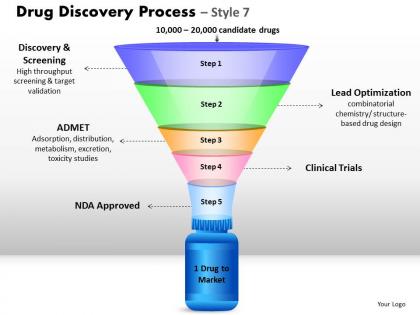
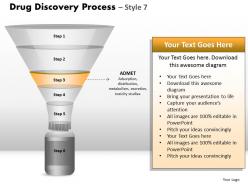
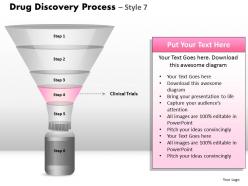
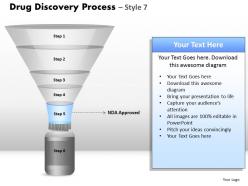
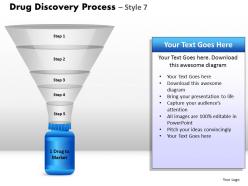
5 staged drug discovery process




Try Before you Buy Download Free Sample Product
 Impress Your
 Audience
 100%
100% Editable
 Save Hours
 of Time


Talented digital designers have worked tirelessly to create this collection of 5 Staged Drug Discovery Process. We are proud to offer this collection to you.
People who downloaded this PowerPoint presentation also viewed the following :
5 staged drug discovery process with all 10 slides:
Even under pressure your presentation needs to perform at peak performance. Get your project looking its best in moments in seconds with our 5 Staged Drug Discovery Process.
FAQs for 5 staged
So basically you start with target identification, then move to lead discovery where you're screening tons of compounds for promising molecules. This step is honestly such a money pit - I've seen teams blow through millions here. Next comes preclinical testing on animals for safety and efficacy. If that goes well, you'll hit the clinical trial phases: Phase I tests safety in humans, Phase II checks if it actually works, Phase III does large-scale confirmation. The whole thing? We're talking 10-15 years and hundreds of millions easy. My advice though - really nail your target validation first before you even think about the rest.
So basically, scientists hunt for drug targets by digging into how diseases actually work at the molecular level. They're looking for proteins or genes that are either messed up or could be tweaked to help. Teams pull data from genomics studies, analyze proteins, test disease models - it's pretty much detective work, honestly. Then they have to prove that messing with these targets actually changes the disease outcome in lab tests. Oh, and here's the kicker - the target has to be "druggable," meaning you can actually get a drug to reach it in real patients. Otherwise you're just spinning your wheels.
So basically HTS is like your first round of elimination in drug discovery. You're testing tons of compounds - we're talking thousands, maybe millions - against whatever protein you're targeting. It's all automated with robots running 24/7, which honestly beats standing at a bench pipetting all day. Think speed dating but for molecules lol. The whole point is finding those initial "hits" that show some activity, even if they're rough around the edges. Once you've got your hits, that's when the real fun starts - medicinal chemists take over to turn them into actual drug candidates.
Honestly, AI is a game changer for drug discovery. You can screen millions of compounds digitally before wasting cash on lab tests that go nowhere. The tech predicts which molecules will actually work and flags safety issues early - saves you from those expensive late-stage failures. Timeline-wise, we're talking maybe 5-7 years instead of the usual 10-15 year slog. AlphaFold from DeepMind is pretty solid for protein structure stuff if you're just getting started. Oh, and it'll help optimize drugs you already have too. Still feels sci-fi to me that computers can design molecules, but here we are.
Honestly, target validation is going to be your biggest headache - proving your target actually drives the disease. Then there's lead optimization, which is basically making your compounds not suck. Most early companies are broke, so you're constantly battling resource constraints. Safety issues will randomly torpedo your best candidates too. Regulatory stuff at this stage? Total wild west - nobody knows what they want. My advice: get tight with good CROs early and always have backup compounds in the pipeline. Your first pick will definitely fail, trust me on that one.
So basically preclinical is all the lab stuff - testing on cells and animals to see if your drug won't kill people and might actually work. Most drugs crash and burn at this stage honestly, which is probably for the best. After you survive that gauntlet, clinical trials are where you finally test on actual humans in super controlled studies. The FDA won't even let you near people until you've proven your compound isn't toxic in the lab first. Skip steps here and you'll blow millions when your human trials inevitably fail. It's like your safety checkpoint before the real expensive part begins.
Dude, PK/PD will literally make or break your whole program. So PK is what your body does to the drug - absorption, metabolism, all that clearance stuff. PD is the opposite - how the drug actually affects your body and the dose response curves. Look, I've watched way too many teams fall in love with compounds that looked amazing in the lab but got metabolized instantly in vivo. Total waste. Even if your molecule hits the target perfectly, it's worthless if it can't stick around long enough to work. Honestly? Start testing both the second you have decent lead compounds. Don't wait. It'll save you months of headaches later when you're scrambling to explain why your "perfect" drug doesn't work in animals.
The FDA is gonna control your whole drug development process, no way around it. They decide what preclinical work you need before testing on humans. Your clinical trial protocols? They approve those too. Manufacturing standards, study designs, even your labeling - all comes down to their guidelines. And yeah, they're the ones who decide if patients ever see your drug. Here's what I learned the hard way: talk to them early through pre-submission meetings. Don't be like me and wait until you're stuck to start those conversations.
Okay so the big three are informed consent, weighing risks vs benefits, and protecting vulnerable people. Participants need to genuinely understand what they're getting into - and they can bail anytime without consequences. The risk-benefit thing gets messy with experimental drugs tbh, like who's really qualified to make that call? Don't exploit desperate patients or people who feel they have no choice. Your IRB should actually be doing their job (though we both know how committees can be). Oh and participant safety always trumps getting results, even if it messes up your timeline.
So biomarkers are basically measurable stuff in your body - proteins, genes, metabolites - that tell you if disease is there or how it's moving along. They've totally transformed drug discovery. You can find the right patients for trials, predict who'll actually respond to treatment, catch safety problems early. Makes precision medicine real instead of just marketing speak. Patient stratification becomes way easier too - smaller trials that actually work instead of these massive expensive failures. Honestly wish more companies would hunt for biomarker opportunities from day one. It's such a time and money saver.
So patient-centered drug design is basically working backwards from what patients actually want instead of creating something and hoping it works for them. You bring patients into trial design from the start, focus on quality of life stuff rather than just lab numbers that mean nothing to real people. Honestly, pharma should've been doing this ages ago but whatever. Regulators are finally pushing this approach too, which could speed up your timelines if you get the patient angle right early on. My advice? Find patient advocacy groups in your area first - they're goldmines for insights.
Oh man, drug discovery is getting crazy with AI right now. Companies are using algorithms to predict how molecules will behave - way faster than doing it the old way. You can literally simulate drug interactions before making anything in the lab, which still blows my mind tbh. The screening robots are insane too, just churning through compounds automatically. Digital twins of biological systems sound like sci-fi but they're actually working. Honestly, the biggest wins are happening where these AI platforms mesh with what labs already do. It's wild how much faster everything's getting.
So universities have all this crazy research happening but no money to actually make drugs. Companies have tons of cash and know how to navigate FDA stuff, but they're not great at the super experimental work. When they team up, it's actually a pretty sweet setup - academics can chase wild ideas while industry handles the boring (but necessary) clinical trial grind. My cousin works at a tech transfer office and she's always trying to match up professors with pharma companies. If you're interested, those offices are definitely where the action happens. Universities basically can't afford to fail at drug development, but companies can.
Look, patient data is completely changing drug discovery right now. Electronic health records, wearables, patient registries - all this stuff helps identify new drug targets and predict who'll actually respond to treatments. What's crazy is how much more data we have compared to like 2015. Real-world evidence validates your clinical trial results too, shows you how drugs work across different patient groups. My advice? Partner with health systems or patient advocacy groups. That's honestly where the best datasets are hiding, and they're way more actionable than anything else.
Dude, you literally can't hit what you don't understand. I learned this the hard way - skipping the biology homework basically guarantees you'll waste months chasing dead ends. Which pathways actually matter? What cells are freaking out? How does this thing even progress? All that research upfront saves you from developing compounds that look promising but flop in trials. Honestly, the companies that nail this part early are the ones getting drugs approved. Target selection, biomarkers, patient groups - everything flows from really knowing your disease inside out. So yeah, dive deep into the latest papers first. Trust me on this one.
-
excellent
-
Designs have enough space to add content.
-
Attractive design and informative presentation.