

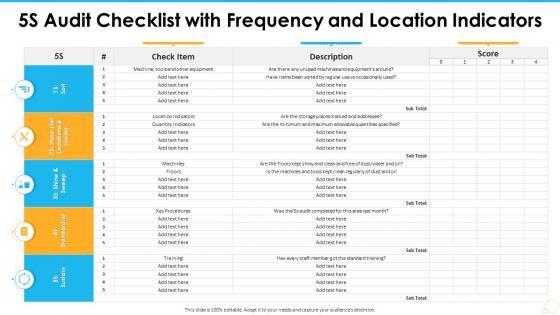
5s audit checklist with frequency and location indicators ppt slides template




Try Before you Buy Download Free Sample Product
 Impress Your
 Audience
 100%
100% Editable
 Save Hours
 of Time


Our 5S Audit Checklist With Frequency And Location Indicators Ppt Slides Template are topically designed to provide an attractive backdrop to any subject. Use them to look like a presentation pro.
People who downloaded this PowerPoint presentation also viewed the following :
5s audit checklist with frequency and location indicators ppt slides template with all 6 slides:
Use our 5S Audit Checklist With Frequency And Location Indicators Ppt Slides Template to effectively help you save your valuable time. They are readymade to fit into any presentation structure.





FAQs for 5s audit checklist with frequency and location indicators
Honestly, it's about keeping your workspace organized and safe without turning into one of those programs that everyone ignores after a month. You're basically checking if your Sort, Set in Order, Shine, Standardize, and Sustain stuff is actually happening. Catches problems early. Gets everyone on the same page with how things should look and work. Creates accountability too - people can't just slack off on keeping things clean and efficient. My advice? Pick one small area first and audit it weekly. Don't go crazy trying to do everything at once or you'll burn out fast.
So basically 5S is about giving everything a specific spot and keeping it there. No more digging around for stuff – trust me, that time really adds up. Sort through your junk, organize what's left, then actually stick to the system. Problems become super obvious when everything's in its place, which honestly makes my life way easier. Visual cues help catch issues before they get messy. Just pick one small area to start with and track it somehow. I was skeptical at first, but workflows definitely get smoother once you commit to it.
For your 5S audit, hit each pillar with specific yes/no questions. Sort means no random junk cluttering workstations. Tools need designated spots with clear labels - that's Set in Order. Shine is pretty straightforward, just check if everything's actually clean and maintained. Standardize gets tricky because you're looking at whether everyone follows the same procedures across different shifts. Honestly, Sustain is the hardest to measure since it's about long-term habits without someone breathing down their necks. Take photos for evidence and score each area numerically. You'll want those numbers to track if things are actually getting better.
Honestly, think of the 5S audit checklist as your personal waste detective kit. It walks you through each workspace systematically so you catch stuff you'd normally walk right past. You're hunting for excess inventory, unnecessary motion, waiting around, defects - all that lean manufacturing waste. Weekly audits work best when you pick just one area to start (don't go crazy trying to do everything at once). The checklist makes you question whether everything actually has a purpose and belongs where it is. Once you start looking with that mindset, you'll be amazed how much obvious waste suddenly jumps out at you.
Dude, you absolutely need your team on board or this whole thing's gonna crash and burn. Your employees know those workspaces better than anyone - they'll catch stuff you'd totally miss. Plus people hate changes that get forced on them, you know? When they actually help plan things out, they're way more invested in making it stick. I'd definitely get them involved from day one, not just during the actual audit. Let them help spot problems and come up with solutions. Trust me, treating them like partners instead of just... subjects being graded makes all the difference for long-term success.
Yeah totally! Just swap out the generic stuff for what actually matters in your field. Healthcare would be all about medical equipment placement, infection control, patient safety - way more important than basic desk organization. Schools might focus on classroom supplies and how easily students can access materials. The 5S basics don't change though. What changes is how you define "organized workplace" for your situation. I'd probably start by thinking about your biggest daily headaches, then figure out checklist items that would actually fix those problems. Makes way more sense than using some cookie-cutter template that doesn't fit.
Honestly, the toughest part is people thinking you're there to criticize them instead of help. Nobody wants to feel judged on how they organize their tools, you know? Get your team involved in building the actual checklist - when they help create the rules, they're way more likely to follow them. Train your auditors the same way so you're not getting wildly different scores for the same thing. Oh, and coach people during the audit instead of just marking them down. Start with areas where people are already excited about it, then expand once you've worked out the kinks.
Monthly audits work well for most companies starting out. Weekly spot checks aren't crazy though - honestly, people need that repetition when 5S is new. Habits don't just magically appear overnight, you know? Once your team gets the hang of workspace discipline, you can probably stretch it to quarterly. But here's the thing - consistency beats frequency every time. I'd rather see you nail monthly audits than have quarterly ones that keep getting "postponed" because everyone's busy. Pick whatever schedule you'll actually stick to, then adjust based on how things look between audits.
Oh man, there's actually a ton of stuff you can track! Time spent hunting for tools is probably the biggest one - that should nosedive pretty quick. Safety incidents too, since everything being organized properly cuts down on accidents big time. Your people will be way happier working in a clean space (I swear it's like night and day). Productivity rates, equipment downtime, audit scores - all good ones. Waste reduction's another solid metric. Honestly though? Don't go crazy tracking everything at first. Pick like 2-3 that actually matter to your team and see how those go.
Dude, skip the paper clipboards - they're honestly such a pain. Get a digital checklist app on your tablet instead. You can snap photos right there, track trends over time, and it spits out reports automatically. QR codes at each station are pretty slick too - they link straight to your audit criteria or before/after pics. The cloud-based stuff is great because your whole team sees results instantly and you can assign fixes on the spot. Honestly, even switching to just a basic checklist app will save you tons of time on data entry. Trust me on this one.
Start with basic 5S training - Sort, Set in Order, Shine, Standardize, Sustain. Everyone needs to get what each one means and how to spot issues during audits. The "Shine" part always confuses people way more than it should, honestly. Train your team on whatever checklist you're using and how to document stuff properly. But here's the thing - they need to understand audits aren't about gotcha moments. It's really about finding ways to improve. I'd do practice rounds first where experienced people show the new folks the ropes, then let them run with it gradually.
So here's the thing - some cultures love the structure of 5S right away, others think it's total micromanagement. Collectivist places usually nail the teamwork part fast. But individualistic teams? They hate being told there's only one way to organize stuff. Language barriers are whatever, the real pain is when "clean enough" means totally different things to different people. I've watched teams argue over what counts as organized lol. Honestly, don't try forcing the same approach everywhere. Get someone local to champion it and tweak your examples to make sense for that specific culture. Way better results.
For tracking 5S compliance, I'd probably start with mobile apps like iAuditor - your team can knock out checklists on their phones and it auto-generates reports with photos. Pretty handy. There's also dedicated software like Weever or LeanDNA if you want fancy dashboards and trending. But honestly? A shared Excel sheet with some conditional formatting works great when you're just getting started. I've seen people overcomplicate this stuff. Pick whatever your team will actually use consistently - that's way more important than having the coolest platform. You can always upgrade later once you figure out what works.
Get those audit results out fast - seriously, don't let them collect dust. Call a quick team meeting within a few days to review what worked and what didn't. Focus on fixing the process instead of blaming people (I've watched too many of these turn into total disaster meetings). Break everything down into specific action items with owners and due dates. Put up some kind of visual scorecard so everyone can track progress between audits. Oh, and definitely ask your team for solutions - they're in the trenches every day and usually have way better ideas than management thinks they do.
Honestly, 5S audits are a game changer for the long run. Everyone knows where stuff goes, so no more wasting time hunting for tools. Way fewer safety issues too - cluttered spaces are just accidents waiting to happen, you know? Your team starts thinking about improvement automatically, which is pretty cool. Productivity stays high because the whole thing runs itself once it's going. Oh, and definitely start with just one area first - I learned that the hard way. Let the results do the talking.
-
Unique research projects to present in meeting.
-
Best way of representation of the topic.