


Timeline For Digital Marketing Audit With Checklist Digital Audit To Evaluate Brand




Try Before you Buy Download Free Sample Product
 Impress Your
 Audience
 100%
100% Editable
 Save Hours
 of Time


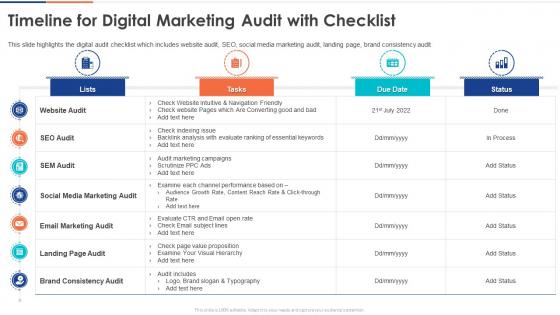
This slide highlights the digital audit checklist which includes website audit, SEO, social media marketing audit, landing page, brand consistency audit.
People who downloaded this PowerPoint presentation also viewed the following :
Timeline For Digital Marketing Audit With Checklist Digital Audit To Evaluate Brand with all 6 slides:
Use our Timeline For Digital Marketing Audit With Checklist Digital Audit To Evaluate Brand to effectively help you save your valuable time. They are readymade to fit into any presentation structure.





FAQs for Timeline For Digital Marketing Audit With Checklist Digital Audit
Okay so there's basically four things you gotta hit. Website stuff first - how fast pages load, if it works on mobile, whether it's actually user-friendly. SEO health is next (keyword rankings, backlinks, any wonky technical problems). Most people totally blow off social media analysis but honestly that's where you see real engagement patterns. Oh and paid ads - check how everything's performing across platforms. Make sure your analytics are actually set up right too, like half the time people are tracking random metrics that don't matter. Just throw it all in a basic spreadsheet so you don't lose track.
Start with Google Analytics, your social platforms, email tools - basically wherever you're spending time or money. Don't get caught up in follower counts though, that stuff's pretty useless. Focus on what actually brings in customers: conversion rates, how much you're paying to get each new customer, organic traffic that's growing. I always tell people to make a simple spreadsheet tracking month-to-month changes. Sounds boring but it works. The cool part is when you realize which channels bring your *best* customers, not just random traffic that bounces right off your site.
Start with your organic traffic trends and how your target keywords are ranking - that's what actually matters for business. Click-through rates from search results too. Then check the technical stuff that might be screwing you over: page speed, crawl errors, mobile issues. Honestly, I used to obsess over domain authority but bounce rate tells you way more about whether people actually want your content. Oh, and compare this quarter to last quarter first - makes it easier to spot what's tanking your traffic.
Okay so social media basically makes all your other marketing way stronger. Good engagement drives traffic to your site and creates that social proof that makes people trust your brand more. Google picks up on social signals too, which helps your search rankings. Here's what most people miss though - follower counts don't mean much if they're not actually buying anything. You gotta track how social converts into real customers. Set up UTM codes on your links (kinda tedious but worth it) so you can see which posts actually drive sales in your analytics. That's where the real magic happens.
Google Analytics and Search Console are must-haves - totally free and they'll show you traffic plus search stuff. SEMrush costs a fortune but honestly it's amazing for spying on competitors and tracking keywords. Same with Ahrefs. For social media, I use Hootsuite Analytics since it pulls everything into one place. Oh, and definitely run Google PageSpeed Insights on your site - slow pages kill conversions. Screaming Frog is clutch for technical audits too. Start with Google's free tools first, then see what else you need. The paid ones add up fast but they're worth it.
Content quality is honestly the backbone of any good digital marketing audit. Your audience can smell bad content from a mile away - trust me on this one. I'd start by comparing your top 10 pieces against your worst performers. The patterns will jump out at you immediately. Check your time on page, social shares, conversion rates. Does everything match your brand voice? Are you hitting SEO basics? Even brilliant campaigns fall flat with crappy content (been there). Oh, and make sure it actually connects with your audience goals - sounds obvious but you'd be surprised how often that gets overlooked.
Honestly, a digital marketing audit just shows you who you're actually reaching vs who you think you're targeting. There's always a gap - sometimes bigger than you'd expect. Pull your analytics from everywhere and compare it to your buyer personas side by side. You'll spot patterns in demographics, behaviors, engagement stuff. What really gets me is how often brands miss entire segments or they're messaging totally wrong for their audience. Sometimes you'll find your people are hanging out on platforms you completely ignored. It's basically getting a reality check on your whole targeting game.
Looking at what competitors do shows you exactly where you're screwing up and what opportunities you're totally missing. Their content, ads, SEO stuff, social media - all of it gives you clues about what actually works with your audience. Sometimes they'll be doing something genius that would've never crossed your mind. I mean, why reinvent the wheel, right? But here's the thing - don't just copy their playbook. Figure out what gaps they're leaving wide open and build something way better to fill those spaces. That's how you actually get ahead instead of just playing catch-up.
Honestly, your website's usability makes or breaks everything else you're doing marketing-wise. I've watched so many good campaigns just die because people hit a slow or confusing landing page. Check your mobile version first - that's usually where the worst problems are hiding. Page speed, navigation, forms that actually make sense... all that stuff matters way more than people think. Run it through PageSpeed Insights and maybe get some heatmap data if you can. Oh, and test your checkout process yourself - you'd be surprised how many broken steps slip through.
Honestly, the worst thing you can do is try auditing everything at once. You'll drown in data and miss the stuff that actually matters. Pick one channel and really dig deep instead of just looking at vanity metrics. Oh, and check your tracking setup first - I can't tell you how many times I've seen people waste weeks on an audit only to find out their analytics were completely broken. That's just painful. Get your stakeholders involved early too, otherwise you'll craft these brilliant recommendations that totally miss what the business actually needs. Set clear goals upfront so everyone knows what success looks like.
Honestly? Every 6-12 months is the sweet spot for most companies. If you're constantly switching up campaigns or in a crazy fast industry, maybe bump it to quarterly. Otherwise yearly works fine. Just don't let it go longer than a year - digital stuff changes so ridiculously fast that your data becomes basically useless. Plus you'll miss obvious ways to improve things. My advice is to literally put it in your calendar right now. I've seen too many teams say "yeah we really need to do an audit" and then... crickets for two years.
Email audits are honestly such a goldmine - you get to see what's actually working vs what you think is working. Open rates and click-throughs tell you which subject lines don't suck, plus when people actually check their email. Check your unsubscribe patterns too because those hurt but they're useful data. The conversion stuff shows if you're making money or just getting people to click around for no reason. Segmentation data reveals whether you're being smart about targeting or just spamming everyone (we've all been there). Use all this to stop sending generic garbage and start sending stuff people want.
Honestly, just bake compliance into your audit routine right away. First thing - double-check your data collection against GDPR, CCPA, whatever industry rules hit your business. Cookie policies need updating (seriously, everyone forgets this). Make sure your email marketing has proper consent docs. Don't skip auditing third-party vendors either - they can bite you later. Document everything as you go though. Build yourself a checklist you can actually reuse next time instead of reinventing the wheel every audit.
Focus on your biggest gaps first - split them into quick wins and longer projects. Knock out the easy stuff like broken links and meta descriptions to build momentum. Those small victories honestly keep everyone from getting discouraged. After that, dive into the heavy lifting: content overhauls, technical SEO fixes, campaign restructuring. Set clear owners and deadlines for everything. Be realistic about what your team can actually handle - I've seen too many ambitious plans fall apart. Track it all in a basic spreadsheet so you're not just creating another report that sits there forever.
So a digital marketing audit basically shows you what's actually making money vs what's just bleeding your budget dry. You'll see which channels convert and which ones just look good on dashboards (spoiler: there's always a gap). It finds holes in your funnel, better-performing audiences, and why some campaigns tank while others crush it. Honestly, most people miss obvious optimization stuff until they dig deeper. Best part? You can move money from the losers to winners and fix whatever's blocking conversions before your next launch.
-
SlideTeam is very efficient when it comes to saving time. I am happy that I chose them for my presentation.
-
I can say with full confidence that all your business, academic, or professional work requirements will be sufficed with SlideTeam. Their gallery is as rich as 2Million+!!