


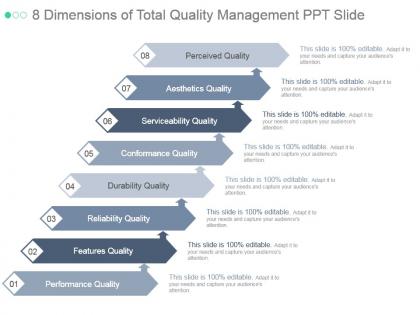
8 dimensions of total quality management ppt slide




Try Before you Buy Download Free Sample Product
 Impress Your
 Audience
 100%
100% Editable
 Save Hours
 of Time


Accelerate the flow with or 8 Dimensions Of Total Quality Management Ppt Slide. Endorsements come in by the dozens.
People who downloaded this PowerPoint presentation also viewed the following :
8 dimensions of total quality management ppt slide with all 5 slides:
Examine emerging concepts with our 8 Dimensions Of Total Quality Management Ppt Slide. They excel at encouraging contemporary thought.

FAQs for 8 dimensions of total quality
So TQM is basically about making customers happy above everything else. Get your whole team involved - not just the bosses making all the calls. Base decisions on real data instead of just winging it. Oh, and continuous improvement is massive. Even small tweaks add up over time. Quality can't just be one department's problem anymore, honestly that's such an outdated way to think. Everyone's gotta own it. I'd start by looking at what processes you have now and pick one tiny thing to fix this week. Don't overthink it.
So TQM basically makes everyone in your company obsessed with quality in a good way. You're constantly asking customers what sucks and fixing it before they even complain. Every employee becomes like a problem-solver instead of just doing their job. The whole point is you never stop improving stuff - less broken products, better timing, smoother interactions. Honestly, customers can tell the difference immediately when everything just works. Oh and definitely map out your customer's experience first to see where you're dropping the ball. That's where you'll find the biggest wins.
Honestly, your employees are everything when it comes to TQM. They're the ones actually seeing problems daily while management sits in meetings about spreadsheets. Without their buy-in, you're basically trying to improve quality from the outside looking in - which never works. The people doing the work know where things go wrong. Get them involved and they'll start catching issues before they blow up into real problems. Plus they'll actually care about fixing stuff instead of just going through the motions. My advice? Ask your team what's driving them crazy every day. You'll be surprised how much they notice.
So TQM basically flips everything around - you're building quality into processes from the start instead of just checking stuff at the end. Way smarter approach if you ask me. Traditional methods are super reactive, like playing catch-up after things go wrong. But TQM gets everyone involved, not just that one quality team (which honestly never made sense anyway - why wouldn't you want all hands on deck?). It's all about preventing problems and keeping customers happy. My advice? Get your whole team talking about improvements instead of dumping it on one department.
Honestly, the toughest part is dealing with people who hate change - they're so used to doing things their way. Leadership's another nightmare because they'll give you all these motivational speeches but then don't actually back you up when push comes to shove. Training's a mess too since most folks can't execute something they barely understand. Budget's always tight, which sucks because TQM isn't cheap. Oh, and everyone wants results yesterday when this stuff takes forever to actually work. Start with small pilot programs first - way less risky that way.
Honestly, data is what makes TQM actually work instead of just being another buzzword. You can stop guessing where problems are and start seeing exactly what's broken. Those endless meetings where everyone argues about their hunches? Skip that drama. Real numbers show you which fires to put out first and whether your fixes actually did anything. Plus you'll catch issues before they blow up into major headaches. My advice - pick 3 or 4 metrics your customers really care about and watch them like a hawk.
So for TQM tools, most places use the Seven Basic Quality Tools - control charts, fishbone diagrams, Pareto charts, that kind of thing. Statistical process control is pretty common too for tracking processes. Six Sigma's everywhere if your company loves data (which honestly, most do now). PDCA cycles are solid for continuous improvement - Plan-Do-Check-Act, rinse and repeat. Quality circles work well when teams actually want to collaborate. But here's the thing - don't try using all of them right away. Pick maybe 3-4 max. I'd start with flowcharts and Pareto analysis since they're straightforward and you'll see results fast.
Look, TQM gets everyone hunting for problems before they blow up into disasters. Your whole team becomes obsessed with doing things better - honestly, it's pretty cool to watch. The best part? You're collecting actual data instead of making wild guesses about what works. Customer feedback keeps you grounded in reality too, not just what sounds good in meetings. Oh, and since people at every level are involved, you catch way more issues early. Try this: grab one process your team does daily and get everyone to suggest improvements. You'll be surprised what they come up with.
Look, TQM straight up won't work if your leaders aren't actually into it. I've watched so many companies try this stuff where executives just talk a good game but don't put their money where their mouth is. Your team needs to see leadership making tough quality decisions, celebrating wins when processes improve, and yeah - holding people accountable too. It's like when your boss says "work-life balance matters" then emails you at midnight, you know? Actions speak louder. If you're rolling this out, make sure your leadership team is genuinely committed to the culture change, not just checking boxes.
Honestly, start with customer satisfaction scores and complaint rates - that's where you'll see if people actually care about your changes. Defect rates and first-pass yield show if your processes are getting tighter. Don't sleep on employee surveys either, because if your team isn't bought in, you're basically pushing a rope uphill. Cost of quality metrics help when you need to prove ROI to the bosses. Oh, and cycle times are useful too. But seriously, pick maybe 3-4 that matter most to your situation. Tracking everything just turns into spreadsheet hell.
So with TQM, you basically treat suppliers like actual partners instead of just people you buy stuff from. Start by figuring out which suppliers really matter to your operation. Then have real conversations about what quality looks like - set clear standards and maybe do some training together. Regular check-ins help too. Honestly, most companies used to just take whatever suppliers gave them, but this approach is way more collaborative. You're sharing goals and sometimes even helping them fix their own processes. It's more work upfront but builds better relationships long-term.
Dude, process mapping is a game-changer for TQM. Basically you're drawing out how work actually moves through your company - not how it's supposed to work, but how it really works. All those annoying handoffs and bottlenecks become super obvious once you see them on paper. I learned this the hard way at my last job. Instead of fixing surface-level problems, you can finally tackle what's actually causing quality issues. My advice? Start with whatever process is driving everyone crazy right now. You'll probably find some ridiculous inefficiencies you never noticed before.
Honestly, most companies just blend TQM with whatever they're already using - ISO 9001, Lean, Six Sigma. Makes way more sense than fighting between systems. First thing I'd do? Map out where your current stuff overlaps with TQM basics like customer focus and continuous improvement. Don't overwhelm people with too many frameworks though - that's where things get messy fast. Look for shared goals across your management systems, then build common metrics. Quick audit of your existing quality practices might surprise you. You're probably already doing half this stuff without realizing it.
Look at Toyota - their whole kaizen thing is basically TQM, and they crushed it. Motorola invented Six Sigma through their TQM work and saved crazy money. Jack Welch rolled it out across all of GE and got huge efficiency wins. What's cool is even service companies like Ritz-Carlton use these principles for their insane customer service standards. Honestly, the companies that succeed don't treat TQM like some quick fix project. They actually build it into how they operate and stick with it for years. That's where the real magic happens.
Honestly, you can't just throw people into TQM and expect magic to happen. Training gets everyone speaking the same language about quality standards. Plus, stuff like statistical process control? People need actual instruction - they're not gonna figure that out solo. I'd start by finding your biggest quality problems and build training around those specific issues. The mindset shift is huge too. Once people feel ownership over quality instead of just following orders, things click. Don't make it a one-and-done workshop either. Keep the training rolling so skills actually stick.
-
Easily Editable.
-
Excellent template with unique design.