


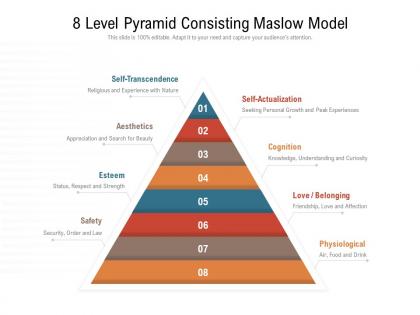
8 level pyramid consisting maslow model




Try Before you Buy Download Free Sample Product
 Impress Your
 Audience
 100%
100% Editable
 Save Hours
 of Time


Give the humble the incentive to continue the effort with our 8 Level Pyramid Consisting Maslow Model. It will encourage them to the hilt.
People who downloaded this PowerPoint presentation also viewed the following :
8 level pyramid consisting maslow model with all 2 slides:
Give the humble due credit with our 8 Level Pyramid Consisting Maslow Model. Be able to applaud their every contribution.

FAQs for 8 level pyramid
Maslow's Hierarchy includes physiological needs, safety, love and belongingness, esteem, and self-actualization, representing progressive stages of human motivation. These levels demonstrate that individuals must satisfy basic survival and security needs before pursuing higher aspirations like recognition and personal fulfillment, with organizations increasingly applying this framework to enhance employee engagement and workplace satisfaction.
Understanding Maslow's Hierarchy enhances employee engagement by enabling managers to address different motivational needs systematically, from basic job security and fair compensation to recognition, professional development, and meaningful work opportunities. Organizations applying this framework create comprehensive engagement strategies that boost retention, productivity, and job satisfaction, with companies in sectors like healthcare, technology, and retail finding that employees perform better when their hierarchical needs are strategically addressed.
Educators can apply Maslow's theory by ensuring students' basic physiological and safety needs are met through nutrition programs, safe learning environments, and clear classroom structures, while fostering belonging through collaborative activities and peer connections. By addressing these foundational levels first, teachers create optimal conditions for higher-order learning, with many schools finding that students demonstrate improved academic performance, increased engagement, and enhanced creativity when their fundamental needs are systematically supported.
Maslow's Hierarchy faces criticism for cultural bias toward Western individualism, lack of empirical evidence for sequential progression, and oversimplification of human motivation complexity. While these limitations challenge universal applicability, organizations increasingly adapt the framework by recognizing diverse cultural values and non-linear motivational patterns, ultimately delivering more nuanced employee engagement strategies.
Maslow's Hierarchy directly influences consumer behavior by aligning marketing messages with specific psychological needs, from basic safety and security to self-actualization and status recognition. Luxury brands target esteem needs through exclusivity messaging, while insurance companies appeal to safety needs, and wellness brands focus on self-actualization, ultimately enabling marketers to create more targeted campaigns that resonate with consumers' intrinsic motivations.
In mental health care, Maslow's Hierarchy guides treatment by addressing foundational needs like safety and stability before tackling higher-level psychological concerns, ensuring comprehensive patient support. Therapists use this framework to prioritize immediate crisis intervention, establish therapeutic relationships, and gradually work toward self-actualization goals, with many mental health facilities finding that this structured approach delivers more effective outcomes and sustainable recovery progress.
Nonprofit organizations can leverage Maslow's model by aligning their messaging with donors' and beneficiaries' specific needs levels, from basic safety appeals to self-actualization through charitable giving. By segmenting communications to address physiological needs for direct aid programs, security concerns for community safety initiatives, and belonging through volunteer opportunities, nonprofits create more targeted, emotionally resonant campaigns that ultimately enhance donor engagement and program effectiveness.
Cultural context significantly influences how Maslow's Hierarchy of Needs is interpreted and prioritized, with collectivist societies often emphasizing community belonging before individual self-actualization, while individualistic cultures focus on personal achievement. Organizations operating across diverse markets find that employee motivation strategies, customer engagement approaches, and product positioning must adapt to these cultural variations, ultimately delivering more effective workforce management and targeted marketing outcomes.
Leaders can use Maslow's framework by systematically addressing each level of employee needs, from ensuring job security and fair compensation to providing recognition, growth opportunities, and meaningful work that aligns with personal values. By understanding where team members are in the hierarchy, leaders can tailor their approach, creating workplace environments that foster belonging, achievement, and self-actualization, ultimately delivering higher engagement, reduced turnover, and enhanced team performance.
Businesses can address Maslow's needs through competitive salaries and safe workplaces (physiological/safety), team-building activities and inclusive cultures (social belonging), recognition programs and career advancement (esteem), and creative projects with autonomy (self-actualization). Companies like Google, Microsoft, and progressive healthcare organizations integrate these approaches strategically, finding that comprehensive employee wellness programs enhance retention, productivity, and innovation while delivering sustained competitive advantage.
Self-actualization manifests in personal development through pursuing creative expression, meaningful work, authentic relationships, and aligning actions with core values and intrinsic motivations. Many professionals find that self-actualization-focused goal-setting enhances job satisfaction, leadership effectiveness, and strategic decision-making, ultimately delivering greater organizational engagement and sustainable performance outcomes.
Technology companies can incorporate Maslow's framework by designing products that address physiological needs through health monitoring apps, safety needs via robust security features, social needs through community platforms, esteem needs with achievement systems, and self-actualization through creative tools. This strategic approach enables companies to create more compelling user experiences, increase engagement across diverse user segments, and ultimately deliver products that resonate deeply with human motivations, with many tech organizations finding that Maslow-informed design significantly enhances user retention and satisfaction.
Social workers can apply Maslow's Hierarchy by designing tiered programs that address basic needs first, such as housing assistance and food security, before focusing on higher-level needs like belonging and self-esteem. This approach enables organizations to create comprehensive support systems that progress from emergency shelter services to community integration programs, ultimately delivering more effective outcomes and sustainable client development across vulnerable populations.
Maslow's Hierarchy enables marketers to craft targeted campaigns by addressing specific psychological needs, from basic security appeals for insurance products to self-actualization messaging for luxury brands and personal development services. This strategic approach allows companies across sectors like financial services, wellness, and technology to create more resonant messaging that connects with consumers at their current need level, ultimately driving higher engagement and conversion rates.
Maslow's theory enhances conflict resolution by addressing underlying needs at each hierarchical level, from basic security concerns to self-esteem and personal fulfillment issues. Through systematic needs assessment, mediators can identify root causes—whether financial stress, relationship dynamics, or recognition desires—enabling targeted solutions that resolve surface disputes while addressing deeper motivational conflicts, ultimately delivering more sustainable outcomes.
No Reviews