


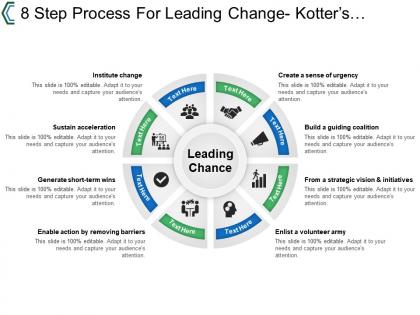
8 step process for leading change kotters model for successful change




Try Before you Buy Download Free Sample Product
 Impress Your
 Audience
 100%
100% Editable
 Save Hours
 of Time


They say clowns help bring out the truth. Our 8 Step Process For Leading Change Kotters Model For Successful Change do the same for your thoughts.
People who downloaded this PowerPoint presentation also viewed the following :
8 step process for leading change kotters model for successful change with all 5 slides:
Ensure your interactions are crystal clear with our 8 Step Process For Leading Change Kotters Model For Successful Change. Avoid being called a joker.

FAQs for 8 step process for leading change kotters model
Kotter's 8-Step Change Model includes creating urgency, building coalitions, developing vision, communicating change, empowering action, generating wins, sustaining acceleration, and instituting change. These stages interrelate sequentially, with early steps like urgency and coalition-building enabling effective vision communication, while quick wins reinforce momentum, ultimately delivering sustainable organizational transformation across industries.
Organizations create urgency by communicating market threats, competitive pressures, declining performance metrics, and missed opportunities through data-driven presentations and stakeholder discussions. This involves leadership sharing compelling evidence with employees across departments, highlighting potential consequences of inaction, and demonstrating how immediate change delivers competitive advantage, ultimately motivating teams toward transformation.
Leaders can build effective guiding coalitions by selecting diverse stakeholders with complementary skills, organizational credibility, and formal authority, while ensuring representation across departments and hierarchy levels. This strategic combination enables comprehensive change management through varied perspectives, enhanced communication channels, and broader organizational buy-in, ultimately delivering sustained transformation momentum and minimizing resistance throughout the implementation process.
A clear vision provides direction, purpose, and emotional connection that guides stakeholders through uncertainty, aligns diverse teams around common goals, and communicates the benefits of proposed changes. Through compelling vision statements, organizations streamline decision-making processes, reduce resistance, and accelerate adoption timelines, with many companies finding that well-articulated visions ultimately deliver higher employee engagement and sustainable transformation outcomes.
Communication serves as the foundation for successful transformation in Kotter's model, particularly in Step 4 where leaders must communicate the vision broadly, frequently, and through multiple channels to ensure organizational alignment. Effective communication enables buy-in across all levels, addresses resistance proactively, and maintains momentum throughout the change process, with many organizations finding that consistent, transparent messaging ultimately delivers faster adoption and sustainable transformation outcomes.
Organizations ensure stakeholder engagement throughout Kotter's 8-Step Change Model by establishing clear communication channels, creating cross-functional teams, and implementing feedback mechanisms at each phase. Through regular town halls, collaborative workshops, and transparent progress updates, companies across sectors like healthcare, manufacturing, and financial services maintain continuous dialogue, address concerns proactively, and build momentum, ultimately delivering sustainable change adoption and organizational alignment.
Common pitfalls include rushing urgency creation without genuine crisis communication, forming coalitions lacking decision-making authority, creating vague visions, under-communicating change messages, failing to remove structural barriers, celebrating isolated wins as final success, and neglecting to embed changes in organizational culture. These implementation failures often stem from treating steps as checkboxes rather than interconnected processes, with many organizations finding that insufficient leadership commitment and inadequate stakeholder engagement across multiple steps ultimately undermines transformation efforts.
Success after implementing Kotter's 8-Step Change Model can be measured through key performance indicators, employee engagement surveys, productivity metrics, customer satisfaction scores, and financial performance benchmarks that align with the original change objectives. Organizations typically track both quantitative outcomes like revenue growth and operational efficiency, alongside qualitative measures such as cultural transformation and employee adoption rates, ultimately delivering sustainable competitive advantage.
Celebrating short-term wins enhances employee morale by providing tangible evidence of progress, reinforcing commitment to change initiatives, building confidence in leadership decisions, and creating positive momentum throughout the organization. These celebrations enable teams to maintain enthusiasm during challenging transitions, reduce resistance to ongoing changes, and demonstrate that strategic efforts deliver measurable results, with many organizations finding that recognized achievements significantly accelerate overall transformation success.
Organizations maintain change momentum by celebrating short-term wins while continuously communicating progress, embedding new behaviors into company culture, and avoiding premature declarations of victory. Through sustained leadership commitment and ongoing reinforcement, companies across industries like healthcare and manufacturing find that institutionalizing changes through updated policies, training programs, and performance metrics ultimately delivers lasting transformation and competitive advantage.
Tools for consolidating gains include regular progress assessments, performance metrics tracking, employee feedback systems, change champions networks, and continuous improvement frameworks like Kaizen. These techniques enable organizations to maintain momentum by identifying emerging challenges, reinforcing successful practices, and adapting strategies, with many companies finding that structured feedback loops and dedicated change teams ultimately deliver sustained transformation and competitive advantage.
Kotter's model adapts to remote environments by emphasizing digital communication channels for creating urgency, forming virtual coalition teams, and leveraging collaborative platforms for vision sharing. Organizations can enhance each step through regular video check-ins, digital feedback systems, and virtual celebration events, while ensuring consistent messaging across distributed teams ultimately delivers sustained change adoption.
Anchoring new approaches in organizational culture ensures that transformational changes become permanent fixtures rather than temporary initiatives that fade over time. Without cultural integration, employees often revert to old behaviors once leadership attention shifts, with many organizations finding that sustainable change requires embedding new practices into daily operations, performance metrics, and reward systems, ultimately delivering lasting competitive advantage.
Organizations can leverage feedback by systematically collecting input during each of Kotter's eight steps, using employee surveys, stakeholder interviews, and performance metrics to identify gaps and resistance points. This continuous feedback loop enables leaders to refine communication strategies, adjust timelines, and strengthen coalition support, ultimately delivering more sustainable transformations with higher employee buy-in across departments.
Kotter's 8-Step Change Model adapts across industries by addressing universal human resistance to change through structured communication, coalition-building, and momentum creation. Healthcare organizations use it for digital transformations, manufacturing companies for lean implementations, and financial services for regulatory compliance changes, with many finding that the model's emphasis on early wins and sustained effort delivers lasting organizational transformation and competitive advantage.
-
Informative presentations that are easily editable.
-
Very well designed and informative templates.