


Échantillons de téléchargement de diapositives de résolution de problèmes A3




Try Before you Buy Download Free Sample Product
 Impress Your
 Audience
 100%
100% Editable
 Save Hours
 of Time


Allumez la lampe du savoir avec nos Échantillons de présentation PowerPoint de résolution de problèmes A3. Allumez l'allumette avec nos Échantillons de présentation PowerPoint de résolution de problèmes A3.
People who downloaded this PowerPoint presentation also viewed the following :
Résolution de problèmes A3 - Exemples de diapositives
Guidez-les vers leur destination avec nos Exemples de présentation PowerPoint de résolution de problèmes A3. Dirigez-les sur le meilleur parcours à suivre.



FAQs for A3 problem solving
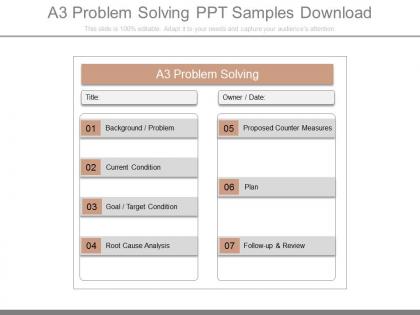
Oh, A3 problem-solving! It's this Toyota thing where you map out your entire problem on one piece of A3 paper. There are eight steps you go through - defining the problem, figuring out what's actually happening now, digging into root causes, then planning your target state and countermeasures. The cool part is you can't just jump straight to solutions like everyone usually does. You have to really understand what's broken first. I honestly think the one-page limit is genius because it forces you to cut the BS and be super clear. Way more visual than typical approaches too. Definitely try it next time you're banging your head against some work problem.
Look, A3 thinking is basically just organized problem-solving - works anywhere. Healthcare teams cut patient wait times with it. Marketing uses it when campaigns tank. IT departments love it for system crashes (which happen way too often, let's be honest). The format makes you actually define what's wrong first, then dig into why it happened. Finance, education, retail - doesn't matter. You're still walking through the same steps. My advice? Pick something small that's bugging you at work and just try it. The structure keeps you from jumping straight to solutions before you understand the real problem.
So there are eight sections in an A3 - background, current state, problem statement, root cause analysis, target state, countermeasures, implementation plan, and follow-up. They build on each other, which is annoying because you can't just skip to the fun solution part. But honestly, that's what makes it work. You're forced to actually understand what's going wrong before you start fixing stuff. Everything fits on one page so you don't ramble on forever. The problem statement is make-or-break though - nail that part or the whole thing falls apart.
Dude, A3s are actually pretty genius for this stuff. You get everyone looking at the same single sheet, so there's no confusion about what problem you're solving or why. The template structure is clutch - anyone can walk into a meeting mid-project and immediately know where things stand. I've seen engineers and finance people actually understand each other using these things, which is honestly rare. Short sentences work great. Longer ones help when you need to explain the visual layout that makes cross-department collaboration way less painful. Use it as your kickoff agenda next time.
Ok so root cause analysis is literally the most important part of A3 - step 4 where you do the "why analysis." That's where you actually dig into what's causing the problem instead of just fixing surface stuff. Use 5-whys or fishbone diagrams, whatever works. Honestly, most people hate this step because it takes forever and feels tedious. But here's the thing - skip it and you'll be solving the same crap again next month. Your team should definitely be involved too since they usually spot the real issues faster than management does.
Dude, your A3 shouldn't look like a boring research paper. Swap out half that text for visuals – flowcharts for processes, before/after pics to show the actual problem. Data gets way clearer with simple graphs too. I always do color-coding for different sections because people scan stuff fast. Those red/yellow/green status dots? Game changer for tracking progress. You want someone to "get it" in like 5 seconds of looking at it. Trust me, I've sat through too many presentations where everyone's eyes just glazed over the wall of text. Make it visual and people will actually pay attention.
Honestly, the worst mistake is rushing the problem definition. You'll burn weeks fixing something that wasn't even broken. Spend way more time upfront figuring out what's really going on vs what everyone thinks is happening - there's usually a gap there. Don't skip talking to stakeholders either, even if you're pretty sure you know the answer already. We all do this but it bites you later. Oh and treat A3 like actual thinking, not just filling boxes to check it off. The magic happens when everyone finally agrees on what's causing the mess. Start with that problem statement and really dig into current state first.
A3 problem solving turns everyone into a problem-solver, which is way better than leaving it all to management. The structured format forces people to actually dig into root causes instead of quick fixes. Honestly, it's pretty satisfying once you get it down! Reviews happen across teams so knowledge spreads naturally. Your people get more invested when they see their solutions actually work and get measured. I'd start small though - build up that problem-solving muscle first. The whole thing becomes second nature after a while, and suddenly you've got continuous improvement baked right into how your team thinks.
Dude, coaching with A3 is brutal sometimes - you'll see the answer right away but have to bite your tongue. Ask questions instead of giving solutions. Your team won't learn otherwise. Set up clear timelines and check-ins from the start, then back off and let them figure it out. Help when they hit roadblocks with approvals or resources, that's your job. But the problem-solving? That's theirs. I learned this the hard way - being too hands-on kills the whole point. Schedule those A3 reviews and focus on how they're thinking through stuff, not just what they wrote down.
Miro and Mural are solid picks for remote A3s - your whole team can jump on the same template at once. Figma works too if you're already using it. Digital is actually kind of nice since you don't have to deal with sticky notes falling off constantly (so annoying). You'll need Zoom or Teams obviously, but someone really needs to keep people on track or it gets messy fast. Oh, and set up your A3 template beforehand - trust me on this one. Google Sheets handles the follow-up action items pretty well.
Think of feedback loops as your "did that actually work?" moments in A3. You test your fix, check the results, then tweak things based on reality vs. what you hoped would happen. Honestly, solutions almost never work perfectly on the first try - that's just life. So you keep cycling through Plan-Do-Check-Act, getting smarter each time. Without regular check-ins, you're basically throwing solutions at the wall and crossing your fingers. The trick is setting up those checkpoints so you can course-correct fast when the data shows you're off track.
Oh totally! I actually use A3 thinking for random personal stuff all the time. Like when I couldn't figure out why I kept oversleeping - turns out my phone charging by my bed was the real culprit, not my alarm volume. The whole "define problem, find root cause, test fixes" thing works for everything. Money problems, workout plateaus, even figuring out friend drama (though that gets weird when you start making charts lol). Just be brutally honest with yourself like you would be at work. Start small though - maybe tackle why your laundry pile never shrinks or something manageable first.
For A3 stuff, I'd track two main buckets - how the process is going and what results you're getting. Process-wise: how fast teams solve problems, engagement levels, whether they're actually following the A3 steps. Results: did you fix the real root cause or just band-aid symptoms? Any cost savings? Are solutions sticking around? Oh, and definitely track how many people are picking up A3 skills - that's honestly where you see the biggest payoff long-term. Don't go crazy measuring everything though. Pick 2-3 metrics that actually matter for your specific issues and start there.
Start by connecting every problem to a real business goal or KPI - otherwise you're just wasting time. Your countermeasures section needs concrete owners and deadlines, not fluffy language. I've watched so many A3s turn into these weird academic exercises that nobody acts on. Root cause analysis should lead straight to solutions that leadership actually cares about. Oh, and definitely run it by a stakeholder first. Half the time what seems like a big operational issue is just... not that important to the business. Short sentences work. Long ones with actual substance work too, but avoid that corporate speak nonsense.
Get some Toyota Kata or Lean training first - you need that foundation or you'll just be filling out forms without understanding why. Most people skip this part and wonder why their A3s suck. "Managing to Learn" by John Shook is solid if you can't do a workshop. Honestly, finding a mentor who's actually done these well is huge - way better than just getting someone to check your formatting. Start small too. Don't pick some massive problem for your first one. Practice the thinking process on simple stuff first, then work up to the complex issues.
-
Design layout is very impressive.
-
Colors used are bright and distinctive.