


Achieving success powerpoint slide backgrounds





Try Before you Buy Download Free Sample Product
 Impress Your
 Audience
 100%
100% Editable
 Save Hours
 of Time


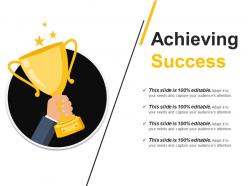
Every now and then business organization achieve their set goals and to display this glorious victory to your fellow employees we highly recommend that you download and use our achieving success PowerPoint slide background. This achieving success PowerPoint presentation will be very useful for those of you who do not have time to craft the slides themselves as the slides contained in this slideshow are predesigned and ready to use. After you download this deck of winners PPT template all you have to do is edit and present it which will also allow you to save your time and energy. The use of high resolution and premium quality slides in designing this trophy business slides will help you raise the standard of your work. Our business experts have crafted this business goals accomplishment PPT slideshow using this image of a hand holding a trophy in one side and the other side has a number of bullet points which are totally editable in nature. Nothing is too daunting for our Achieving Success Powerpoint Slide Backgrounds. They have the heart to take it on.
People who downloaded this PowerPoint presentation also viewed the following :
Achieving success powerpoint slide backgrounds with all 5 slides:
Conduct the jamboree with our Achieving Success Powerpoint Slide Backgrounds. Insist on folks indulging in celebration.


FAQs for Achieving success
Honestly, I used to chase what everyone else thought was "success" - total waste of time. Here's what actually works: figure out what YOU want first. Write it down. Could be money, balance, impact, whatever. Then just chip away at it daily. I know that sounds boring, but consistency beats everything else. Build good relationships along the way (they matter more than you think). Keep learning new stuff. And when things blow up - because they will - just bounce back and keep going. The whole "reverse-engineer your goals" thing actually works if you stick with it.
Honestly, your brain works way better when it has something concrete to chase after. Like instead of "get better at sales," try "boost sales 15% by June." Night and day difference. The vague stuff just leaves you spinning your wheels - I learned this the hard way lol. But when you're specific? Your subconscious actually knows what to do with that info. It's wild how much clearer everything becomes. Same with fitness goals. "Get in shape" means nothing, but "run 3 miles twice weekly" gives you actual steps. Write down one super specific goal right now and watch how fast you figure out what to do next.
Look, resilience is just how well you bounce back from crap situations. Everyone's gonna face setbacks - that's life. But here's the thing: resilient people don't see failures as the end of the world. They treat them like learning experiences instead. It's weird how that shift in thinking changes everything. Think of it like having better shock absorbers for life's bumps. You'll still feel the hit, but you won't get completely thrown off course. And honestly? You can actually get better at this over time. Next time something goes wrong, try thinking of it as just gathering info, not getting defeated.
Oh man, success means totally different things depending on where you're from! Like in the West, it's all about your paycheck and job title - very "me first" mentality. But tons of Asian and African cultures? They're more focused on family harmony and helping the community thrive. Some places care way more about spiritual stuff than making bank. Others are all about respect and social connections. Honestly makes me think about how narrow my own definition probably is sometimes. If you're working with people from different backgrounds, definitely worth asking what success actually means to them.
Track revenue growth and profit margins obviously, but customer acquisition cost and lifetime value matter way more than people think - they show if you're actually building something sustainable. Don't forget operational stuff like employee retention and customer satisfaction either. Market share's huge too depending on your space. Honestly though? Pick like 3-5 metrics max that actually help you make decisions. I see too many founders drowning in dashboard data that looks impressive but doesn't change anything. What industry are you in again? That'll totally shift which ones matter most.
Dude, networking really is everything - like 80% of good jobs never even hit the boards. Most hiring happens through "oh I know someone perfect for this." Those networking events? Still awkward as hell, but worth it. Even random coffee chats can turn into something big later. One time this guy I barely knew from a conference called me about an opportunity like two years later - totally random but it worked out. Focus on people you already know first though. Your old coworkers, college friends, even that person from your gym who works in your field. You'd be surprised how willing people are to help when you're genuine about it.
Honestly, the worst ones are fear of failure and imposter syndrome - they'll destroy your confidence fast. Perfectionism is brutal too because it tricks you into thinking you're being productive when really you're just stuck. I swear, some of the smartest people I know get completely paralyzed by this stuff. Then there's analysis paralysis where you overthink literally everything until you never actually do anything. Oh, and imposter syndrome hits even when you're totally qualified for something. The trick is catching yourself when these patterns start and just pushing through the discomfort anyway.
Look, the world's changing so fast that if you're not learning new stuff, you'll get left behind. I spend like 15 minutes a day just reading about random things in my field - sounds tiny but it actually adds up. When your industry shifts (and it will), you can roll with it instead of panicking. Learning new skills also makes you way better at solving problems creatively. Honestly? It just makes work less boring. Nobody wants to feel like they're doing the exact same thing for years. Plus people notice when you're always growing - it shows you're not just coasting through life, you know?
Honestly, I used to be the queen of setting massive goals and then burning out spectacularly. What helped me was breaking everything down into tiny wins I could actually celebrate. Like, ridiculously small stuff sometimes. Try thinking of failure as just information instead of this crushing defeat. When something goes wrong, get curious about it rather than hiding from it. Write down what you learned - even from the stupid mistakes. I surround myself with people who push me in good ways, and I focus way more on progress than perfection now. Oh, and gratitude for small steps forward makes a huge difference. You'll be surprised how much mindset shifts when you're not chasing some impossible standard.
Dude, I used to think grinding 24/7 was everything. Total mistake. Here's the thing - you actually perform better when you're not constantly fried. Better decisions, more creative thinking, all that good stuff. Success is more like a marathon anyway, so you need to pace yourself to show up consistently for years. What's even the point if you hit your goals but you're miserable and your relationships are trash? Honestly, just try setting real boundaries around work hours first. You'll probably be shocked how much your productivity jumps.
Oh man, this hits different as you age. Early twenties? All about the paycheck and Instagram likes, honestly. Then you hit your thirties and suddenly toxic jobs aren't worth it when you've got real stuff going on. Relationships matter more than grinding 24/7. By your forties it's like... what legacy am I leaving? Am I actually helping people? The whole definition just keeps evolving. I check in with myself every few years because what drove me at 25 would bore me to tears now. It's wild how priorities shift without you even realizing it.
Okay so first thing - break your big goal into tiny pieces you can actually check off. I'm obsessed with visual progress tracking, even if it's just scribbling on a napkin. Tell someone what you're doing! Sounds dumb but the awkward accountability pressure is surprisingly effective. Find people chasing similar stuff because their motivation rubs off on you. Here's the thing though - when you inevitably feel like crap and don't want to do anything, that's when systems save you, not feelings. Each week just pick one concrete step forward. That's it.
Honestly, just think of failure as collecting data instead of getting defeated. Every mess-up shows you what doesn't work, which gets you closer to what actually does. It's like debugging code - each error message helps you figure out the fix faster (okay that might be a stretch but whatever). The trick is pulling specific lessons from each screw-up and tweaking your approach. Don't think "I failed" - try "I learned X approach bombs in Y situation." Keep a basic failure log. Write down what went sideways and what you'll try differently next time. Sounds nerdy but it works.
Dude, get a mentor if you can. They're like cheat codes for your career - showing you shortcuts they figured out through years of screwing up. You'll dodge so many mistakes that way. Plus they open doors you don't even know exist yet and introduce you to people who matter. My old boss always said mentors see your blind spots better than you do, which is annoyingly true. They push you past that comfort zone BS too. Start small - find someone whose path you respect and ask for like 15 minutes monthly. Worth it.
Honestly? Being adaptable is everything right now. Things move so ridiculously fast that what worked two years ago might be totally useless today. I've watched really smart people get completely blindsided when their whole industry just... shifted. Meanwhile the ones doing well are constantly pivoting and picking up new stuff. They actually get excited about changes instead of freaking out. My old manager used to say "stay paranoid" which sounds dramatic but makes sense. Keep learning random things in your field. Practice switching up your plans when life throws curveballs at you.
-
Visually stunning presentation, love the content.
-
Innovative and Colorful designs.